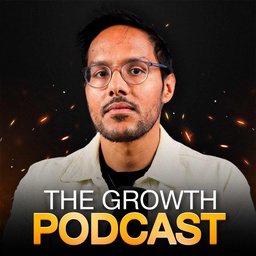
 Aakash Gupta
AI PM is the Job Opportunity of the Decade (Crash Course)
Aakash Gupta and Hamza Farooq on why AI product management is real, lucrative, and learnable fast.
In this episode of Aakash Gupta, featuring Hamza Farooq and Aakash Gupta, AI PM is the Job Opportunity of the Decade (Crash Course) explores why AI product management is real, lucrative, and learnable fast AI Product Management is positioned as a real, rapidly growing role with compensation rising to rival top software engineering markets due to its cross-functional technical and product scope.
At a glance
WHAT IT’S REALLY ABOUT
Why AI product management is real, lucrative, and learnable fast
- AI Product Management is positioned as a real, rapidly growing role with compensation rising to rival top software engineering markets due to its cross-functional technical and product scope.
- Hamza outlines a six-month, build-first learning roadmap emphasizing hands-on prototyping, tool fluency, and repeated practice rather than prior AI credentials.
- A live demo shows how to assemble an AI-powered product using a simple architecture—LLM API + n8n backend + Lovable frontend—connected via webhooks for real-time interaction.
- The episode clarifies key AI system concepts for PMs—RAG, context engineering, and fine-tuning—explaining when each is appropriate and how they combine in production systems.
- Hamza shares how he applies these skills in his startup (Traversal/Olive) for agent-driven forecasting and why teaching (Maven, universities) accelerates his own learning and product insight.
IDEAS WORTH REMEMBERING
9 ideasAIPM pay is high because the role now blends PM, systems, and AI fluency.
Hamza argues AIPMs must understand capabilities like RAG, fine-tuning, and context design—skills that previously weren’t expected of PMs—making them rarer and more valuable.
You can transition into AIPM without prior AI experience by following a structured build plan.
The episode frames GenAI as a recent shock to everyone (post-2023), so the advantage comes from disciplined learning, not tenure, and a six-month timeline is presented as feasible.
Start with a simple, repeatable architecture: LLM API + orchestration backend + frontend.
They repeatedly return to a minimal blueprint—LLM as an endpoint, n8n as the backend “engine,” and Lovable as the UI—so you can ship prototypes quickly and iterate.
Webhooks are the simplest bridge from a prototype UI to real backend intelligence.
The demo shows how webhook triggers and responses enable Lovable to send user queries to n8n, run agent logic, and return outputs, turning “chat” into an actual product flow.
OpenRouter reduces friction by letting you swap LLMs without replatforming.
Hamza recommends starting with well-known models (OpenAI, Claude, DeepSeek) and using OpenRouter as a single access key to compare cost/performance and reliability quickly.
RAG is the core unlock for enterprise AI because most org knowledge is unstructured.
With an estimated 80% of data in PDFs, decks, and memos, RAG enables ‘Google-like search on your internal docs’ plus grounded summaries with citations and source chunks.
Context engineering matters more than prompt engineering for production personalization.
He defines context engineering as the designed combination of system prompt + user prompt + long-term memory + retrieved knowledge (RAG), enabling user-specific behavior at scale.
Fine-tuning is for behavior/vocabulary specialization, not as a replacement for knowledge retrieval.
Fine-tuning is described as task adaptation (e.g., always writing high-quality Python or learning domain acronyms), while fresh/grounded knowledge should come from RAG connectors.
The fastest way to know what to build is a three-wave progression.
Hamza suggests building (1) efficiency/time savers, then (2) quality boosters, then (3) net-new experiences that weren’t possible before, using each wave to level up complexity.
WORDS WORTH SAVING
5 quotes“There’s a lot of hype on AI, but it’s actually the opposite when it comes to AIPM roles.”
— Hamza Farooq
“It’s basically not just a PM role anymore… You have to be a jack of all trades.”
— Hamza Farooq
“You can literally do a Google search on your own documents.”
— Hamza Farooq
“Prompt engineering is what you tell an LLM. Context engineering is how you design the instructions for your LLM.”
— Hamza Farooq
“I teach because I grow.”
— Hamza Farooq
QUESTIONS ANSWERED IN THIS EPISODE
5 questionsWhat specific evidence underlies the claim that AIPM median compensation is “skyrocketing,” and how does it vary by company stage and geography?
AI Product Management is positioned as a real, rapidly growing role with compensation rising to rival top software engineering markets due to its cross-functional technical and product scope.
In the Airbnb search demo, what exactly is the MCP connector doing, and how would you replace it with a production-grade integration?
Hamza outlines a six-month, build-first learning roadmap emphasizing hands-on prototyping, tool fluency, and repeated practice rather than prior AI credentials.
When does n8n become the wrong orchestration choice (latency, observability, scale, cost), and what would you migrate to next?
A live demo shows how to assemble an AI-powered product using a simple architecture—LLM API + n8n backend + Lovable frontend—connected via webhooks for real-time interaction.
What are the minimum security controls you’d add before deploying a Lovable+n8n webhook app publicly (auth, rate limits, logging, PII handling)?
The episode clarifies key AI system concepts for PMs—RAG, context engineering, and fine-tuning—explaining when each is appropriate and how they combine in production systems.
How should an AIPM decide between RAG, fine-tuning, or both for a regulated domain (healthcare/finance) with rapidly changing policies?
Hamza shares how he applies these skills in his startup (Traversal/Olive) for agent-driven forecasting and why teaching (Maven, universities) accelerates his own learning and product insight.
EVERY SPOKEN WORD
Install uListen for AI-powered chat & search across the full episode — Get Full Transcript
Get more out of YouTube videos.
High quality summaries for YouTube videos. Accurate transcripts to search & find moments. Powered by ChatGPT & Claude AI.
Add to Chrome