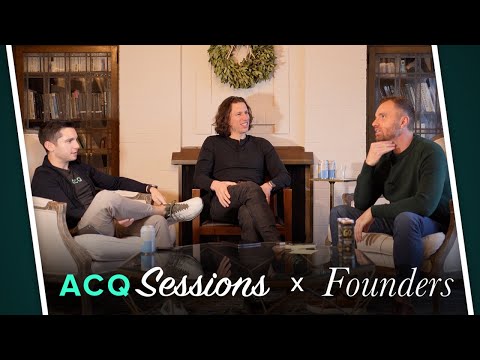
Sessions: David Senra (Founders Podcast)
David Senra (guest), Ben Gilbert (host), David Rosenthal (host), David Rosenthal (host), Ben Gilbert (host), David Rosenthal (host), David Rosenthal (host)
In this episode of Acquired, featuring David Senra and Ben Gilbert, Sessions: David Senra (Founders Podcast) explores three podcasters dissect founder biographies, leverage, craft, and durability lessons David Senra recounts a three-hour dinner with Charlie Munger, highlighting Munger’s sharp memory at 99, his calm attitude toward problems, and the compounding leverage of reading and acting on a few key ideas.
Three podcasters dissect founder biographies, leverage, craft, and durability lessons
David Senra recounts a three-hour dinner with Charlie Munger, highlighting Munger’s sharp memory at 99, his calm attitude toward problems, and the compounding leverage of reading and acting on a few key ideas.
The trio explores how to extract “truth” from biased historical sources, why biographies matter despite revisionism, and how studying history functions as leverage—essentially “game tape” for entrepreneurs and investors.
They go deep on podcast craft and business models: editing for audience time, ads vs memberships, back-catalog monetization, the ‘moving parade’ concept in marketing, and building premium brands through durable trust.
Personal arcs (Senra’s upbringing, reading habit, immigration stories, and parenthood) connect to broader themes: mentorship through books, choosing best-in-class peers, and the tradeoffs between ambition and family time.
Key Takeaways
Study founders like athletes study game tape.
They frame biographies and company histories as repeatable ‘film study’—not to copy exact moves, but to internalize patterns, fundamentals, and decision principles across many situations (Kobe/MJ analogy).
Get the full analysis with uListen
Aim for durability before growth—especially when profits are far future.
Senra cites Thiel’s point that Silicon Valley overrates growth rates and undervalues durability; if aggressive growth risks company death, you never reach the long-dated profits that matter most in tech.
Get the full analysis with uListen
Don’t chase perfect historical truth—extract the underlying ideas.
Because ‘humans see things as we are,’ every source is biased; instead of litigating every fact, focus on the concepts behind stories (e. ...
Get the full analysis with uListen
Marketing works because audiences are a moving parade, not a standing army.
Ogilvy’s idea explains why old episodes, evergreen ads, and long-running campaigns stay effective: new people enter the market constantly, so ‘old’ content is new to them.
Get the full analysis with uListen
Treat audience time as sacred; tight editing compounds trust.
Acquired describes line-by-line edits removing ~20 minutes of fluff; Senra agrees high-earning audiences have high opportunity cost, so concision is part of the product’s premium promise.
Get the full analysis with uListen
The best media brands are built on authenticity and long-term consistency.
They argue podcasting scales authenticity; playing a character may juice short-term growth but breaks in real life and becomes exhausting—durability comes from being the same person on- and off-mic.
Get the full analysis with uListen
Build an ‘unfair advantage’ by systematizing recall and repetition.
Senra’s Readwise workflow (20k+ highlights) functions as searchable memory; daily resurfacing replaces doomscrolling and improves his ability to connect patterns across founders in real time.
Get the full analysis with uListen
Great outcomes require embracing inevitable problems with indifference.
Senra’s top Munger takeaway: troubles are inescapable, so expect them; choose great people and high-quality systems to reduce problem frequency, then calmly deal with what remains.
Get the full analysis with uListen
Podcast monetization should match audience value density.
They discuss why premium business shows often earn more via ads than paywalls: you can’t charge most listeners what advertisers will pay for access to high-value decision-makers.
Get the full analysis with uListen
VCs differentiate by improving founder odds, not by offering money.
From founders’ perspective, capital is commoditized (especially in boom times); the real product is ‘improved odds’ via judgment, network, distribution, and non-toxic behavior—many founders actively resent mediocre VCs.
Get the full analysis with uListen
Wealth-and-kids is an unsolved, person-dependent problem.
They cite examples (Magnus/TCI heirs vs Buffett kids) and Kettering’s ‘I don’t know’ stance; Munger’s pragmatic point: withholding money can also backfire relationally—there’s no universal formula.
Get the full analysis with uListen
Content marketing at its best teaches first, sells invisibly.
Berkshire letters (and Paul Graham essays) are praised as ‘greatest salesmanship’ because the primary act is education and clarity; the commercial benefit (dealflow, buyers-of-choice positioning) is a byproduct.
Get the full analysis with uListen
Notable Quotes
“Learning from history is a form of leverage.”
— David Senra
“You’re not advertising to a standing army, you’re advertising to a moving parade.”
— David Senra (attributing to David Ogilvy)
“Differentiation is survival.”
— David Senra (quoting Jeff Bezos)
“Troubles, from time to time, should be expected. This is inescapable, so why would you let it bother you?”
— David Senra (summarizing Charlie Munger)
“The value of every business… is 100% sensitive to interest rates… Interest rates power everything in the economic universe.”
— David Senra (quoting Warren Buffett)
Questions Answered in This Episode
From your dinner, what were the 3–5 most ‘actionable’ Munger principles you wrote down immediately afterward, and how will you apply them in your work?
David Senra recounts a three-hour dinner with Charlie Munger, highlighting Munger’s sharp memory at 99, his calm attitude toward problems, and the compounding leverage of reading and acting on a few key ideas.
Get the full analysis with uListen AI
How do you personally decide when a disputed anecdote in a biography is ‘good enough’ to use versus too unreliable to repeat?
The trio explores how to extract “truth” from biased historical sources, why biographies matter despite revisionism, and how studying history functions as leverage—essentially “game tape” for entrepreneurs and investors.
Get the full analysis with uListen AI
Senra says he looks for ideas, not fact-perfect narratives—where does that approach break down (e.g., moral judgment, attribution, causality)?
They go deep on podcast craft and business models: editing for audience time, ads vs memberships, back-catalog monetization, the ‘moving parade’ concept in marketing, and building premium brands through durable trust.
Get the full analysis with uListen AI
What would ‘durability-first’ look like as a concrete operating checklist for a venture-backed startup that currently optimizes for growth?
Personal arcs (Senra’s upbringing, reading habit, immigration stories, and parenthood) connect to broader themes: mentorship through books, choosing best-in-class peers, and the tradeoffs between ambition and family time.
Get the full analysis with uListen AI
Acquired edits for time; Senra edits solo—what are the top 3 editing heuristics each of you use to cut without losing soul or clarity?
Get the full analysis with uListen AI
Transcript Preview
I found this guy who tweeted something a couple days ago or whenever. It was hilarious. He goes, "Most people's alarm clock is David Goggins telling them to wake up and get after it. My alarm clock is David Senra yelling at me, telling me to be like Edwin Land." [laughing]
[laughing]
I was like, all right, repetition works.
Who got the truth? Is it you, is it you, is it you? Who got the truth now? Is it you, is it you, is it you? Sit me down, say it straight, another story on the way. Who got the truth?
Welcome to this special episode of Acquired, the podcast about great technology companies and the stories and playbooks behind them. I'm Ben Gilbert.
I'm David Rosenthal.
And we are your hosts. Today's episode is our next installment of Acquired Sessions, a video format on YouTube that we started playing with last year. Our guest today is David Senra of the Founders Podcast. David is quite possibly the only person we know who is more obsessed than us- [chuckles] ... with business history and the lessons that great founders teach us. David, David Senra, that is, has read hundreds of founder biographies and done deep episodes on them all.
I don't know that I'm at hundreds yet as me, David, but I, I'm definitely in dozens.
[laughing]
I aspire to be at hundreds, but David Senra is just one of our closest podcaster friends, and friends period, out there. His show is awesome. Here on this episode, we had him out to my living room here in San Francisco, and we had just a awesome, really fun multi, multi-hour conversation, just like the ones that he and I have scheduled every month on Zoom when the mics are off. And it was super organic, super unstructured. We covered a ton of ground, including that, I think two nights before we recorded, David was just coming up from LA, where he had dinner with Charlie Munger, and so we spent a lot of time talking about that, Charlie's influence on David, his and Warren's influence on all three of us, a bunch of thoughts on advice generally. And as you can imagine, David just sprinkled dozens and dozens of historical examples and founder stories throughout the episode.
It is crazy. Every time someone's making a point, he'll dive in, "This is just like that thing Edwin Land said that one time." [chuckles]
Or David Ogilvy, or Coco Chanel, or who have you.
David is definitely close with the eminent dead. I will say, after editing this episode, I had one enormous takeaway: David Senra is really, really into podcasting, so get fired up to meet him on his level. All right, quick things: go follow ACQ2, brand-new show. Search i- any podcast player, available for free. Become an LP. There is voting going on right now for our next episode, which LPs all have input on, and for every new LP that joins, we will shoot you an email to your inbox. Voting closes about a week after this comes out, and we are straight-up picking whatever you tell us the next episode should be, with really no editorial from us, so help us direct the next episode. Join the Slack. It is one of the only places on the internet with this super high level of incredibly thoughtful discussion by well-connected, kind folks with a deep appreciation for history. People meet co-founders, they find jobs, and they get nuanced takes on the news of the day in there. So join at acquired.fm/slack. Lastly, this show is not investment advice. David and I may have investments in the companies we discuss, and this show is for informational and entertainment purposes only. Now, on to Acquired Sessions. So David, do you wanna tell us who you had dinner with the other night?
Install uListen to search the full transcript and get AI-powered insights
Get Full TranscriptGet more from every podcast
AI summaries, searchable transcripts, and fact-checking. Free forever.
Add to Chrome