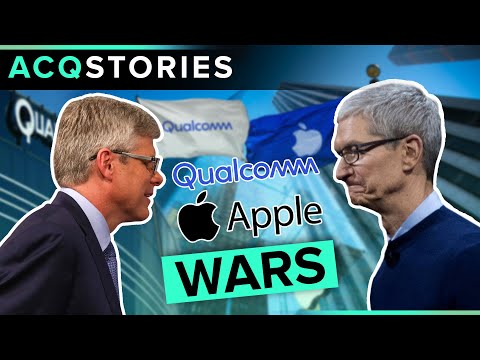
The Apple Qualcomm Wars
David Rosenthal (host), Ben Gilbert (host)
In this episode of Acquired, featuring David Rosenthal and Ben Gilbert, The Apple Qualcomm Wars explores qualcomm’s licensing model clashes with Apple and national security politics The discussion traces Qualcomm’s mounting pressures after major missteps (a $900M Broadcom lawsuit loss and the failed $2B Mirasol display fab) despite continued revenue growth.
Qualcomm’s licensing model clashes with Apple and national security politics
The discussion traces Qualcomm’s mounting pressures after major missteps (a $900M Broadcom lawsuit loss and the failed $2B Mirasol display fab) despite continued revenue growth.
It explains why activists pushed Qualcomm to split its licensing and chip businesses, and contrasts that with Broadcom/Avago’s roll-up, debt-financed, private-equity-like semiconductor strategy.
A pivotal moment was Broadcom’s attempted $117B hostile takeover of Qualcomm, blocked by the Trump administration on national-security grounds—seen as a major strategic win for keeping Qualcomm independent.
The core focus is the Apple-Qualcomm legal war: Apple and the FTC alleged Qualcomm abused standards-essential patents and modem dominance to demand excessive, non-FRAND licensing fees and restrictive deal terms, pushing Apple to briefly dual-source with Intel before settling to avoid missing the 5G transition.
Key Takeaways
Qualcomm’s strategic risk wasn’t only technical—it was ecosystem trust.
Even while growing revenue, Qualcomm’s licensing posture and deal tactics compounded “ecosystem reputation” problems that later intensified conflicts with governments and key customers.
Get the full analysis with uListen
The Mirasol fab illustrates the cost of vertical bets outside core competency.
Qualcomm’s $2B manufacturing investment in reflective displays ended with “zero customers,” reinforcing how capital-intensive hardware bets can backfire when adoption and quality lag.
Get the full analysis with uListen
Keeping licensing and chips together was a defensive moat, not just a structure choice.
Activists argued the licensing unit “prints cash,” but the episode frames integration as strategically important—particularly when negotiating with OEMs whose products depend on both chips and IP access.
Get the full analysis with uListen
Broadcom’s model is portrayed as semiconductor “private equity” via debt and margin extraction.
Avago/Broadcom is described as borrowing heavily to acquire assets, then “squeezing” them for profitability—implying reduced reinvestment and long-term innovation risk.
Get the full analysis with uListen
The blocked Broadcom takeover is framed as a major U.S. industrial-policy inflection point.
The deal’s prevention—partly tied to Huawei exposure and national-security concerns—is depicted as preserving a key U. ...
Get the full analysis with uListen
Apple’s lawsuit centered on standards-essential patent leverage and allegedly non-FRAND pricing.
Apple claimed Qualcomm used its modem dominance and SEP portfolio to demand large per-phone royalties (e. ...
Get the full analysis with uListen
Intel modems were less about performance and more about negotiating leverage—until 5G forced a retreat.
Apple pursued Intel as an alternative supplier to gain bargaining power, but widening performance gaps and the risk of missing 5G availability pushed Apple to settle and return to Qualcomm modems.
Get the full analysis with uListen
Notable Quotes
“They spun a two billion dollar fab to make it… There’s ultimately zero customers for this next gen.”
— David Rosenthal
“Real companies don’t have fabs.”
— Ben Gilbert
“Broadcom is borrowing lots and lots of debt… and then squeezing them for profitability.”
— David Rosenthal
“This is one of the huge wins of the Trump administration… was keeping Qualcomm an independent American company.”
— Ben Gilbert
“Apple could make up, up to one-third of Qualcomm’s handset chip revenue.”
— David Rosenthal
Questions Answered in This Episode
On what basis did Rosenthal conclude Qualcomm “got greedy”—what specific contract clauses or behaviors most clearly crossed the line?
The discussion traces Qualcomm’s mounting pressures after major missteps (a $900M Broadcom lawsuit loss and the failed $2B Mirasol display fab) despite continued revenue growth.
Get the full analysis with uListen AI
How exactly did Qualcomm’s licensing economics work in practice (per-phone royalty vs chip pricing), and what numbers were actually established in court versus estimated by analysts?
It explains why activists pushed Qualcomm to split its licensing and chip businesses, and contrasts that with Broadcom/Avago’s roll-up, debt-financed, private-equity-like semiconductor strategy.
Get the full analysis with uListen AI
Why does the episode argue it was the “right call” not to split Qualcomm’s licensing and chip units—what strategic benefits depend on staying integrated?
A pivotal moment was Broadcom’s attempted $117B hostile takeover of Qualcomm, blocked by the Trump administration on national-security grounds—seen as a major strategic win for keeping Qualcomm independent.
Get the full analysis with uListen AI
What were the strongest national-security arguments for blocking Broadcom’s takeover, and what evidence suggests Qualcomm’s lobbying relationships were decisive?
The core focus is the Apple-Qualcomm legal war: Apple and the FTC alleged Qualcomm abused standards-essential patents and modem dominance to demand excessive, non-FRAND licensing fees and restrictive deal terms, pushing Apple to briefly dual-source with Intel before settling to avoid missing the 5G transition.
Get the full analysis with uListen AI
How did Qualcomm’s requirement that Apple speak out against WiMAX function—was it a common industry tactic or unusually coercive?
Get the full analysis with uListen AI
Transcript Preview
So Qualcomm loses a lawsuit with Broadcom in 2009, has to pay nine hundred million dollars. In 2012, uh, Paul Jacobs, well, at the helm, makes a, a, a really bad bet, maybe it's a good bet, but bad outcome, on a reflective display technology called Mirasol.
Oh, I remember.
They spun a two billion dollar fab to make it, um, well-
They actually made a fab?
Yeah.
Oh, damn.
There's ultimately zero customers for this next gen-- The promise was cool.
Real companies don't have fabs.
It was supposed to be like a screen that looks like a magazine page, but they were never really able to reproduce the, the, the image quality-
That's right. I was working at The Wall Street Journal at this time and like, "Oh, man."
That was the future. Uh, 2013-
Turns out the iPad was the future.
Yes. Steve Mollenkopf comes in and becomes CEO, or I suppose, gets promoted, uh, to become CEO. Very technical leader, uh-
He was COO before.
Was COO before. Uh, but the problems, uh, problems... They keep growing revenue, they keep doing well as a company, but the, the ecosystem issues for them and ecosystem reputation continues. So in 2015, uh, they enter into not just an issue with other companies, but now with nations. So they have a licensing dispute with China. You have an activist investor who comes in that same year, Jana Partners, to try to split up the licensing and the chip business.
Mm.
The, that activist investor is kind of saying, "Why do these need to be the same company? The licensing business is printing cash. It has-
And at this point in time, many semiconductor companies have split out the actual, like-
Yep
... chip operations and the IP. Like, a lot of old semiconductor companies are basically just litigation companies [chuckles] at this point.
Yeah. So that's the Broadcom model. So it's interesting to say, okay, what is Broadcom at this point? Broadcom is actually a company called Avago, where the CEO of that ha- uh, basically made a bet and said, "I think the semiconductor industry is no longer experiencing growth. I think that industry should be harvesting profits," 'cause I think, I think it's predicated on Moore's Law decelerating, but basically saying, "I don't think that this industry should be reinvesting as much in R&D anymore because it's a, it's a settled frontier, and what should be happening is we should be rolling up these companies." So Avago buys Broadcom, takes Broadcom's name, buys some other stuff like LSI Logic.
LSI Logic! Oh-
I think-
... big, uh, Sequoia win.
Don Valentine's-
Yeah
... one of his ver- first very few investments.
Yeah, yeah, yeah.
Um, [lips smack] and, and really, the, the Broadcom strategy is to roll up the semiconductor industry, uh, squeeze them-
Whoa
... as much as possible. In fact, they're basically a private equity firm. Broadcom is borrowing l- lots and lots of debt to make the acquisitions that they're making, and then squeezing them for profitability. So John-
Install uListen to search the full transcript and get AI-powered insights
Get Full TranscriptGet more from every podcast
AI summaries, searchable transcripts, and fact-checking. Free forever.
Add to Chrome