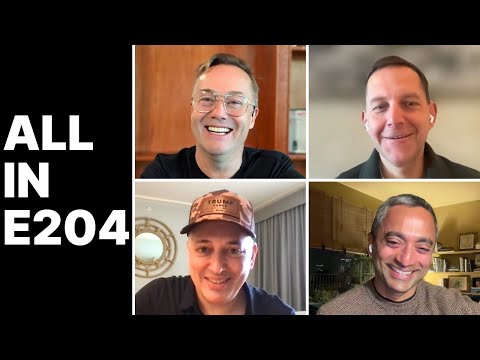
Trump's market impact: Bitcoin, M&A, IPOs + transition picks; Polymarket CEO raided by FBI
Jason Calacanis (host), David Friedberg (host), David Sacks (host), Chamath Palihapitiya (host), Chamath Palihapitiya (host), Chamath Palihapitiya (host), Jason Calacanis (host), Jason Calacanis (host), David Sacks (host), David Friedberg (host), Guest (guest)
In this episode of All-In Podcast, featuring Jason Calacanis and David Friedberg, Trump's market impact: Bitcoin, M&A, IPOs + transition picks; Polymarket CEO raided by FBI explores trump’s Win Supercharges Crypto, Shakes Markets, Media, And Bureaucracy The All-In besties unpack the market and political aftershocks of Trump’s election victory, focusing on the surge in Bitcoin and fintech, the prospects for IPOs and M&A, and a sharp turn in regulatory expectations. They argue that clearer crypto rules and a friendlier posture toward risk assets are driving a broad risk-on environment, even as high Treasury yields signal deep fiscal issues ahead.
Trump’s Win Supercharges Crypto, Shakes Markets, Media, And Bureaucracy
The All-In besties unpack the market and political aftershocks of Trump’s election victory, focusing on the surge in Bitcoin and fintech, the prospects for IPOs and M&A, and a sharp turn in regulatory expectations. They argue that clearer crypto rules and a friendlier posture toward risk assets are driving a broad risk-on environment, even as high Treasury yields signal deep fiscal issues ahead.
The conversation broadens into how Trump’s incoming cabinet could function as a deliberate ‘extinction event’ for parts of the federal bureaucracy, with high-beta picks like RFK Jr., Matt Gaetz, and Tulsi Gabbard framed as potentially transformative but risky. They also debate whether pharma advertising should be allowed on TV, given its role in media capture and healthcare inflation, and analyze the FBI raid on Polymarket’s CEO as either routine enforcement or possible political retribution.
Throughout, they distinguish between disciplining ‘big tech’ monopolies versus enabling a healthier mid-cap M&A and IPO environment, and stress that doing nothing about federal bloat and lawfare is no longer a viable option.
Key Takeaways
Trump’s win has triggered a broad risk-on shift, especially for crypto and fintech.
Bitcoin hit an all-time high near $92K and crypto-exposed equities like Affirm, Robinhood, PayPal, and Coinbase are up 50–100% since late summer. ...
Get the full analysis with uListen
Despite optimism, the besties expect 2025 IPO and M&A activity to be more muted than VCs hope.
Chamath and Sacks argue that with risk-free Treasuries yielding ~4. ...
Get the full analysis with uListen
Clearer crypto regulation under Republicans (e.g., FIT21) could structurally re-rate the industry.
Sacks highlights the FIT21 bill, which would classify tokens on ‘functional and decentralized’ blockchains as commodities under the CFTC and more centralized ones as securities under the SEC. ...
Get the full analysis with uListen
A healthier competitive landscape may require targeting big-tech dominance while freeing sub–$1T companies to consolidate.
Sacks praises Lina Khan’s willingness to pressure monopolies like Amazon, Apple, and Google, even as he faults her for over-broad enforcement that chilled small-tech M&A. ...
Get the full analysis with uListen
Pharma advertising on TV likely distorts news coverage and reinforces a captured healthcare system.
Sacks argues that most pharma TV spend is not about persuading consumers—who can’t buy drugs without prescriptions—but about purchasing favorable or selectively silent coverage from networks dependent on pharma ad revenue. ...
Get the full analysis with uListen
The FBI raid on Polymarket’s CEO raises questions about selective enforcement and election narratives.
After settling with the CFTC in 2022 and blocking U. ...
Get the full analysis with uListen
Trump’s cabinet is being framed as a deliberate ‘extinction event’ for the federal bureaucracy.
Friedberg likens Trump’s personnel strategy to punctuated equilibrium in evolution: long periods of bureaucratic growth suddenly disrupted by a massive external shock. ...
Get the full analysis with uListen
Notable Quotes
“There will be a point where Bitcoin is an independent asset and a non-speculative store of value… but that day is not now.”
— Chamath Palihapitiya
“You’re basically paying 20 times cash flow to own a risk-free bond, or 30 times to own the S&P 500. So what is this IPO going to give you?”
— David Sacks
“I would argue that Trump’s mandate was to be kind of the extinction event… this is going to be the most disruptive force that federal agencies have ever seen.”
— David Friedberg
“Why is so much money going from pharma to these news outlets? The real reason is it’s influence buying. It’s influence peddling.”
— David Sacks
“We all agree the United States is currently on an unsustainable fiscal path… What’s the downside of shaking it up?”
— David Sacks
Questions Answered in This Episode
If FIT21 becomes law, which specific crypto projects or categories do you expect to be reclassified as commodities versus securities, and how would that immediately change their business strategies and valuations?
The All-In besties unpack the market and political aftershocks of Trump’s election victory, focusing on the surge in Bitcoin and fintech, the prospects for IPOs and M&A, and a sharp turn in regulatory expectations. ...
Get the full analysis with uListen AI
You argued that mid-cap tech companies should be allowed to merge freely while trillion‑dollar ‘Mag 7’ platforms are restricted—how would you design that threshold and enforcement in practice so it doesn’t just entrench a new tier of dominant ‘Mag 70’ firms?
The conversation broadens into how Trump’s incoming cabinet could function as a deliberate ‘extinction event’ for parts of the federal bureaucracy, with high-beta picks like RFK Jr. ...
Get the full analysis with uListen AI
Friedberg framed Trump’s cabinet as an ‘extinction event’ for federal agencies: what concrete metrics or case studies would you use 2–4 years from now to decide whether that shock actually produced healthier, more resilient institutions versus just chaos and lost capacity?
Throughout, they distinguish between disciplining ‘big tech’ monopolies versus enabling a healthier mid-cap M&A and IPO environment, and stress that doing nothing about federal bloat and lawfare is no longer a viable option.
Get the full analysis with uListen AI
On pharma advertising, how would you surgically distinguish between legitimate public‑health awareness campaigns (e.g., for breakthrough MS treatments) and influence‑buying behavior that corrupts news coverage, without handing the government a broad censorship tool over commercial speech?
Get the full analysis with uListen AI
Regarding the Polymarket raid, if it turns out there was coordinated last‑minute manipulation of prediction markets to support a ‘Kamala surge’ narrative, what reforms—legal, technical, or transparency-based—would you propose to safeguard prediction markets without over‑criminalizing normal trading behavior?
Get the full analysis with uListen AI
Transcript Preview
Hey, everybody. Welcome back to the All In Podcast. With us again today, yawning from Milan, your favorite, the chairman dictator, Chamath Palihapitiya. You look a little tired, my friend. How you doing over there, buddy?
I left Monday. I flew to Singapore.
Hm.
I was on the ground for two days, and I flew here. I'm here for two days, and then I go to London for five days.
Okay.
I'm exhausted.
So you are on a whirlwind tour.
I mean, I'm base- I'm flying around the world, literally flying around the world moving west. Man.
Right.
I'm tired.
And this is all-
How do people do it?
... in service.
My gosh.
It's... I mean, at our age, you feel it.
How do people do it?
It hits differently when you, when you pass 40. And I'm assuming this is 80/90 business? You're out there selling? You selling? You're selling grok? You're selling 80/90? You're out there doing BD?
Little selling, little closing, and then I'm speaking at the Oxford Union on Wednesday.
Okay. Okay. Well, that sounds fancy.
Bucket list. Check into bucket list.
Ah. Okay. There you have it. And in his camo hat and in his election afterglow. Look at the glow.
Afterglow. (laughs)
He is in that afterglow. He is post-coitus. He are post-election.
Anybody got a cigarette? I need to-
(laughs)
I need to light up a cigarette. (laughs)
Light up with his ex-
(exhales) Yeah.
That was a close one.
Yeah.
I didn't think I was gonna make it, but you did. You did like 26.
Do you like my camo hat, J-CAL?
What does it say?
This is, this is a hat... Well, it says Trump 2027.
Oh. Oh, more fun. What does it say?
(laughs)
"You're hunting libs." Oh.
Now, remember, remember when, uh, Tim Walz rolled out the camo hat?
Ah, yes. Yes.
And you said it was gonna win the election for Harris-Walz?
It might. It might.
'Cause...
I thought that he might have a shot, yes. Yeah, I was wrong about that one. "Be Bowie, Bowie quiet."
We got all the camo guys. They voted for us.
Yeah, hunting wibbawls. Nobody's gonna get this, uh, impersonation, but it's very good. It looks good on you.
Was that, was the Elmer Fudd?
(laughs)
That's Elmer Fudd. "Be Bowie, Bowie quiet. We're hunting wibbawls."
That sounds like Mike Tyson.
Well, "I'm gonna mess up that, Jake Paul."
How about I wear a different Trump hat every week for the next four years?
(laughs)
Absolutely fantastic. It's... I mean, the ratings on this show-
There's so many good ones.
I mean, all I care about at this point, I'm getting savaged, i- i- in any way possible.
Install uListen to search the full transcript and get AI-powered insights
Get Full TranscriptGet more from every podcast
AI summaries, searchable transcripts, and fact-checking. Free forever.
Add to Chrome