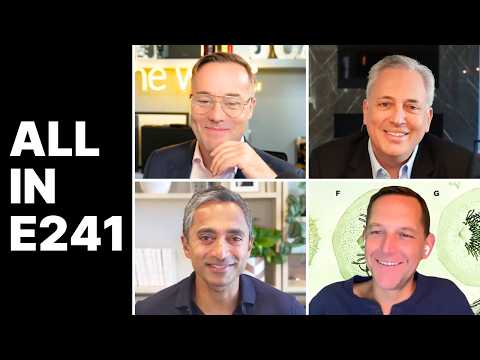
Trump Takes On the Fed, US-Intel Deal, Why Bankruptcies Are Up, OpenAI's Longevity Breakthrough
Chamath Palihapitiya (host), Jason Calacanis (host), David Sacks (host), David Friedberg (host), Narrator, Jason Calacanis (host)
In this episode of All-In Podcast, featuring Chamath Palihapitiya and Jason Calacanis, Trump Takes On the Fed, US-Intel Deal, Why Bankruptcies Are Up, OpenAI's Longevity Breakthrough explores trump Battles Fed, Buys Into Intel, AI Rewrites Human Longevity Playbook The episode ranges from light banter about the All-In Summit to deep debates on the politicization and future role of the Federal Reserve, Trump’s battle with Fed Governor Lisa Cook, and the appropriateness of presidential influence over monetary policy. The besties then dissect the U.S. government’s surprise 10% stake in Intel, contrasting it with China’s state-capitalism model and debating whether America should build a sovereign wealth fund tied to strategic investments and Social Security. Rising corporate bankruptcies are framed less as a tariff shock and more as long-delayed fallout from a decade of zero-interest-rate policy and blocked M&A, alongside mounting CRE and refinancing stress. The show closes with a detailed discussion of OpenAI’s protein-design breakthrough on Yamanaka factors, its implications for reversing aging, and how specialized AI models may transform biotech and therapeutics within the next decade.
Trump Battles Fed, Buys Into Intel, AI Rewrites Human Longevity Playbook
The episode ranges from light banter about the All-In Summit to deep debates on the politicization and future role of the Federal Reserve, Trump’s battle with Fed Governor Lisa Cook, and the appropriateness of presidential influence over monetary policy. The besties then dissect the U.S. government’s surprise 10% stake in Intel, contrasting it with China’s state-capitalism model and debating whether America should build a sovereign wealth fund tied to strategic investments and Social Security. Rising corporate bankruptcies are framed less as a tariff shock and more as long-delayed fallout from a decade of zero-interest-rate policy and blocked M&A, alongside mounting CRE and refinancing stress. The show closes with a detailed discussion of OpenAI’s protein-design breakthrough on Yamanaka factors, its implications for reversing aging, and how specialized AI models may transform biotech and therapeutics within the next decade.
Key Takeaways
The Fed is more political than it pretends, and that has real economic costs.
Chamath and Sachs argue the Federal Reserve is functionally a partisan, politically appointed body, not a neutral technocratic priesthood. ...
Get the full analysis with uListen
There is a serious argument for shifting rate-setting from human committees to market mechanisms.
Chamath questions whether a small committee, meeting monthly on month-old, often-revised data, should control monetary policy in a $130T real-time global economy. ...
Get the full analysis with uListen
Attaching equity to strategic subsidies, like the Intel deal, may be a better model than pure grants.
All three broadly endorse swapping CHIPS Act grants for non-voting equity in Intel. ...
Get the full analysis with uListen
A U.S. sovereign wealth fund tied to Social Security could both capture upside and address looming insolvency risk.
Friedberg proposes that equity from deals like Intel, plus future strategic holdings, should sit in a formal vehicle—ideally integrated into the Social Security OASI trust fund, which today holds only special-issue Treasuries and is projected to go insolvent around 2030–33. ...
Get the full analysis with uListen
The current uptick in large bankruptcies is more ‘delayed cleansing’ from ZIRP than instant tariff shock.
Chamath dismisses media narratives attributing the 2025 bankruptcy spike to recent tariffs, noting large firms don’t fail within 30–60 days from policy changes. ...
Get the full analysis with uListen
Commercial real estate and other rate-sensitive sectors remain fragile until rate cuts meaningfully arrive.
Sachs explains the ‘wall of debt’ in commercial real estate: $2. ...
Get the full analysis with uListen
AI-designed proteins are accelerating the path to practical rejuvenation therapies, potentially within a decade.
Friedberg details OpenAI’s GPT-4B Micro model, fine-tuned on protein sequences and structural/biological text, which proposed modified Yamanaka-factor proteins (variants of O, S, K, M) that dramatically increase conversion efficiency. ...
Get the full analysis with uListen
Notable Quotes
“The idea that we still can’t admit that the Federal Reserve is political is part of the problem.”
— Chamath Palihapitiya
“We’ve turned over responsibility to a handful of humans using bad inputs.”
— Chamath Palihapitiya
“Trump is right to be frustrated. Powell has been intensely political.”
— David Sacks
“If you’re gonna give large amounts of money to chip manufacturers, it’s better to get equity for that than for it to be a freebie.”
— David Sacks
“We should be very optimistic about the path we’re on in reversing aging.”
— David Friedberg
Questions Answered in This Episode
If market-based mechanisms and blockchain oracles replaced the Fed’s rate-setting role, what specific safeguards would be needed to prevent short-term speculation from destabilizing long-term price stability?
The episode ranges from light banter about the All-In Summit to deep debates on the politicization and future role of the Federal Reserve, Trump’s battle with Fed Governor Lisa Cook, and the appropriateness of presidential influence over monetary policy. ...
Get the full analysis with uListen AI
In the Intel deal, how should the U.S. determine which sectors or companies qualify as ‘national security–critical’ enough to justify equity-based public investment versus letting them sink or swim in private markets?
Get the full analysis with uListen AI
What concrete legal and governance structures would you design for a U.S. sovereign wealth fund so its assets genuinely backstop Social Security or debt reduction rather than becoming another pot for discretionary spending?
Get the full analysis with uListen AI
Given the dramatic improvement in Yamanaka-factor efficiency from GPT-4B Micro, what experimental or regulatory milestones would most convincingly de-risk the cancer/tumor danger of partial cellular reprogramming in humans?
Get the full analysis with uListen AI
On bankruptcies: how do you distinguish between healthy ‘creative destruction’ of ZIRP-era zombies and early warning signs of systemic credit stress, particularly in CRE and leveraged sectors, before it spills into the broader economy?
Get the full analysis with uListen AI
Transcript Preview
Oh, look at that. It's a moose.
Sorry, guys, I got a little visitor.
The moose.
Hey, buddy. The moose has landed. (laughs) Oh, he's up on my desk. Oh, how's your Uncle Jason, huh?
Let's see that handsome face. There he is.
There's the moose. The moose is loose. Let's see. Should we do a side by side?
What a handsome visage.
(laughs) What a handsome visage.
You're an idiot. That isn't good stuff.
That's a stately animal.
(laughs)
Come here, buddy. You ready for ranch time? All right, get him outta here. Get him outta here. We gotta show the predation. (laughs)
Let your winners ride.
Rain Man, David Sachs.
I'm going all in.
And I said- We open sourced it to the fans and they've just gone crazy with it.
Love you guys.
West Side Queen of Kinwah. I'm going all in.
All right, everybody. Welcome back to the number one podcast in the world, the All In podcast. We're back, we're back. It's the original crew. You got your classic, you got your classic. And speaking of a classic, Friedberg's been tearing it up. What an amazing event we're gonna have September 8th and 9th in Los Angeles. The fourth annual All In Summit. Allin.com/events. And, uh, now comes the incredibly awkward moment in the program, David Sachs, where we see Friedberg attempt to do an ad read. I'm gonna let him just try to do the first one, and then I'll interrupt him and say, "Let, let a professional handle it." But let's give it a shot here. Let's see how Friedberg does with his uncomfortable promo.
These are not your typical event sponsorships. Every summit partner is building an insane activation.
All right, stop.
Okay.
It's, it's terrible. Three, two-
Okay.
All right. Oracle's coming, and they've done an amazing job. They're gonna build out this amazing bar in the expo hall. Drinks on our friends at Oracle. Yes. And they're gonna be sponsoring the PE and VC dinner, as well as the AI infrastructure dinner. We have all these bird of a feather dinners where you can meet people in your tribe. Our friend, Jeremy Allaire at Circle, he's also supporting it. He's building out a huge teched-out networking lounge right in the heart of the event. And Circle and BVNK are also partnering to sponsor the Stablecoin Dinner. Chamath loves his stablecoins, he'll be there. And Iren, they operate data centers powered by my favorite, renewable energy. And they're putting on Casino Night.
That's all you, JCal.
That's me.
You're gonna be at that. Yeah.
Absolutely. Me and my pal Chris Wright are gonna go there.
(laughs)
And, uh, we're gonna be in the solar tent, and it's gonna heat up.
Yeah.
And we also have... How crazy is this? BVNK. It's not enough they're doing the Stablecoin Dinner with Circle. They're gonna build out an arcade in the expo hall so you can get some games.
Install uListen to search the full transcript and get AI-powered insights
Get Full TranscriptGet more out of YouTube videos.
High quality summaries for YouTube videos. Accurate transcripts to search & find moments. Powered by ChatGPT & Claude AI.
Add to Chrome