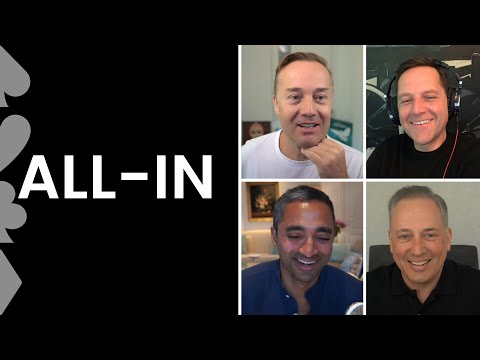
E84: Markets update, crypto collapse, Russia/Ukraine endgame, state of the podcast
Chamath Palihapitiya (host), David Sacks (host), Jason Calacanis (host), David Friedberg (host), Jason Calacanis (host), Chamath Palihapitiya (host), David Sacks (host), David Friedberg (host)
In this episode of All-In Podcast, featuring Chamath Palihapitiya and David Sacks, E84: Markets update, crypto collapse, Russia/Ukraine endgame, state of the podcast explores all-In crew reunites, dissects markets carnage, crypto crash, Ukraine stakes The hosts open by airing internal drama about equity splits, control of the show, and the failed attempt to turn All-In into a larger media company, ultimately confirming they remain equal 25% partners and will keep it as “just a pod.”
All-In crew reunites, dissects markets carnage, crypto crash, Ukraine stakes
The hosts open by airing internal drama about equity splits, control of the show, and the failed attempt to turn All-In into a larger media company, ultimately confirming they remain equal 25% partners and will keep it as “just a pod.”
They then dive into macroeconomics: how years of quantitative easing and stimulus created massive asset bubbles, why inflation is now entrenched, and why they expect a long, painful adjustment across stocks, housing, private equity, and labor markets.
A major segment focuses on crypto’s collapse, over-leverage, alleged grift around token deals, and the regulatory and legal reckoning they believe is coming as billions in retail losses attract prosecutors and lawmakers.
They close by critiquing Western policy on Russia/Ukraine, energy dependence, and China’s strategic gains, and game out likely 2024 U.S. presidential matchups while taking frequent shots at Biden’s performance and Trump’s viability.
Key Takeaways
Expect a long, grinding bear market rather than a quick rebound.
Chamath argues that ~$30 trillion of excess global liquidity pumped in since 2008 must effectively be unwound, a process he expects to take 2–3 years with choppy markets and multiple ‘shoes to drop’ across asset classes.
Get the full analysis with uListen
Startups should plan for 3–4 years of runway and take painful cuts now.
Sacks relays growth-investor guidance that capital availability could drop ~75%, meaning founders who only have two years of runway may be forced to raise in the depths of a recession on terrible terms—if they can raise at all.
Get the full analysis with uListen
Crypto’s crash reveals massive leverage, structural grift, and legal risk.
They describe crypto as a ‘liquidity sponge’ that soaked up cheap money, fueled by token schemes where investors flipped early allocations; now that prices have collapsed, they expect aggressive enforcement actions and lawsuits.
Get the full analysis with uListen
The Fed’s slow response to inflation has forced it into overcorrection.
Friedberg and Sacks contend that the Fed kept buying bonds and holding rates too low despite clear growth and early inflation signals in 2021, forcing today’s rapid hikes that risk both recession and policy overshoot.
Get the full analysis with uListen
Founders are intellectually aware of the downturn but behaviorally in denial.
Sacks notes a disconnect where CEOs say they understand the macro risk yet still plan to ‘out-accelerate competitors’ instead of taking deep cuts, making only 10% reductions that he calls “just a performance review,” not real medicine.
Get the full analysis with uListen
Western sanctions on Russia were porous, backfired economically, and aided China.
Chamath and Friedberg argue that poorly designed sanctions spiked global commodity prices while Russia rerouted exports, ran record surpluses, and pushed more trade into non-dollar currencies—strengthening Russia and benefitting China.
Get the full analysis with uListen
U.S. foreign and energy policy missteps have compounded inflation and geopolitical risk.
Sacks criticizes Biden for canceling U. ...
Get the full analysis with uListen
Notable Quotes
“We’re at the beginning of the beginning of something that just fundamentally has to take some amount of time to work its way through the system.”
— Chamath Palihapitiya
“Three to four years is the new two years of runway… If you try to raise in a year, you’ll be in the middle of a recession and investors will have all the leverage.”
— David Sacks (relaying Coatue summit advice)
“Crypto is like a liquidity sponge. It sucks up excess liquidity when money is free, and now that sponge is getting wrung out.”
— David Sacks
“We just had $2 trillion of money taken from retail [in crypto]… governments really hate it when retail investors lose money—watch out.”
— David Friedberg
“We allowed our largest competitive frenemy, China, to drive their entire economy at a 30–40% discount to what we have to pay… this is not how you preserve the reserve currency of America.”
— Chamath Palihapitiya
Questions Answered in This Episode
If the bear market and liquidity unwind truly take 2–3 years, what leading indicators should investors and founders watch to know when we are closer to the bottom?
The hosts open by airing internal drama about equity splits, control of the show, and the failed attempt to turn All-In into a larger media company, ultimately confirming they remain equal 25% partners and will keep it as “just a pod.”
Get the full analysis with uListen AI
How should an early-stage startup concretely decide between deep cuts now versus trying to ‘out-accelerate’ competitors in this environment?
They then dive into macroeconomics: how years of quantitative easing and stimulus created massive asset bubbles, why inflation is now entrenched, and why they expect a long, painful adjustment across stocks, housing, private equity, and labor markets.
Get the full analysis with uListen AI
What specific regulatory framework for crypto would balance innovation with real consumer protection and avoid simply pushing activity offshore?
A major segment focuses on crypto’s collapse, over-leverage, alleged grift around token deals, and the regulatory and legal reckoning they believe is coming as billions in retail losses attract prosecutors and lawmakers.
Get the full analysis with uListen AI
Given the apparent failures and unintended consequences of the Russia sanctions, what would a more effective and strategically coherent sanctions regime have looked like?
They close by critiquing Western policy on Russia/Ukraine, energy dependence, and China’s strategic gains, and game out likely 2024 U. ...
Get the full analysis with uListen AI
If U.S. voters are likely to reject both high inflation and election denialism, what characteristics should the next generation of presidential candidates from either party embody to be both electable and effective?
Get the full analysis with uListen AI
Transcript Preview
J-Cal, you look a little grifty. You feel okay?
Yeah.
Me? I'm great. I'm great.
You look half a milli richer today.
(laughs)
What's it like to be half a milli richer?
J-Cal, you look like a failed hostage taker. (laughs)
(laughs)
Laugh it up, boys. Laugh it up, boys. Laugh it up, boys. When you see my other projects drop-
Oh, my God.
... you're gonna be crying again, okay?
I can't wait. Why don't you take yes for an answer, J-Cal? Look at him.
I- I'm taking yes for an answer. Welcome to the All-In podcast with three miserable rich bastards who pull up-
(laughs)
... the ladder behind them.
(laughs)
Do you wanna explain why it took us a month to produce a new episode, J-Cal?
Uh, what about the-
And just in your view.
Whoa, hold on a second, attorney.
Let me give you guys the TLDR. J-Cal thought the All-In pod was his, and then he realized it wasn't.
(laughs)
No. And so if you guys wanna go, there we go. There, I'm- I'm totally-
That's it.
... transparent.
All right, let's do it.
I requested, I requested to own 6% more of the All-In podcast.
No, no, no. Back up to the summit. Back up to when you wanted to kick me-
No, back-
... off the show.
No.
Yeah.
Back up before that where we-
Oh, my God, are we really doing this?
Yeah, we're gonna do it.
Yeah, let's do it.
Well, okay, if you wanna do it, we'll do it.
We can't talk about this for 45 minutes, because what happens then-
It's so boring. So boring.
... we plan the summit-
So boring.
We plan the summit. J-Cal doesn't like how I was concerned about the summit, and I bitched at him, and, you know, I was negative to him. Finish the summit, and J-Cal wants to kick me off the show.
Yes.
Brad Gerstner, Bill Gurley would have higher ratings.
Here comes the bullying. Here comes the bullying.
People think it was me and J-Cal getting into it. It wasn't. It was actually, it started with-
All right.
... Friedberg and J-Cal getting into it.
J-Cal wanted me off the show.
All right. I'll, uh, do I get to explain the series of events-
Go ahead.
... or no? Okay.
He wanted me off the show.
True or false, J-Cal?
I felt-
(laughs) Admit it. Admit it.
... that if Friedberg, if Friedberg wasn't enjoying his time here and was going to constantly complain every week about every detail of why the show's not good, there was always the option for him to maybe do half the shows and have Brad Gerstner do half the shows, or have Bill Gurley, or rotate in. And so if he was going to be miserable all the time and worried about the show, I gave him the option to have somebody else take his spot.
Install uListen to search the full transcript and get AI-powered insights
Get Full TranscriptGet more out of YouTube videos.
High quality summaries for YouTube videos. Accurate transcripts to search & find moments. Powered by ChatGPT & Claude AI.
Add to Chrome