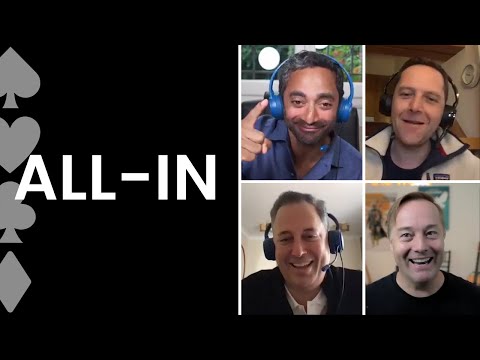
E39: West coast super drought & climate crisis, Nuclear virtue signaling, chaos in SF & more
Jason Calacanis (host), Chamath Palihapitiya (host), David Sacks (host), Narrator, David Friedberg (host), David Sacks (host), Jason Calacanis (host), Narrator
In this episode of All-In Podcast, featuring Jason Calacanis and Chamath Palihapitiya, E39: West coast super drought & climate crisis, Nuclear virtue signaling, chaos in SF & more explores super-drought, nuclear politics, San Francisco chaos, and Delta doubts This All-In Podcast episode weaves together California’s worsening mega-drought, structural failures in water and energy policy, and the political risks facing Governor Gavin Newsom during fire season. The hosts argue for both near-term emergency preparedness (air quality, power backups, community centers) and long-term infrastructure like nuclear power, desalination, and smarter water management, while criticizing environmentalist opposition to nuclear as performative. They then pivot to San Francisco’s crime and governance, alleging data manipulation, ideological capture, and intimidation tactics by DA Chesa Boudin’s office, prompting calls for his recall and even leaving California. The show closes with a discussion of the COVID Delta variant’s impact on vaccine effectiveness, the risk of renewed restrictions, and the global need to accelerate vaccination to slow viral evolution.
Super-drought, nuclear politics, San Francisco chaos, and Delta doubts
This All-In Podcast episode weaves together California’s worsening mega-drought, structural failures in water and energy policy, and the political risks facing Governor Gavin Newsom during fire season. The hosts argue for both near-term emergency preparedness (air quality, power backups, community centers) and long-term infrastructure like nuclear power, desalination, and smarter water management, while criticizing environmentalist opposition to nuclear as performative. They then pivot to San Francisco’s crime and governance, alleging data manipulation, ideological capture, and intimidation tactics by DA Chesa Boudin’s office, prompting calls for his recall and even leaving California. The show closes with a discussion of the COVID Delta variant’s impact on vaccine effectiveness, the risk of renewed restrictions, and the global need to accelerate vaccination to slow viral evolution.
Key Takeaways
Prepare now for acute drought and fire impacts, not just climate theory.
With record-low soil moisture, depleted snowpack, reduced hydro power and high heat, the hosts argue California should be running daily briefings and pre-positioning masks, air purifiers, generators, and community cooling/power centers before fire season spikes AQI and forces outdoor work and schools to shut down.
Get the full analysis with uListen
Long-term resilience requires serious investment in nuclear, desalination, and grid reform.
They contend that nuclear power paired with desalination could create energy and water abundance, stabilizing agriculture and the grid, but U. ...
Get the full analysis with uListen
Water scarcity is as much political and structural as it is physical.
Most California water goes to agriculture (roughly 10x residential use), yet pricing is distorted, leaks and usage are poorly metered, and politically powerful interests (e. ...
Get the full analysis with uListen
San Francisco’s public safety crisis is compounded by narrative management and loss of trust.
The panel claims DA Chesa Boudin’s office is downgrading charges to make crime stats look better, while allies in media and academia amplify the line that “crime is falling” and label critics as racists, which they see as Orwellian and corrosive to democratic accountability.
Get the full analysis with uListen
Anti-nuclear sentiment among climate advocates may be undermining climate goals.
They argue that overreactions to Three Mile Island, Chernobyl, and Fukushima led to abandoning a low-carbon, reliable energy source, pushing Europe (e. ...
Get the full analysis with uListen
Cultural pessimism and cynicism hinder ambitious problem-solving.
Referencing a study linking cynicism to lower IQ and earnings, the hosts argue that pervasive anti-innovation attitudes, NIMBYism, and a “vetocracy” of veto players keep the U. ...
Get the full analysis with uListen
Delta variant underscores both vaccines’ value and the urgency of global rollout.
Israeli data suggesting Pfizer effectiveness against infection dropping to ~64% (while still strongly protecting against severe disease) and breakthrough cases among vaccinated individuals reinforce the need for boosters and rapid vaccination worldwide to shrink the “Petri dish” where new variants evolve.
Get the full analysis with uListen
Notable Quotes
“This is almost like where we were going into COVID... it may not happen, but the probability is high enough that something bad may happen that we should probably start to get prepared for it.”
— David Friedberg
“If we stopped flying after two airline crashes, where would the world be? Now impose that on nuclear energy.”
— Chamath Palihapitiya
“No one will really understand politics until they understand that politicians are not trying to solve our problems. They're trying to solve their own problems.”
— David Sacks (quoting Thomas Sowell and expanding)
“There’s not a shortage of water in the world. It is a function of building desalination plants if that’s what we need.”
— David Sacks
“Pessimists get to be right and optimists get to be rich.”
— David Sacks
Questions Answered in This Episode
What specific policies or governance changes would be required to make a ‘Manhattan Project’ for modern nuclear power politically and legally feasible in the U.S.?
This All-In Podcast episode weaves together California’s worsening mega-drought, structural failures in water and energy policy, and the political risks facing Governor Gavin Newsom during fire season. ...
Get the full analysis with uListen AI
How can California realistically rebalance agricultural, residential, and industrial water use without collapsing key parts of its economy?
Get the full analysis with uListen AI
Where is the line between legitimate public safety concern and fear-based rhetoric, and who should arbitrate that in cities like San Francisco?
Get the full analysis with uListen AI
What institutional reforms could reduce the ‘vetocracy’ effect and allow large-scale infrastructure to be built in years, not decades, without sacrificing safety or oversight?
Get the full analysis with uListen AI
Given the emergence of Delta and other variants, what is the most practical long-term strategy: periodic boosters, updated vaccine cocktails, or a fundamental shift in how we live with endemic COVID?
Get the full analysis with uListen AI
Transcript Preview
What did your doctor give you to make you lose all this weight? What did- what is your celebrity doctor giving you? Tell the truth. Did you get that new shot?
No, it's like, people- people on Twitter are like, "Your- your Twitter account's sounding a lot more like Jake account." And I'm like-
(laughs)
... "I think we're on the s- I think we're on the same diet. I think that's what's going on here."
(laughs)
(instrumental music plays) In three, two- Let your winners ride. Rainman, David Sacks. And they said we open sourced it to the fans and they have just gone crazy with it. Love you guys. Queen of Quinoa. Hey, everybody. Hey, everybody. Welcome to another episode of The All-In Pod. With us today, of course, the Queen of Quinoa.
(laughs)
And from his castle in Italy (laughs) , the cackling, uh, dictator, Chamath Palihapitiya, nice gardenias, and back from his big, big battle, his brawl, unblocked and undefeated, the Rainman himself, David Sacks.
And judging by the comments, uh, I'd say dominant.
Oh, you read the comments?
(laughs)
That's just another sign of your obsession-
Oh, like you don't.
... with how you're perceived.
Like you don't. Like you don't.
Don't even. I never read the comments.
Don't pretend. Don't pretend.
Rule number one, don't read the comments. We're not doing it again.
Well, it shows. It shows because you're not listening to the comments, so it makes sense.
Oh, okay. Go ahead. And- and- and you got your whole troll army?
But look, we have, we have-
How many people have you hired on your social media team-
(laughs)
... to troll me from anonymous accounts on Twitter now to prove your points?
Now you're paranoid too?
I'm- I'm not gonna-
Don't be paranoid. Don't be paranoid. Anyway, look-
All right, he's not gonna let me.
... we've patched things up.
It's patched up.
Don't- don't break the peace. We have detente.
(laughs) All right. So Freeburg is busy, uh, writing tweet storms now, um, about the drought in California, which seems to be, uh, just gonna be a really bad year basically. So Freeburg, walk us through it. How bad is California's drought gonna be this year?
So the drought is already very bad. Um, I put out a- a lot of tweets at 2:00 in the morning last night, I think. I drank way too much caffeine yesterday. I'm in the mountains and like the only way I can avoid having headaches is like drinking caffeine all day and it was a mistake. It kept me up all night. But-
You sure it's not the (beep) ?
(laughs)
Maybe you're so excited about this (beep) that you just can't sleep-
Because you're on pins and needles. (laughs)
Install uListen to search the full transcript and get AI-powered insights
Get Full TranscriptGet more from every podcast
AI summaries, searchable transcripts, and fact-checking. Free forever.
Add to Chrome