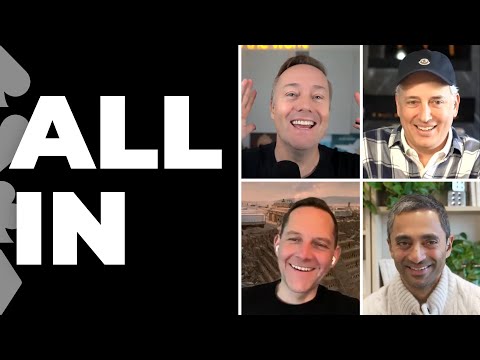
E121: Macro update, Fed hike, CRE debt bubble, Balaji's Bitcoin bet, TikTok's endgame & more
Chamath Palihapitiya (host), Jason Calacanis (host), David Sacks (host), David Friedberg (host), Guest (guest), Guest (guest), Narrator
In this episode of All-In Podcast, featuring Chamath Palihapitiya and Jason Calacanis, E121: Macro update, Fed hike, CRE debt bubble, Balaji's Bitcoin bet, TikTok's endgame & more explores fed’s risky tightrope, CRE time bomb, Bitcoin hysteria, TikTok reckoning The hosts dissect the Federal Reserve’s latest rate hike, debating whether the Fed is mismanaging inflation and financial stability, and outlining how its decisions are stressing banks and the broader economy.
Fed’s risky tightrope, CRE time bomb, Bitcoin hysteria, TikTok reckoning
The hosts dissect the Federal Reserve’s latest rate hike, debating whether the Fed is mismanaging inflation and financial stability, and outlining how its decisions are stressing banks and the broader economy.
They dive into the looming commercial real estate (CRE) debt problem, explaining how rising rates, falling office demand, and frozen credit could cascade into bank balance sheets and potentially require massive federal backstops.
Balaji Srinivasan’s $1M-in-90-days Bitcoin bet is analyzed and largely dismissed as publicity and book-talking, even as the panel agrees that more money printing and some inflationary response are likely over time.
The episode closes on U.S. moves against crypto and TikTok, with a strong bipartisan push to either force a TikTok divestiture or outright ban, and a brief note on the progress and economics of new space-launch startups.
Key Takeaways
The Fed is trading one crisis for another by fixating on lagging inflation data.
Sacks argues the Fed was late to fight inflation and is now over-tightening despite clear banking stress, while Chamath contends the Fed chose the worst middle-ground by hiking only 25 bps instead of decisively breaking inflation or clearly pausing.
Get the full analysis with uListen
Commercial real estate could be the next major shock to banks.
With office vacancies surging, leases rolling down, and refinancing costs spiking while credit is frozen, many CRE-backed loans will no longer pencil out, pushing owners to default and leaving smaller banks—who hold most CRE debt—carrying potentially large, opaque losses.
Get the full analysis with uListen
Massive federal support for property and banks is likely, not optional.
Friedberg expects $2–3 trillion in federal programs to stabilize CRE, plus more for banks and housing, arguing that high debt levels and systemic leverage make it politically and economically impossible to allow a full asset-price reset.
Get the full analysis with uListen
Bitcoin is not behaving like a true systemic hedge in this crisis.
Chamath notes that if Bitcoin were genuinely functioning as an off-ramp from the dollar, it should have exploded far beyond the high-$20Ks given current turmoil; instead, adoption remains narrow and trading is mostly speculative rather than defensive.
Get the full analysis with uListen
Crypto is facing a coordinated regulatory squeeze in the U.S.
Sacks cites a string of SEC actions, state AG moves, enforcement against exchanges and staking, and policy proposals, framing them as an emerging ‘Operation Choke Point’ targeting crypto rails just as broader monetary stress increases.
Get the full analysis with uListen
The basic bank business model is misaligned with what depositors think they’re buying.
Depositors believe they’re paying for a safe payments service, while banks treat deposits as unsecured, leveraged funding to invest with upside kept by management and shareholders; the hosts suggest either full-deposit protection plus tighter asset rules, or a clear, honest separation of safe custody vs. ...
Get the full analysis with uListen
TikTok is likely to face either a forced spinoff or an outright U.S. ban.
Bipartisan hostility in Congress was intense, and Chew’s inability to deny CCP consultation or data access cleanly led Chamath to predict shutdown is more politically likely than a technically verifiable, clean divestiture that satisfies security concerns.
Get the full analysis with uListen
Notable Quotes
“They took the worst option, which is neither did they cut nor did they raise enough.”
— Chamath Palihapitiya
“There are three phases to this financial crisis: the banking crisis we’re in, then a commercial real estate crisis, and then a government debt crisis.”
— David Sacks
“Every time they try to connect it to Bitcoin, they sound like a crazy person because they’re just talking their book.”
— Chamath Palihapitiya
“The more you insure at this point, the cheaper the insurance will actually be, because now the probability of having this bank run goes way, way down.”
— David Friedberg
“There’s a fundamental market failure with banking: the depositor and the bank think they’re getting two completely different things.”
— David Sacks
Questions Answered in This Episode
If you were running the Fed today, how would you balance the trade-off between fighting inflation and preventing further banking and CRE crises over the next 12–24 months?
The hosts dissect the Federal Reserve’s latest rate hike, debating whether the Fed is mismanaging inflation and financial stability, and outlining how its decisions are stressing banks and the broader economy.
Get the full analysis with uListen AI
What specific policy or regulatory changes could realign banking so that deposits are truly treated as safe custody rather than cheap, leveraged risk capital?
They dive into the looming commercial real estate (CRE) debt problem, explaining how rising rates, falling office demand, and frozen credit could cascade into bank balance sheets and potentially require massive federal backstops.
Get the full analysis with uListen AI
In a serious CRE downturn, where office buildings are auctioned at fire-sale prices, how should losses be shared between property owners, banks, bondholders, and taxpayers?
Balaji Srinivasan’s $1M-in-90-days Bitcoin bet is analyzed and largely dismissed as publicity and book-talking, even as the panel agrees that more money printing and some inflationary response are likely over time.
Get the full analysis with uListen AI
What objective, quantitative signals would convince you that the dollar is genuinely losing reserve-currency status, beyond high-profile anecdotes like oil trades in yuan?
The episode closes on U. ...
Get the full analysis with uListen AI
If TikTok were forced to divest to a U.S. owner, what technical and governance safeguards would be necessary to credibly ensure no CCP data access or influence over its recommendation algorithms?
Get the full analysis with uListen AI
Transcript Preview
What are you eating, Friedberg? Is that buffalo jerky? What is that?
It's a red pepper.
It is not the biltong, that's for sure.
I didn't have time for lunch. I got, I got pistachios, and I got a red pepper.
Oh, me too. Oh, wait, wait! Look at this.
Hey!
Look. Hey!
Oh!
(laughs) Let's see. Is that our branded pistachios? (laughs)
Aren't these the best pistachios?
Look it up.
They're the best.
You got salt, salt and vinegar. Yeah, that's the best.
Salt and vinegar. Yeah, yeah, they're the best.
Yeah.
Are those unpeeled pistachios? (laughs)
(laughs)
These guys are so rich people peel their nuts.
People have been peeling my nuts since the Facebook IPO.
(laughs) I'm going all in.
Let your winners ride.
Rain Man David Sachs. I'm going all in.
And I said we open sourced it to the fans and they have just gone crazy with it.
Love you, Wes Eisinga. Queen of quinoa. I'm going all in.
Hey, everybody, welcome to episode 121 of the world's greatest podcast, the All In podcast, with me again, of course, The Dictator himself, Chamath Palihapitiya, The Sultan of Science, David Friedberg, and The Rain Man himself, yeah, definitely, David Sacks. Gentlemen-
And you-
... how are we doing?
... the world's greatest-
Oh.
... genuflector. (laughs)
(laughs) Strike, strike, strike. The world's greatest moderator is here.
(laughs)
Oh, this... You guys, I gotta tell you something, the grift is on. A lot of corporate gigs for me to moderate. I don't even have to prepare. I just show up and moderate. Ah. So great.
What is that? What, what is an example of such a, such a gig?
There's a lot of corporations and conferences that pay a pretty penny to have the world's greatest moderator come and interview people.
This is like the Used Car Parts Association of America having a convention.
It'll be like, I did one with like a thousand litigators at an attorney conference for like the SaaS software they all use, and it was a wonderful fireside. You know, it's just great. This is like the grift is on.
Do you have to-
No ads.
Uh, do you have to fly commercial or they fly you private?
It's commercial at this point. Yeah.
That's okay then.
What does your, what does your rider say? What kind of-
(laughs)
Do you want... Do, do you ask for spiced salted macadamia nuts?
(laughs)
What do you ask for?
I do not have them peel my nuts. No. What I do is I blend the travel cost into the speaking fee, and then nobody knows when I'm in or out, what hotel I'm staying at or whatever, but basically I'm back on the road, folks. I'm back on the road meeting people.
Install uListen to search the full transcript and get AI-powered insights
Get Full TranscriptGet more from every podcast
AI summaries, searchable transcripts, and fact-checking. Free forever.
Add to Chrome