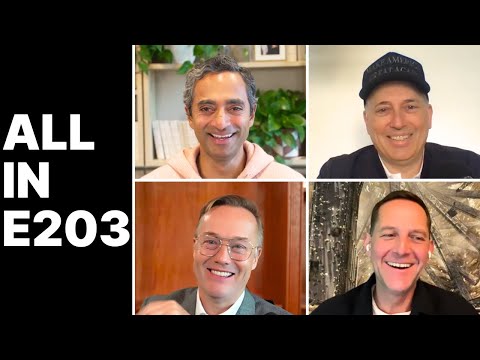
Trump wins! How it happened and what's next
Jason Calacanis (host), David Sacks (host), Chamath Palihapitiya (host), Jason Calacanis (host), Chamath Palihapitiya (host), Narrator, Narrator, David Friedberg (host)
In this episode of All-In Podcast, featuring Jason Calacanis and David Sacks, Trump wins! How it happened and what's next explores trump’s Landslide, Dems’ Collapse, And The Battle For The Bureaucracy The All-In hosts dissect Donald Trump’s decisive 2024 victory over Kamala Harris, arguing it signals a broad rejection of Democratic policies, woke culture, and legacy media narratives. They credit inflation, border and crime concerns, and Harris’s candidacy more than any single campaign tactic, while emphasizing Trump’s use of alternative media and Elon Musk’s late-stage efforts in Pennsylvania and among young men.
Trump’s Landslide, Dems’ Collapse, And The Battle For The Bureaucracy
The All-In hosts dissect Donald Trump’s decisive 2024 victory over Kamala Harris, arguing it signals a broad rejection of Democratic policies, woke culture, and legacy media narratives. They credit inflation, border and crime concerns, and Harris’s candidacy more than any single campaign tactic, while emphasizing Trump’s use of alternative media and Elon Musk’s late-stage efforts in Pennsylvania and among young men.
A major throughline is that the defeat belongs to the entire Democratic Party, not just Harris, due to spending-fueled inflation, soft-on-crime policies, de facto open borders, and an overreliance on identity politics and censorship. The hosts predict that unless Democrats tack back to the center and abandon their current base of affluent, over-educated progressives, Republicans could enjoy a durable majority.
Looking forward, they expect a unified GOP government to focus on ending the Ukraine war, sealing the border, cutting federal spending, and aggressively reforming the administrative state, with RFK Jr., Vivek Ramaswamy, and Tulsi Gabbard floated for key roles. They also celebrate moderate pushback against progressives in California and argue that Dobbs and state-level abortion votes are gradually reducing abortion’s salience as a federal wedge issue.
Key Takeaways
Trump’s win is framed as a systemic rejection of Democratic governance, not just Kamala Harris.
Sacks and Chamath argue that rampant inflation from multi-trillion-dollar spending, de facto open borders, soft-on-crime DA policies, and an interventionist foreign policy made the entire Democratic agenda untenable. ...
Get the full analysis with uListen
Cultural overreach and identity-based politics alienated broad swaths of voters across demographics.
Chamath describes a “cataclysmic dismissal of wokeism, cancel culture, and judgmentalism,” saying voters were tired of being labeled racist, sexist, or transphobic instead of having their concerns debated. ...
Get the full analysis with uListen
Alternative media and earned media gave Trump leverage that money and legacy outlets couldn’t match.
Friedberg shows that Democrats outspent Republicans roughly 3x at the presidential level (about $900M vs. ...
Get the full analysis with uListen
Elon Musk’s targeted involvement in Pennsylvania and among young men is portrayed as pivotal.
The hosts credit Musk for going into 'demon mode' and focusing relentlessly on Pennsylvania and disaffected young male voters via rallies, X livestreams, and a PAC-driven get‑out‑the‑vote infrastructure built in weeks. ...
Get the full analysis with uListen
A central project of Trump’s second term will be confronting and shrinking the administrative state.
Sacks calls the federal bureaucracy a de facto 'fourth branch' of government, with ~3 million employees of whom only ~3,000 are presidential appointees and extremely hard to fire. ...
Get the full analysis with uListen
Cabinet and leadership choices—especially avoiding neocons—will determine whether Trump delivers on his anti‑war and reform promises.
They warn that 'swamp creatures' and neocons who opposed Trump will immediately flock to Mar-a-Lago now that he’s won, as happened in Trump’s first term with figures like Bolton and Esper. ...
Get the full analysis with uListen
State politics show a broad backlash against progressive crime and homelessness policies, and abortion is shifting into a state-managed equilibrium.
They highlight California’s Prop 36 (overturning parts of Prop 47 and tightening shoplifting laws) passing with ~70% support, progressive DA George Gascón’s defeat in LA, and outsider Daniel Lurie’s likely win for San Francisco mayor as evidence that even deep‑blue electorates are rejecting 'soft on crime' governance. ...
Get the full analysis with uListen
Notable Quotes
“It was a cataclysmic dismissal of wokeism, of cancel culture, of judgmentalism. It was a ringing endorsement of meritocracy and just plain simple common sense.”
— Chamath Palihapitiya
“The legacy media’s spell is broken. Their credibility has been destroyed, and the repudiation of the legacy media is one of the most important results of this election.”
— David Sacks
“We are ruled by a fourth branch of government that is not in the Constitution, that doesn’t report to anybody. It is not subject to elections. We can’t vote them out, and we can’t fire them.”
— David Sacks
“I think we’re going to look back on this era… as a return to originalism. We are returning to the founding principles of this startup called America.”
— Chamath Palihapitiya
“How do so many normal, high‑functioning, well‑intended people switch sides?… You need to just take a step back and take a beat, and re‑underwrite where you’re coming from.”
— Chamath Palihapitiya
Questions Answered in This Episode
You argue the Democratic Party, not just Kamala Harris, owns this defeat. If you had to design a realistic 2028 Democratic platform that could win back the voters who just broke for Trump, what exactly would you strip out, and what would you add?
The All-In hosts dissect Donald Trump’s decisive 2024 victory over Kamala Harris, arguing it signals a broad rejection of Democratic policies, woke culture, and legacy media narratives. ...
Get the full analysis with uListen AI
You repeatedly describe legacy media’s 'spell' as broken, yet those outlets still reach tens of millions daily. What hard evidence would you point to over the next four years to prove that alternative platforms like X and podcasts now decisively outweigh CNN/MSNBC/NYT in shaping national outcomes?
A major throughline is that the defeat belongs to the entire Democratic Party, not just Harris, due to spending-fueled inflation, soft-on-crime policies, de facto open borders, and an overreliance on identity politics and censorship. ...
Get the full analysis with uListen AI
On immigration, you frame Trump’s '15 million deportations' pledge as rhetorical overstatement and focus on starting with criminals. What, in your view, is the morally and economically optimal end-state number of deportations over a four‑year term—and where does that leave the long‑term status of the remaining undocumented population?
Looking forward, they expect a unified GOP government to focus on ending the Ukraine war, sealing the border, cutting federal spending, and aggressively reforming the administrative state, with RFK Jr. ...
Get the full analysis with uListen AI
You’re calling for a 'Twitter Files for the federal government' and massive declassification. In practice, what safeguards would you put in place so that this level of transparency doesn’t compromise national security operations, sources, or genuinely sensitive intelligence?
Get the full analysis with uListen AI
You celebrate California’s Prop 36 and the ouster of progressive DAs as a rational backlash to crime, but you also want to curb the power of agencies and unelected officials. How do you prevent a reform wave from simply swinging too far in the opposite direction—toward over‑policing, over‑incarceration, or new forms of bureaucratic abuse under a different ideological banner?
Get the full analysis with uListen AI
Transcript Preview
Well, let's, uh, let's just go around the horn. Who voted for Trump? Let's all raise their hands for those who voted for Trump. Ready? One, two, three, go.
I voted twice.
(laughs)
I voted twice.
Me too. For me, it was so easy. How many swing states did you vote in? (laughs) I voted in four swing states. (laughs)
They sent multiple ballots to my house, I filled in all of them.
Nick, cut this shit out. Okay, let's start. (instrumental music plays)
We'll let your winners ride. Rain man, David Sax. And I said, we open sources to the fans, and they've just gone crazy with it. Love you Bessie. Queen of Quinoa.
Hey everybody, welcome back (laughs) to my J. Cal impression. God, your energy is so dorky. Welcome, welcome. I'm Tim Waltz. I'm Tim Waltz of the All-In Pod. Welcome, welcome, welcome, welcome.
Knucklehead. You're the knucklehead of the All-In Pod.
(laughs) I'm a knucklehead. Did you just sashay into the, your seat? (laughs) Yeah. I am, right here. J. Cal. Show us your jazz. Show us your jazz hands.
By the way, that name, you just enjoy that name, Tim Waltz, while you can, 'cause you're never gonna hear about that guy again. He's gonna be more forgettable than Tim Kaine. They're gonna be doing SNL skits on how-
Oh God, did you see that Sat Net Live bit?
They're gonna be doing SNL skits on how forgettable he is.
That, that SNL skit was next level. I agree. Okay, so today, we are gonna cover the biggest- Anything in the news? Yeah, right. Um, we'll start out with a little housekeeping, and then we'll get into it. So, like and subscribe on YouTube, youtube.com/@allin. We're trying to hit a million subscribers. Don't forget the holiday party, allin.com/events. It is Saturday, December 7th in SF. We have a couple of great announcements for the holiday party, which I think we are spending way too much money on. Steve Aoki will be DJing. Nice.
What?
Uh, uh, Andrea Botez will be there doing the opening DJ set, and her sister, Alex, will be joining us as well. Andrea and Alex- Botez sisters? ... will also be playing. The Botez sisters. We're gonna have a chess tournament during the party, which will be super fun. Sax, you can get in on that. Challenge, um, Alex Botez or David Sax to chess. Gary Richards, also known as Destructo, he's sort of the hardest person on the planet.
This is our chance for a rematch.
That's right.
As I recall, I, I beat her last time.
Yeah, and we will have the board on screen. As I also recall, you totally told me to go (beep) myself and wouldn't give me anything. (laughs) I also blundered my queen and still won on time, which I will always hold dear in my heart. But that was-
Install uListen to search the full transcript and get AI-powered insights
Get Full TranscriptGet more out of YouTube videos.
High quality summaries for YouTube videos. Accurate transcripts to search & find moments. Powered by ChatGPT & Claude AI.
Add to Chrome