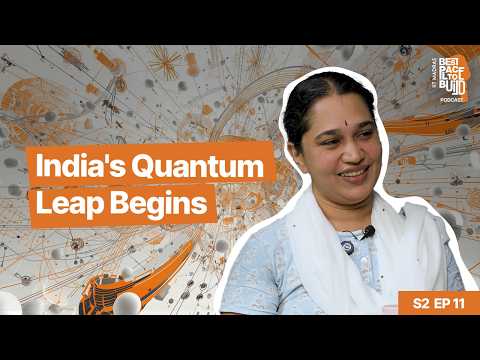
Quantum Mechanics, qubits, superposition & superconductors with Prof. Prabha Mandayam | BP2B S2 E11
Prabha Mandayam (guest)
In this episode of Best Place To Build, featuring Prabha Mandayam, Quantum Mechanics, qubits, superposition & superconductors with Prof. Prabha Mandayam | BP2B S2 E11 explores quantum computing basics, hardware progress, and India’s path forward today Prof. Prabha Mandayam explains qubits via the Bloch-sphere intuition—superposition expands information states beyond classical 0/1 and enables certain algorithmic speedups.
Quantum computing basics, hardware progress, and India’s path forward today
Prof. Prabha Mandayam explains qubits via the Bloch-sphere intuition—superposition expands information states beyond classical 0/1 and enables certain algorithmic speedups.
The conversation traces why quantum computing became strategically important: Deutsch’s early algorithm, Shor’s factoring threat to RSA, and Grover’s quadratic speedup for search/optimization.
A central bottleneck is decoherence (noise) and the resulting need for quantum error correction, which is harder than classical coding because arbitrary quantum states cannot be cloned.
The episode surveys leading hardware architectures—photonic, superconducting, trapped ions, and neutral atoms—highlighting why superconducting platforms currently lead in qubit counts but still fall far short of fault-tolerant scale.
India’s National Quantum Mission is presented as a concrete, hub-based effort (computing, communication, sensing, materials), with near-term deliverables like city-to-city quantum key distribution links and mid-scale prototype processors.
Key Takeaways
A qubit is best understood as a point on a sphere, not a number between 0 and 1.
Mandayam uses the Bloch-sphere picture: classical bits sit at the poles (0 and 1), while quantum states occupy infinitely many surface points parameterized by two angles, enabling superposition states.
Get the full analysis with uListen
Quantum advantage is primarily about reducing computational steps/time, not replacing billions of transistors with a few qubits.
Even with relatively modest qubit counts, certain algorithms can reduce query complexity (e. ...
Get the full analysis with uListen
Shor’s algorithm is the inflection point that made quantum computing a security and geopolitics issue.
Factoring large integers threatens RSA-based public-key encryption; this catalyzed government and industry funding, shifting quantum computing from “toy problems” to strategic infrastructure.
Get the full analysis with uListen
Decoherence is the core engineering obstacle: isolation helps, but control/measurement reintroduce noise.
You want qubits shielded from the environment, yet you must interact with them to compute and read out results—creating a fundamental trade-off that drives hardware design and error-correction needs.
Get the full analysis with uListen
Quantum error correction is harder than classical coding because you cannot copy unknown quantum states.
Classical repetition codes rely on redundancy via copying; the No-Cloning Theorem blocks a “quantum Xerox,” so protection must be achieved through entanglement-based encodings and syndrome-style measurements.
Get the full analysis with uListen
Fault-tolerant quantum computing likely requires orders of magnitude more qubits than today’s demos.
The episode contrasts ~100-qubit proof-of-principle chips with estimates of tens of thousands of ideal qubits (or ~million with error correction overhead) for cryptographically relevant Shor-scale computations.
Get the full analysis with uListen
India can still catch up because the field is young and the mission sets concrete engineering milestones.
Mandayam argues India’s theory base is strong and hardware efforts are being diversified across architectures; deliverables like QKD links (e. ...
Get the full analysis with uListen
Notable Quotes
“Imagine the coin in flight, and let’s say you capture it in a box as it is in flight. That’s a quantum state.”
— Prof. Prabha Mandayam
“Last year, with Google’s, like, 100 qubit experiment… that’s like a first proof of principle that you can put 100 qubits on a chip.”
— Prof. Prabha Mandayam
“Take your friend’s notes… and make a copy of the entire notebook. No, not possible. So you cannot copy quantum information.”
— Prof. Prabha Mandayam
“If you had very ideal qubits… you could, for example, crack today’s RSA with about tens of thousands of qubits… [with] error-corrected qubits… at least a million qubits.”
— Prof. Prabha Mandayam
“Today, it’s very much an engineering problem.”
— Prof. Prabha Mandayam
Questions Answered in This Episode
In your Bloch-sphere explanation, what’s the most common misconception people form about “being between 0 and 1,” and how do you correct it without heavy math?
Prof. ...
Get the full analysis with uListen AI
When you say quantum speedups come from fewer queries/steps, what practical bottleneck usually dominates first in today’s devices: qubit count, gate fidelity, or circuit depth?
The conversation traces why quantum computing became strategically important: Deutsch’s early algorithm, Shor’s factoring threat to RSA, and Grover’s quadratic speedup for search/optimization.
Get the full analysis with uListen AI
You mention factoring 15 and 21 as proofs of principle—what specific missing capability prevents scaling to even a 20-bit number demonstration?
A central bottleneck is decoherence (noise) and the resulting need for quantum error correction, which is harder than classical coding because arbitrary quantum states cannot be cloned.
Get the full analysis with uListen AI
Can you walk through (conceptually) how syndrome measurements let quantum error correction work without violating the No-Cloning Theorem?
The episode surveys leading hardware architectures—photonic, superconducting, trapped ions, and neutral atoms—highlighting why superconducting platforms currently lead in qubit counts but still fall far short of fault-tolerant scale.
Get the full analysis with uListen AI
Among superconducting, trapped-ion, neutral-atom, and photonic approaches, what single engineering breakthrough would most quickly change the “leading architecture” ranking?
India’s National Quantum Mission is presented as a concrete, hub-based effort (computing, communication, sensing, materials), with near-term deliverables like city-to-city quantum key distribution links and mid-scale prototype processors.
Get the full analysis with uListen AI
Transcript Preview
[upbeat music] It's too much information.
I'm going, I'm going, I'm going to share what I understood. [chuckles]
Yeah.
I'm sure I'm wrong.
But imagine the coin in flight, and let's say you capture it in a box as it is in flight. That's a quantum state. So I should tell you that I was one of those people in 2000 who actually did not write the JEE exam.
Okay.
So, you know, I have never thought about this as is there a, you know, career path here? Is there-
Mm.
It's more about what has interested me. Last year, with Google's, like, 100 qubit experiment, it has more or less come. That's like a first proof of principle that you can put 100 qubits on a chip. You can connect them all up in some way that makes them resilient to this error. Take your friend's notes, right, the night before the exam, and make a copy of the entire notebook. No, not possible. So you cannot copy quantum information.
Hi, this is Amrit. We are at IIT Madras, my alma mater, and India's top university for people who like to build. We are here to meet some builders, ask them: What are you building? What does it take to build? And what makes IIT Madras the best place to build? [upbeat music] Hello, and welcome to the Best Place to Build Podcast. Today, we are sitting with Professor Prabha Mandayam, a renowned physicist and a faculty here at the Physics Department at IIT Madras. Her area of interest is quantum information and error correction. She's an author of a book, Functional Analysis of Quantum Information Theory, and her NPTEL lectures on quantum computing are very popular. You can see I'm looking into my notes, so I know nothing about this subject, so it's an opportunity for me to learn. Welcome to the podcast, Professor.
Thank you, Amrit. Thank you for having me here.
Uh, Professor, I don't know anything about this, so, um, it's a challenge I'm offering to you. [chuckles] Please, can you tell me about quantum computing in the next half an hour, so that I can survive the next ten years?
[chuckles] Um, yes. Uh, certainly, I will try. So, um, okay, so quantum computing, as the name suggests, is that you try to compute with objects, physical objects, that are truly quantum in nature, right? So a very, um, simple example that, uh, or a simple picture that I can give you is, uh, a kind of geometric picture to contrast how a quantum bit will be different from a classical bit, right? So we- in classical computers, you know that we encode in zeros and ones, right?
Correct.
Classical communication is zeros and ones, right? Yeah.
Yeah, so in, in what I know of classical computers is that, um, we convert everything to binary. There are a set of binary operations-
Correct
... a set of algorithms-
Yeah
... that work on those binary operations.
Install uListen to search the full transcript and get AI-powered insights
Get Full TranscriptGet more out of YouTube videos.
High quality summaries for YouTube videos. Accurate transcripts to search & find moments. Powered by ChatGPT & Claude AI.
Add to Chrome