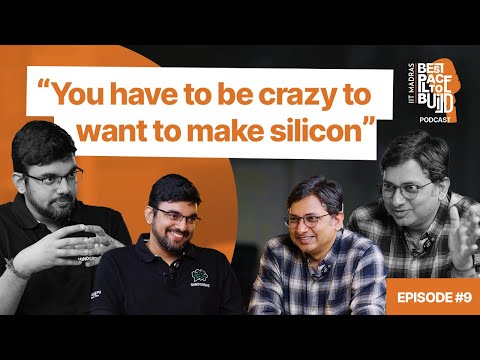
Sharan Srinivas | CTO, Mindgrove Technologies | “You have to be crazy to want to make silicon”| Ep.9
Sharan Srinivas (guest)
In this episode of Best Place To Build, featuring Sharan Srinivas, Sharan Srinivas | CTO, Mindgrove Technologies | “You have to be crazy to want to make silicon”| Ep.9 explores mindgrove CTO explains building chips, India’s mission, and failure. Mindgrove raised about $8M in Series A, with returning investors doubling down and new participation from Rocketship VC and Mela Ventures, plus approval under India’s Design Linked Incentive (DLI) scheme worth ~₹15 crore upon milestones.
Mindgrove CTO explains building chips, India’s mission, and failure.
Mindgrove raised about $8M in Series A, with returning investors doubling down and new participation from Rocketship VC and Mela Ventures, plus approval under India’s Design Linked Incentive (DLI) scheme worth ~₹15 crore upon milestones.
The episode breaks down the semiconductor value chain—fabless design, foundries, and OSAT/ATMP packaging/testing—using concrete examples like TSMC (manufacturing), ASML (lithography machines), and the ‘die vs package’ distinction.
Srinivas explains why ‘nm’ is now largely a node label, why leading-edge (e.g., 3nm) improves performance-per-watt but is exponentially costlier, and why 28nm is a practical “Goldilocks node” for embedded and industrial use cases.
Mindgrove’s first commercial chip, SecureIoT (28nm), is positioned as India’s first commercial-grade high-performance microcontroller SoC built around the IIT Madras Shakti C-Class processor, bridging academic demonstration to sellable product.
The discussion frames India’s semiconductor push as both strategic sovereignty (“new oil”) and employment/economic ecosystem building, emphasizing that fabs seed wide supplier and services job creation rather than being the sole job engine.
Key Takeaways
Fabless startups win by focusing on design, outsourcing manufacturing complexity.
Mindgrove positions itself as a pure-play design house: it designs the chip, uses external foundries for fabrication and external OSAT/ATMP partners for assembly/testing, then sells packaged chips—mirroring models like Qualcomm and NVIDIA.
Get the full analysis with uListen
‘Nanometer’ is no longer a literal transistor dimension—treat it as a capability/cost tier.
Srinivas notes that 3nm is partly branding and no longer maps cleanly to a single physical dimension, but it still signals higher density and better performance-per-watt—at dramatically higher tool and manufacturing costs.
Get the full analysis with uListen
28nm remains highly competitive for embedded markets where constraints differ from smartphones.
Embedded/industrial systems often prioritize voltage ranges, electrical characteristics, reliability, and cost over extreme compute density; Mindgrove calls 28nm a “Goldilocks node” that balances performance and power without leading-edge expense.
Get the full analysis with uListen
Commercial-grade silicon is fundamentally different from a research demonstrator.
RISE/Shakti proved feasibility with academic tooling and tape-outs, but commercialization requires sellable-grade reliability, packaging/testing readiness, and use of commercial EDA licenses—turning “it works” into “it ships.”
Get the full analysis with uListen
SoC value comes from integrating the whole system, not just the CPU core.
SecureIoT is framed as a full “system on chip” including the processor, memories/caches, peripherals, and interconnect—similar in concept to Snapdragon, but far smaller and targeted to specific embedded use cases.
Get the full analysis with uListen
Government programs help most when they remove obstacles and let teams execute.
Despite “government speed,” Srinivas describes DLI/ISM engagement as responsive to feedback, and stresses the need for startups to be “systematic to the point of paranoia” on compliance, often dedicating a team to it.
Get the full analysis with uListen
The ‘safe to fail’ ecosystem matters, but founders must still accept real failure risk.
He argues semiconductors are a high-stakes domain with huge incumbents and failure rates like any startup sector; progress depends on grit plus the judgment to stop when something truly doesn’t work.
Get the full analysis with uListen
Notable Quotes
““You have to be a special grade of mental… to be able to want to make silicon in today’s world.””
— Sharan Srinivas
““It will come when you make it.””
— Sharan Srinivas (quoting Prof. V. Kamakoti’s response about getting a Shakti chip)
““The ecosystem is set up for you to fail safely. Are you willing to accept that failure?””
— Sharan Srinivas
““A three nanometer node is exponentially more expensive than a 28 nanometer.””
— Sharan Srinivas
““I’ll give you $100 million to spend. How long will it take you to spend? … Five minutes flat.””
— Sharan Srinivas
Questions Answered in This Episode
For SecureIoT, what specific hardware security primitives are on-chip (e.g., secure boot, key storage, crypto accelerators), and which threats are you explicitly targeting?
Mindgrove raised about $8M in Series A, with returning investors doubling down and new participation from Rocketship VC and Mela Ventures, plus approval under India’s Design Linked Incentive (DLI) scheme worth ~₹15 crore upon milestones.
Get the full analysis with uListen AI
You chose 28nm as a “Goldilocks node”—what were the concrete trade-offs (cost, power, analog/IO, availability of fabs/OSAT, longevity) that ruled out 40/65/90nm or 22nm?
The episode breaks down the semiconductor value chain—fabless design, foundries, and OSAT/ATMP packaging/testing—using concrete examples like TSMC (manufacturing), ASML (lithography machines), and the ‘die vs package’ distinction.
Get the full analysis with uListen AI
What were the biggest changes required to move Shakti C-Class from an IITM technology demonstrator to a commercial-grade microcontroller SoC?
Srinivas explains why ‘nm’ is now largely a node label, why leading-edge (e. ...
Get the full analysis with uListen AI
On Vision SoC, what is the planned compute mix (CPU/DSP/NPU/ISP), and which computer-vision workloads (encoding/analytics/inference) are you optimizing for first?
Mindgrove’s first commercial chip, SecureIoT (28nm), is positioned as India’s first commercial-grade high-performance microcontroller SoC built around the IIT Madras Shakti C-Class processor, bridging academic demonstration to sellable product.
Get the full analysis with uListen AI
You mentioned manufacturability checks (DRC/dry runs)—what were the most common late-stage design issues you had to catch before tape-out?
The discussion frames India’s semiconductor push as both strategic sovereignty (“new oil”) and employment/economic ecosystem building, emphasizing that fabs seed wide supplier and services job creation rather than being the sole job engine.
Get the full analysis with uListen AI
Transcript Preview
The ecosystem is set up for you to fail safely.
Mm.
Are you willing to accept that failure? Shashwat and I spent about a year just figuring out what to build. You also need support from your PhD guide. Your PhD guide can make and break- make or break your career. That creates a question: Why are all silicon making companies that large? [upbeat music]
Hi, my name is Amrit. We've heard that IIT Madras is the best place to build. [upbeat music] So we've come down to the Sudha and Shankar Innovation Hub. We want to meet some people. These are builders. We want to talk to them about their work, and also ask them, what makes IIT Madras the best place to build? [upbeat music] Hi, welcome to the Best Place to Build podcast. I'm sitting with Sharan. Sharan is the CTO of one of the hottest new startups from IIT Madras, called Mindgrove. They're in the semiconductor space, and we'll learn from him what he does, and about the semiconductor space, and about the build culture at IIT Madras. He's at the center of it all. Hi, Sharan, welcome.
Thank you for having me here. It's a pleasure to come back to this space.
Yeah. Um, firstly, congratulations on your funding announcement. It's a big deal, and earlier this year you got the DLI nod also. Can you talk to us about your funding announcement?
Sure. We've, uh... We are actually quite grateful that, um, we've had almost every investor who invested in us in the previous round, doubling down on us. We take that as a sign that what we are- we are moving in the right direction, and we are trying to do the right thing, um, and then as a, as a vote of confidence. In addition, we have two new investors, uh, Rocketship VC and Mela Ventures, who will be, uh, joining the cap table of Mindgrove Technologies after our Series A round. And, um, we have, uh, raised a total of about 8 million US dollars, and that's, that's the capital we have to take things forward. We, we took our seed round with the pitch that we wanted to make a chip. Now, the, the, the, the pitch is, we want to keep making more chips, and we want to sell the ones that, that we have actually made. So that eight, $8 million, uh, in order to get around to do that, and we additionally have, uh, been approved for the DLI scheme, or the Design Linked Incentive scheme, that is offered by the government of India. This is approximately $2 million, INR, uh, 15 crores worth of, uh, uh, incentives if you meet certain milestones, and we have been, quite thankfully, uh, approved for that, so quite chuffed. But looking forward to the, the, the challenges that are almost certainly going to come, come at us, uh, in the process of doing this.
And you also have some really good quality VCs. Uh, Rocketship, of course, IITM alumnus themselves. Um, there's Peak XV, there's Speciale. Speciale being, um, an investor who has repeatedly invested in IIT Madras-based, uh, tech startups. That's amazing. Yeah, and these are brave investors, because some of these will require 10 years, these, these company... Maybe not tech, but maybe, uh, to, uh, sort of pay back.
Install uListen to search the full transcript and get AI-powered insights
Get Full TranscriptGet more out of YouTube videos.
High quality summaries for YouTube videos. Accurate transcripts to search & find moments. Powered by ChatGPT & Claude AI.
Add to Chrome