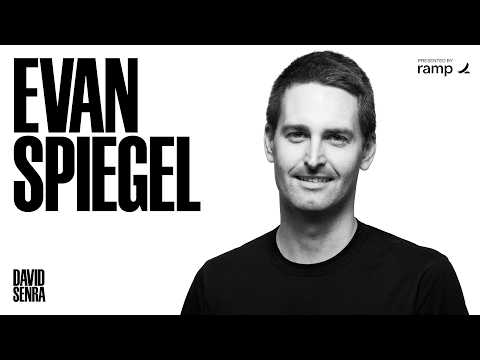
Evan Spiegel: Turning Down a Billion Dollars
David Senra (host)
In this episode of David Senra, featuring David Senra, Evan Spiegel: Turning Down a Billion Dollars explores evan Spiegel on vision-led products, culture, moats, and Specs future Spiegel traces his product philosophy to studying photography history (especially Edwin Land) and to an upbringing blending arts, sciences, and empathy-driven community service.
Evan Spiegel on vision-led products, culture, moats, and Specs future
Spiegel traces his product philosophy to studying photography history (especially Edwin Land) and to an upbringing blending arts, sciences, and empathy-driven community service.
Snapchat was intentionally built as a messaging-first alternative to performative social media, emphasizing the camera, ephemerality, and reduced public judgment to improve real relationships.
After Facebook cloned Snapchat early, Snap learned “no moat in software” and shifted to defensible systems: network effects in communication, creator/content ecosystems, and an AR developer platform.
Snap’s culture aims to be “uncompromising and kind,” using rapid, high-volume design iteration and candid feedback without fear to sustain creativity at speed.
AI is radically compressing the design-to-code cycle and expanding engineering capacity, enabling Snap to ship faster, diversify revenue (notably subscriptions), and launch new standalone apps while funding Specs hardware R&D.
Key Takeaways
Start with humanity, not the technology.
Spiegel frames Snap’s inventions (ephemerality, Stories, AR) as responses to how people feel using products—judged, distracted, or disconnected—then builds features to reduce those harms and strengthen relationships.
Get the full analysis with uListen
Distribution and feedback loops beat “perfect product” work.
Future Freshman failed because the team overbuilt for 18 months and ignored distribution; the App Store later became Snap’s scalable channel, and rapid prototyping became core to how Snap ships.
Get the full analysis with uListen
Assume software will be copied; build what’s hard to clone.
The Facebook Poke clone taught Snap that features aren’t defensible; Snap doubled down on messaging network effects, creator ecosystems, and AR platform tooling—systems that compound over time.
Get the full analysis with uListen
Network effects are about active connections, not node count.
Snap’s growth thesis is that one best friend can represent a huge share of communication value, allowing a smaller network to be highly valuable if it captures the most-used relationships.
Get the full analysis with uListen
High-velocity idea generation is a competitive advantage.
Weekly design critiques review hundreds of concepts; most never ship, but volume increases the chance of breakthroughs and reduces toxic attachment to single ideas.
Get the full analysis with uListen
Kindness enables truth; niceness avoids it.
Snap’s “kind, smart, creative” values treat candid feedback as care for someone’s growth, while aiming to remove fear so teams can iterate and critique without shutting down creativity.
Get the full analysis with uListen
Hardware success requires owning differentiated parts of the stack.
For Specs, Snap focuses control where it can uniquely improve customer experience (e. ...
Get the full analysis with uListen
Premium-first positioning funds durable hardware R&D.
Spiegel argues durable hardware businesses start with enthusiasts and premium margins (Apple/Tesla pattern), then reinvest margins into R&D to widen the lead—hard to do starting low-margin mass market.
Get the full analysis with uListen
AI is a resource unlock that favors idea-rich, resource-constrained teams.
Spiegel calls AI “the best thing that’s ever happened to Snapchat,” because it expands engineering throughput and shortens design-to-code cycles—critical when competing with “infinite resources” incumbents.
Get the full analysis with uListen
Diversifying revenue reduces strategic fragility.
Snap is shifting its ad engine from an enterprise-heavy, upper-funnel mix to SMB performance advertising, while scaling subscriptions (Snapchat+ ~25M subs) to align revenue more directly with user value.
Get the full analysis with uListen
Operational cadence should surface problems early and company-wide.
Spiegel uses structured forums (inspired by Walmart’s “In it to Win it”) plus walk-arounds to ensure issues aren’t solved locally and forgotten, but escalated and fixed systemically.
Get the full analysis with uListen
Keep distinct operating systems for hardware vs. software businesses.
Specs is run as a separate subsidiary because hardware demands precision and long lead times, unlike software where mistakes can be fixed same-day; separation protects focus, rigor, and brand positioning.
Get the full analysis with uListen
Notable Quotes
“Technology gets more, and more, and more personal.”
— Evan Spiegel
“Snapchat opens into your experience of the world… not a feed of content from other people.”
— Evan Spiegel
“We learned very, very early on that there’s no moat in software.”
— Evan Spiegel
“The best way to have a good idea is to have lots of ideas.”
— Evan Spiegel
“There’s a big difference between kind and nice… Kind is about wanting the best for them.”
— Evan Spiegel
Questions Answered in This Episode
Snapchat was built as “messaging, not social media”—what product decisions today still preserve that distinction as feeds and creators grow?
Spiegel traces his product philosophy to studying photography history (especially Edwin Land) and to an upbringing blending arts, sciences, and empathy-driven community service.
Get the full analysis with uListen AI
You say the first six months of Stories had low usage; what specifically did you change (UI, onboarding, incentives) before it inflected?
Snapchat was intentionally built as a messaging-first alternative to performative social media, emphasizing the camera, ephemerality, and reduced public judgment to improve real relationships.
Get the full analysis with uListen AI
If software has no moat, what are Snap’s current “hard-to-copy” assets ranked by importance: messaging network effects, AR platform, creator/content ecosystem, or hardware IP?
After Facebook cloned Snapchat early, Snap learned “no moat in software” and shifted to defensible systems: network effects in communication, creator/content ecosystems, and an AR developer platform.
Get the full analysis with uListen AI
How do you measure whether Snapchat improves wellbeing versus harms it, and what metrics (retention, sentiment, close-friend interactions) best predict that outcome?
Snap’s culture aims to be “uncompromising and kind,” using rapid, high-volume design iteration and candid feedback without fear to sustain creativity at speed.
Get the full analysis with uListen AI
In the weekly design critique with hundreds of ideas, what are the top 3 filters that decide what ships (10x test, user emotion, revenue impact, technical feasibility)?
AI is radically compressing the design-to-code cycle and expanding engineering capacity, enabling Snap to ship faster, diversify revenue (notably subscriptions), and launch new standalone apps while funding Specs hardware R&D.
Get the full analysis with uListen AI
Transcript Preview
[upbeat music] Super excited to talk to you. Uh, we've been talking a bunch before we started recording. I did a podcast on you, like almost 10 years ago. It's episode, I think, 22 of Founders based on this book on How to Turn Down a Billion Dollars. The thing that stuck out to me the most that w- when I read that book, 'cause a lot of that story takes place when you're just like still in college, and you're talking about two of your entrepreneur heroes. And Steve Jobs, makes sense, my entrepreneur hero too. But you mentioned this guy named Edwin Land, and I'm reading this, I'm like, "How the fuck does a 21-year-old kid even know who Edwin Land is?" I've done like-
[laughs]
... 10 podcasts on him, read every single biography. Tell me what, like how you discovered Edwin Land, and what you admired about him.
Yeah. I, I think, you know, he's so central to the history of photography, and so, you know, as we've set out to try to reinvent the camera and how people express themselves with the camera, we studied a lot, you know, about the evolution of the camera over time. I mean, one of the funny stories that we found out, the first selfie ever was taken by a guy named Robert Cornelius, and the c- my co-founder, Bobby, his name is Robert Cornelius Murphy. So like we [laughs]
[laughs]
... we found just like by un- unpacking like the history of, of photography, a lot of interesting, you know, similarities and parallels, and we've learned a ton from founders like Edwin Land, who transformed photography really by focusing on building amazing products, and thinking about, you know, how to make sure those products fit into people's lives and uplifted humanity. I think, you know, if you look at instant photography and the role that that played in people's lives, Edwin thought of the camera as something that was incredibly personal, right? And, and I think, um, as we've looked at the, the sort of trajectory of technology, over the long arc of time, technology gets more, and more, and more, and more personal. And so I think as technology gets more deeply interwoven in our lives, the founders who are thinking about making technology more personal, uh, and how it, you know, how the, how the things they're inventing like fit into and support humanity, I think that's a real advantage.
But how does a 21-year-old kid decide, 'cause you even said it in the book, that you're like, "I wanna build a company at the intersection of technology and liberal arts." What was happening that you were interested, like, in doing that?
Part of it was my background growing up. So I went to school, uh, in Santa Monica here, uh, you know, and, and, uh, at a, a school called Crossroads. Uh, Crossroads, you know, it's like the, the full name for Crossroads is actually Crossroads School for Arts and Sciences. So it actually is, you know, the intersection of science and, and art together. And actually, a lot of what the school is focused on is developing empathy, building empathy, and they have this thing called council, for example, where you sit with about 12 other students and, you know, speak from the heart, uh, and take turns expressing yourself. And the school is really oriented on, on how you build strong relationships, build empathy with other people. And so I, I literally, I, I grew up at a school that was so focused on the intersection of art and science, but then also wrapped all of it in, you know, a commitment to humanity, to understanding one another, to building relationships, you know, to giving back. I mean, the school is very anchored in community service. Uh, our, our ki- three of our kids go there, uh, now, which is fun. Uh, some of the teachers are still there. But I think a lot of it was from my upbringing and that being a real focus. And then, you know, as I, as I got a bit older and I got, you know, into things like graphic design and I built my own computer, I was always sort of working at that intersection of, of art and, and technology.
Install uListen to search the full transcript and get AI-powered insights
Get Full TranscriptGet more out of YouTube videos.
High quality summaries for YouTube videos. Accurate transcripts to search & find moments. Powered by ChatGPT & Claude AI.
Add to Chrome