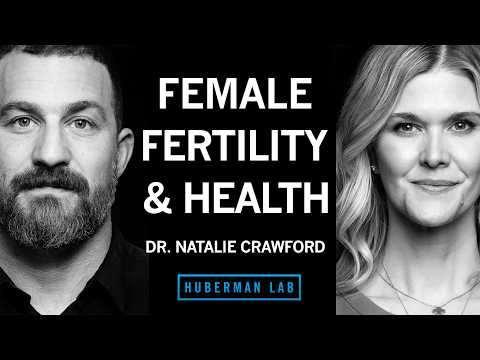
How Women Can Improve Their Fertility & Hormone Health | Dr. Natalie Crawford
Dr. Natalie Crawford (guest), Andrew Huberman (host)
In this episode of Huberman Lab, featuring Dr. Natalie Crawford and Andrew Huberman, How Women Can Improve Their Fertility & Hormone Health | Dr. Natalie Crawford explores science-based fertility and hormone strategies: testing, lifestyle, and key myths Fertility is framed as a broad health marker tied to metabolic health, chronic inflammation, and long-term risks like cardiovascular disease and earlier mortality, rather than only the ability to get pregnant.
Science-based fertility and hormone strategies: testing, lifestyle, and key myths
Fertility is framed as a broad health marker tied to metabolic health, chronic inflammation, and long-term risks like cardiovascular disease and earlier mortality, rather than only the ability to get pregnant.
Crawford advocates proactive assessment—especially AMH testing and ovulation tracking—to guide earlier, more informed reproductive decisions instead of waiting for “failure” to meet infertility definitions.
The episode clarifies what can and cannot be tested: egg quantity (ovarian reserve) is approximated by AMH, while egg quality is inferred mainly from age, metabolic health, and clinical context.
Lifestyle “non-negotiables” (sleep, stress, strength/muscle, nutrition, and toxin reduction) are positioned as major levers for egg/sperm outcomes, with specific warnings about cannabis, nicotine, and certain anti-inflammatories around ovulation.
The discussion covers fertility preservation and assisted reproduction (egg freezing, IVF, embryo banking), addressing common myths, ethical debates, and access/insurance barriers, while highlighting patient choice and autonomy.
Key supplemental and emerging interventions (prenatal nutrients, CoQ10, vitamin D, omega-3s; and exploratory tools like GLP-1s, HGH add-on, PRP, red light) are reviewed with emphasis on evidence strength and appropriate use cases.
Key Takeaways
Use fertility as an early warning signal for broader health issues.
Crawford links infertility with higher rates of metabolic syndrome, cancer, cardiovascular events, stroke, and earlier death—often because infertility can be an early sign of inflammation or insulin resistance rather than the direct cause.
Get the full analysis with uListen
Get an AMH test proactively if you might want children.
AMH estimates ovarian reserve (egg quantity), not egg quality; knowing whether reserve is normal/low can change timelines and choices (try sooner, freeze eggs/embryos, investigate causes). ...
Get the full analysis with uListen
Track ovulation—not just periods—to detect early hormone/ovulation disorders.
Regular bleeding can miss early problems like a short luteal phase (<11 days), which may signal thyroid/prolactin issues, PCOS, low reserve, or other causes; ovulation tracking provides more sensitive insight than calendar-based cycle tracking.
Get the full analysis with uListen
Egg freezing/IVF does not “use up” eggs faster or cause early menopause.
Stimulation recruits the cohort of follicles already “out of the vault” that month; IVF aims to rescue more of that cohort from atresia rather than tapping the long-term reserve.
Get the full analysis with uListen
Avoid NSAIDs around ovulation when trying to conceive.
NSAIDs (e. ...
Get the full analysis with uListen
Cannabis is a high-impact, modifiable fertility risk for both partners.
She describes cannabis as strongly detrimental to sperm parameters and embryo development, associated with higher miscarriage rates, fewer eggs retrieved in women, lower fertilization, and reduced live-birth outcomes; she emphasizes stopping cannabis during “trimester zero” and pregnancy.
Get the full analysis with uListen
Reduce high-frequency endocrine disruptor exposures, especially fragrances and thermal receipts.
Evidence from cohort studies links endocrine disruptors to poorer IVF markers and outcomes; practical advice includes choosing “fragrance-free” (not merely “unscented”) products and reducing/handling thermal receipts due to BPA exposure risk.
Get the full analysis with uListen
Prior pregnancy can be ‘protective,’ but secondary infertility is still real.
She cites cohort data suggesting fecundability stays higher longer for women who previously had a live birth with the same partner, yet age, sperm changes, and time-dependent diseases (endometriosis/adenomyosis) can still lead to difficulty conceiving again.
Get the full analysis with uListen
Plan contraception transitions with fertility timelines in mind.
Most contraception doesn’t raise long-term infertility rates, but the Depo-Provera shot can suppress ovulation for up to ~18 months after one dose, and progestin IUD removal may require ~6 months for optimal endometrial recovery.
Get the full analysis with uListen
Be cautious with lab testing if using high-dose biotin supplements.
Biotin ≥300 mcg for about a week can distort steroid and related lab assays (estradiol, progesterone, hCG, TSH, testosterone), potentially misleading fertility monitoring and hormone evaluation.
Get the full analysis with uListen
Notable Quotes
“Fertility is a health marker.”
— Dr. Natalie Crawford
“If you have infertility, you have increased rates of metabolic syndrome, cancer, heart attack, stroke, and dying early.”
— Dr. Natalie Crawford
“Menopause at its purest is ovarian failure.”
— Dr. Natalie Crawford
“We’re withholding a seventy-nine dollar test.”
— Dr. Natalie Crawford
“If you’re trying to get pregnant, you can take [NSAIDs] only when you’re on your period… but we don’t want you taking them for the rest of the cycle because you can prevent ovulation.”
— Dr. Natalie Crawford
Questions Answered in This Episode
AMH helps estimate egg quantity, not quality—how should someone interpret a “low AMH but regular cycles” result without panicking or dismissing it?
Fertility is framed as a broad health marker tied to metabolic health, chronic inflammation, and long-term risks like cardiovascular disease and earlier mortality, rather than only the ability to get pregnant.
Get the full analysis with uListen AI
What specific ovulation-tracking methods (LH strips, basal temp, cervical mucus, wearables) does Crawford find most reliable for detecting luteal phase issues in real-world patients?
Crawford advocates proactive assessment—especially AMH testing and ovulation tracking—to guide earlier, more informed reproductive decisions instead of waiting for “failure” to meet infertility definitions.
Get the full analysis with uListen AI
Crawford recommends removing a progestin IUD ~6 months before trying—what signs (bleeding patterns, ultrasound findings) indicate endometrial recovery is adequate sooner or needs longer?
The episode clarifies what can and cannot be tested: egg quantity (ovarian reserve) is approximated by AMH, while egg quality is inferred mainly from age, metabolic health, and clinical context.
Get the full analysis with uListen AI
Given the strong claims about cannabis harming sperm/embryos, what is the minimum abstinence window she recommends for men and women (e.g., 90 days for sperm) and what data supports that timing?
Lifestyle “non-negotiables” (sleep, stress, strength/muscle, nutrition, and toxin reduction) are positioned as major levers for egg/sperm outcomes, with specific warnings about cannabis, nicotine, and certain anti-inflammatories around ovulation.
Get the full analysis with uListen AI
How should couples balance “trimester zero” lifestyle optimization against the risk of waiting too long with advancing maternal age?
The discussion covers fertility preservation and assisted reproduction (egg freezing, IVF, embryo banking), addressing common myths, ethical debates, and access/insurance barriers, while highlighting patient choice and autonomy.
Get the full analysis with uListen AI
Transcript Preview
Everybody should get an AMH test. I think it's a very important marker. If you are listening to this and you want kids one day, ask your doctor for this test. It is not a test of egg quality. And we talked about what egg quality is, right? Genetics and egg competency, but it is a ch- of how many eggs you have, and that knowledge can be really impactful for how you view your future and your plan.
Welcome to the Huberman Lab podcast, where we discuss science and science-based tools for everyday life. [guitar music] I'm Andrew Huberman, and I'm a professor of neurobiology and ophthalmology at Stanford School of Medicine. My guest today is Dr. Natalie Crawford. Dr. Natalie Crawford is a double board-certified physician specializing in obstetrics and gynecology, fertility, and reproductive health. Today, we discuss the actionable steps that all women can take to improve their reproductive and hormone health, both to enhance probability of successful pregnancy, but also because fertility and hormone health are strong correlates of general health and longevity. Dr. Crawford shares what all women, regardless of age or reproductive goals, can do to enhance their health using lifestyle, nutrition, supplementation, and prescription medical tools that she indeed uses in her practice. We also have a very honest discussion about biological versus chronological age and fertility, why age is not just a number, but also why it is that many women do successfully conceive in their 40s. Of course, there's a lot of information online nowadays about women's hormones, fertility, and health. Today, thanks to Dr. Crawford, you'll learn what is known and documented and what she has herself consistently observed clinically in her practice about women's health and fertility. Few, if any people, have Dr. Crawford's training, clinical acumen, understanding of the new research, and incredible ability to communicate the well and lesser-known actionable steps for improving female health. Dr. Crawford also has a new book out entitled The Fertility Formula: Take Control of Your Reproductive Future, which again focuses on reproductive health, but also hormone health and how both of those things impact female health in the short and long term. Before we begin, I'd like to emphasize that this podcast is separate from my teaching and research roles at Stanford. It is, however, part of my desire and effort to bring zero cost to consumer information about science and science-related tools to the general public. In keeping with that theme, today's episode does include sponsors. And now for my discussion with Dr. Natalie Crawford. Dr. Natalie Crawford, welcome back.
Thank you so much for having me. I'm thrilled to be here.
And congratulations on your new book-
Thank you
... The Fertility Formula. It's no small feat to complete a book, and it's, and it's especially a big feat to complete a book that offers people so much advice, not just people who wanna get pregnant, but also looking at things through the lens of fertility as an important health metric.
Install uListen to search the full transcript and get AI-powered insights
Get Full TranscriptGet more from every podcast
AI summaries, searchable transcripts, and fact-checking. Free forever.
Add to Chrome