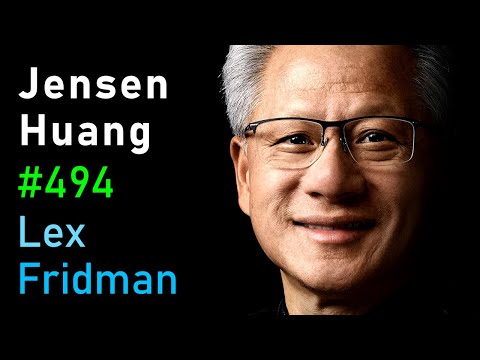
Jensen Huang: NVIDIA - The $4 Trillion Company & the AI Revolution | Lex Fridman Podcast #494
Lex Fridman (host), Jensen Huang (guest)
In this episode of Lex Fridman Podcast, featuring Lex Fridman and Jensen Huang, Jensen Huang: NVIDIA - The $4 Trillion Company & the AI Revolution | Lex Fridman Podcast #494 explores jensen Huang on co-design, scaling laws, power, and leadership philosophy Huang argues that AI performance now depends on distributing work across massive systems, making extreme co-design across chips, networking, power, cooling, software, and algorithms a necessity rather than an optimization.
Jensen Huang on co-design, scaling laws, power, and leadership philosophy
Huang argues that AI performance now depends on distributing work across massive systems, making extreme co-design across chips, networking, power, cooling, software, and algorithms a necessity rather than an optimization.
He describes NVIDIA’s organizational and leadership style as a company-wide, always-on co-design process, enabled by large cross-disciplinary staffs, group problem-solving, and decision-making through shared “belief shaping.”
He frames AI progress as multiple interacting scaling laws (pre-training, post-training with synthetic data, test-time reasoning, and agentic scaling), concluding that compute—and especially efficient compute—remains the core driver.
He identifies power availability and efficiency as the key near-term limiter, advocating both tokens-per-watt improvements and better grid contracting that uses “idle” capacity via graceful service degradation.
He claims NVIDIA’s moat is CUDA’s install base plus rapid execution and broad ecosystem integration, and he sketches a future where “AI factories” produce valuable tokens that expand compute demand and potentially justify multi-trillion-dollar outcomes.
Key Takeaways
Rack-scale AI forces co-design across the entire stack.
Huang’s core claim is that once workloads are sharded across thousands of nodes, networking, memory, software, and even cooling/power become first-order constraints; optimizing only the GPU yields diminishing returns due to Amdahl’s law.
Get the full analysis with uListen
NVIDIA’s org chart is built to mirror the product: constant cross-discipline collaboration.
He runs with a very large direct staff and avoids one-on-ones so problems are attacked by many specialties at once; the company “does extreme co-design all the time,” not just during product cycles.
Get the full analysis with uListen
CUDA succeeded because install base beats elegance.
He argues platform success is primarily determined by developer reach and long-term trust, citing x86 as proof; putting CUDA on GeForce was painful (gross margin hit, market cap drawdown) but created the mass adoption foundation.
Get the full analysis with uListen
Scaling laws didn’t end— they multiplied into a loop.
Huang lays out pre-training, post-training (increasingly synthetic data), test-time (reasoning/search), and agentic scaling (spawning teams of agents) that feed back into new data and training cycles.
Get the full analysis with uListen
Inference will not be ‘easy’ because reasoning is compute-intensive.
He rejects the idea that inference commoditizes into small, simple chips, saying “thinking is hard,” and expects test-time scaling plus agents to drive heavy compute and new system architectures.
Get the full analysis with uListen
Power is the practical ceiling; efficiency and grid contracts are levers.
He pushes tokens-per-second-per-watt improvements via co-design, but also proposes using existing grid slack most of the year by relaxing “six nines” contracts and designing data centers that degrade gracefully under rare peak conditions.
Get the full analysis with uListen
NVIDIA’s moat is (1) CUDA install base and (2) ecosystem breadth plus execution velocity.
He claims developers target CUDA first because it’s everywhere, improves rapidly, and will be supported indefinitely; NVIDIA also integrates vertically for optimization while integrating horizontally into every major cloud and industry segment.
Get the full analysis with uListen
Notable Quotes
“Inference is thinking, and I think thinking is hard. Thinking is way harder than reading.”
— Jensen Huang
“Install base defines an architecture, not—everything else is secondary.”
— Jensen Huang
“We need things to be as complex as necessary but as simple as possible.”
— Jensen Huang
“No company in history has ever grown at a scale that we're growing while accelerating that growth.”
— Jensen Huang
“The iPhone of tokens arrived.”
— Jensen Huang
Questions Answered in This Episode
On ‘extreme co-design’: what are the top 3 cross-domain trade-offs that most often force you to change the chip architecture (e.g., networking vs. memory vs. power)?
Huang argues that AI performance now depends on distributing work across massive systems, making extreme co-design across chips, networking, power, cooling, software, and algorithms a necessity rather than an optimization.
Get the full analysis with uListen AI
You said you avoid one-on-ones and solve problems in groups—what breaks in that model at 60+ direct reports, and how do you prevent ‘everyone listening’ from slowing decisions?
He describes NVIDIA’s organizational and leadership style as a company-wide, always-on co-design process, enabled by large cross-disciplinary staffs, group problem-solving, and decision-making through shared “belief shaping.”
Get the full analysis with uListen AI
On scaling laws: what specific evidence would convince you that test-time scaling (reasoning/search) is hitting diminishing returns compared to more pre-training or post-training?
He frames AI progress as multiple interacting scaling laws (pre-training, post-training with synthetic data, test-time reasoning, and agentic scaling), concluding that compute—and especially efficient compute—remains the core driver.
Get the full analysis with uListen AI
You claim synthetic data removes the data ceiling—what are the failure modes (model collapse, bias amplification, reward hacking) you most worry about in that synthetic loop?
He identifies power availability and efficiency as the key near-term limiter, advocating both tokens-per-watt improvements and better grid contracting that uses “idle” capacity via graceful service degradation.
Get the full analysis with uListen AI
Power: what would a real-world ‘graceful degradation’ SLA look like for an AI data center, and who has to sign off (cloud customers, utilities, regulators) to make it mainstream?
He claims NVIDIA’s moat is CUDA’s install base plus rapid execution and broad ecosystem integration, and he sketches a future where “AI factories” produce valuable tokens that expand compute demand and potentially justify multi-trillion-dollar outcomes.
Get the full analysis with uListen AI
Transcript Preview
The following is a conversation with Jensen Huang, CEO of NVIDIA, one of the most important and influential companies in the history of human civilization. NVIDIA is the engine powering the AI revolution, and a lot of its success can be directly attributed to Jensen's sheer force of will and his many brilliant bets and decisions as a leader, engineer, and innovator. This is the Lex Fridman Podcast. And now, dear friends, here's Jensen Huang. You've propelled NVIDIA into a, uh, new era in AI, moving beyond its focus on chip-scale design to now rack-scale design. And I think it's fair to say that, uh, winning for NVIDIA for a long time used to be about building the best GPU possible, and you still do. But now you've expanded that to extreme co-design of GPU, CPU, memory, networking, storage, power, cooling, software, the rack itself, the pod that you've announced, and even the data center. So let's talk about extreme co-design. What, uh, is the hardest part of, uh, co-designing a system with that many complex components and design variables?
Yeah, thanks for that question. So first of all, the reason why extreme co-design is necessary is because the problem no longer fits inside one computer to be accelerated by one GPU. The problem that you're trying to solve is you would like to go faster than the number of computers that you add. So you added, uh, you know, ten thousand computers, but you would like it to go a million times faster. Then all of a sudden, you have to take the algorithm, you have to break up the algorithm, you have to refactor it, you have to shard the pipeline, you have to shard the data, you have to shard the model. Now, all of a sudden, when you distribute the problem this way, not just scaling up the problem, but you're distributing the problem, then everything gets in the way. This is the Amdahl's law problem, where, uh, the amount of speed up you have for something depends on how much of the total workload it is. And so if computation represents fifty percent of the problem, and I sped up computation infinitely, like a million times, you know, I only sped up the total workload by a factor of two. Now, all of a sudden, not only do you have to distribute the com-computation, you have to, you know, shard the pipeline somehow, uh, you also have to solve the networking problem because you've got all of these computers are all connected together. And so distributed computing at the scale that we do, the CPU is a problem, the GPU is a problem, the networking is a problem, the switching is a problem, and distributing the workload across all these computers are a problem. It's just a massively complex computer science problem. And so we just gotta bring every technology to bear. Otherwise, we scale up linearly, or we scale up based on, uh, the capabilities of Moore's Law, which has largely slowed because Dennard scaling has slowed.
Install uListen to search the full transcript and get AI-powered insights
Get Full TranscriptGet more out of YouTube videos.
High quality summaries for YouTube videos. Accurate transcripts to search & find moments. Powered by ChatGPT & Claude AI.
Add to Chrome