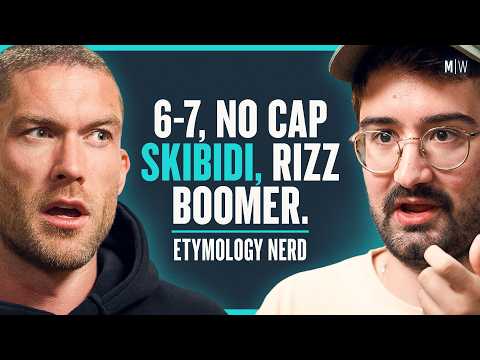
THEY’RE BRAINWASHING YOU! (& other secrets that made you click) - Etymology Nerd
Chris Williamson (host), Adam Aleksic (guest)
In this episode of Modern Wisdom, featuring Chris Williamson and Adam Aleksic, THEY’RE BRAINWASHING YOU! (& other secrets that made you click) - Etymology Nerd explores how platforms, influencers, and AI reshape language, identity, and attention “Word of the year” picks and viral nonsense terms (e.g., “six seven”) are framed as marketing and clip-farming tactics that exploit the attention economy.
How platforms, influencers, and AI reshape language, identity, and attention
“Word of the year” picks and viral nonsense terms (e.g., “six seven”) are framed as marketing and clip-farming tactics that exploit the attention economy.
Different platforms and subcultures generate distinct “dialects,” where slang functions as identity signaling and in-group membership, accelerating language change via algorithms.
Influencer and broadcaster voices are treated as engineered performance styles (floor-holding, uptalk, pacing, clarity) optimized for retention, authority, or excitement.
AI is already feeding back into human language—detectably shifting word choice (e.g., “delve”) and writing patterns—raising concerns about hidden biases and homogenization.
Language change is portrayed less as decay (“brain rot”) and more as adaptive creativity, while warning that distribution incentives privilege arousal (rage, fear, awe) over contentment and nuance.
Key Takeaways
“Word of the year” is often a distribution strategy, not a linguistic verdict.
Adam argues dictionary word-of-the-year selections can be marketing plays that ride controversy and meme momentum, similar to how creators “clip farm” to trigger sharing and engagement.
Get the full analysis with uListen
Absurd viral terms can still “mean” something socially.
Even vacuous phrases like “six seven” are described as meta-commentary on the information ecosystem—designed to provoke questions, generate clips, and signal awareness of the attention panopticon.
Get the full analysis with uListen
Platforms function like “houses” with expected registers and dialects.
Just as you speak differently at your grandmother’s than at a frat house, users adopt platform-specific norms (LinkedIn professionalism, Twitter play, fandom lexicons), with many micro-dialects inside each.
Get the full analysis with uListen
Influencer voices are engineered for retention and positioning.
Lifestyle influencer speech emphasizes warmth/relatability (uptalk, drag-out syllables), while educational influencer speech emphasizes authority (faster pacing, stressed keywords), and MrBeast-style delivery prioritizes shock-and-awe excitement.
Get the full analysis with uListen
Uptalk, filler words, and “No, because…” are attention tools—often unconscious.
“Floor-holding” keeps the listener from “scrolling away” by signaling the speaker isn’t finished; hooky openers create in-medias-res momentum that reduces friction from formal introductions.
Get the full analysis with uListen
AI is measurably changing human language, not just writing.
The conversation highlights evidence that ChatGPT boosts certain “prestige” (often Latin-derived) words like “delve,” which then appear more in human speech and institutional texts, creating a feedback loop of model-to-human influence.
Get the full analysis with uListen
The biggest risk is incentive-driven homogenization and bias, not slang itself.
They push back on “brain rot” narratives, arguing words are neutral tools, but algorithms/AI reward arousing emotions and certain styles—potentially compressing accent diversity, narrowing discourse, and embedding political or cultural bias.
Get the full analysis with uListen
Notable Quotes
““Whenever a dictionary chooses their word of the year, that’s a marketing ploy by big dictionary.””
— Adam Aleksic
““Absurdity is a meaning… The absurdity of the word is its own definition.””
— Adam Aleksic
““Dead silence is very bad on the algorithm… that uptalk… is very good for online hooking.””
— Adam Aleksic
““Every single term now is a search engine optimization term because the algorithm is looking at every single word you use.””
— Adam Aleksic
““We are now being trained by ChatGPT to use different language.””
— Adam Aleksic
Questions Answered in This Episode
What exactly makes “six seven” meaningful beyond being “random,” and how is that different from older nonsense slang?
“Word of the year” picks and viral nonsense terms (e. ...
Get the full analysis with uListen AI
Can you map concrete examples of a TikTok dialect vs Twitter dialect vs LinkedIn dialect—what linguistic features change (syntax, tone, vocabulary, pacing)?
Different platforms and subcultures generate distinct “dialects,” where slang functions as identity signaling and in-group membership, accelerating language change via algorithms.
Get the full analysis with uListen AI
Which parts of the “lifestyle influencer accent” are most predictive of higher retention: uptalk, vowel lengthening, vocal fry, or pacing?
Influencer and broadcaster voices are treated as engineered performance styles (floor-holding, uptalk, pacing, clarity) optimized for retention, authority, or excitement.
Get the full analysis with uListen AI
How does “floor-holding” show up in scripted YouTube versus live streaming, and what are the most common audio cues creators use?
AI is already feeding back into human language—detectably shifting word choice (e. ...
Get the full analysis with uListen AI
Is the ‘AAE → ballroom/gay slang → straight women → mainstream’ pipeline always true, and where does it break or get oversimplified?
Language change is portrayed less as decay (“brain rot”) and more as adaptive creativity, while warning that distribution incentives privilege arousal (rage, fear, awe) over contentment and nuance.
Get the full analysis with uListen AI
Transcript Preview
Six seven was voted word of the year in 2025 from dictionary.com. Is that cheating? Not even a word. Doesn't mean anything.
Well, you have to understand that whenever a dictionary chooses their word of the year, that's a marketing ploy by big dictionary to sell more dictionaries.
[laughs] Yes.
Six seven, of course, is this reference where if you say it, you can go viral. That's the idea behind six seven. That's the whole joke, that this is a possibility of getting clipped, that you can cash in on the virality of it for your own gain, and dictionary.com played that game. But every single person who did it also cashed in on that. There was a Connecticut House Representative, Bill Buckbee, who said six seven on the Connecticut's, uh, state floor. And all these people are doing the exact same thing as Taelon Kinney, who is the, um, basketball player who started the trend, and all the Gen Alpha kids who are cashing in on it, like the six seven kid. All of it was a ploy for virality, and it is a realization that clip farming is the future of distribution online.
Wow, okay. But it's a word that doesn't mean anything, and is specifically designed to be vacuous and to incite the question, "What does that mean?" Is that, is that unique?
I don't believe that it doesn't mean anything.
Right.
I believe even when something is absurd, absurdity is a meaning, and it's absurd for a reason. It's absurd because it's sort of critiquing the general information ecosystem. It's absurd that this would emerge as a word, but that is the meaning. The absurdity of the word is its own definition.
Ah, okay. So it's a story about... It's, it's a meta word in a way.
Yeah, exactly.
Yeah.
It's, it's all a... It's a knowing wink.
Okay.
By uttering six seven, you're playing into the panopticon.
Rage bait was Oxford's 2025 word of the year.
Right. [laughs] They're also... They were rage baiting with that. They, they're hoping that it sparks controversy. Now when people are commenting about the word rage bait being chosen as the word of the year, that drives the word further on Twitter or whatever, X, excuse me, and, uh, and as a result, more people know about Oxford Dictionaries. You gotta remember, this is big dictionary at work.
And slop was another one as well. So a word describing... A, a word that is sloppy describing something that is sloppy being used for people to complain about the fact that, "Look at the state of language today. It's all... Well, it's slop, actually."
Yeah, I, I like to combat that idea that language is slop or brain rot. Um, there's nothing inherently in a word that's good or bad. It's a tool that you can use. But I think we cast our negative associations of social media onto the language. And, uh, yeah, of course, a lot of the videos we see are slop, but that doesn't mean the words themselves are bad for your brain.
Install uListen to search the full transcript and get AI-powered insights
Get Full TranscriptGet more from every podcast
AI summaries, searchable transcripts, and fact-checking. Free forever.
Add to Chrome