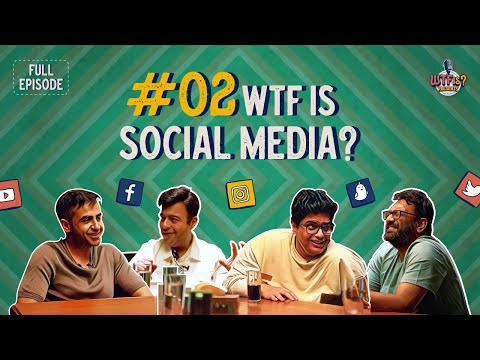
Ep. #2: Secrets of Social Media Success, Mental Health & Distribution Hacks - 3 OGs Reveal All
Umang Bedi (guest), Tanmay Bhat (guest), Nikhil Kamath (host), Nikhil Kamath (host), Aprameya Radhakrishna (guest), Tanmay Bhat (guest), Aprameya Radhakrishna (guest), Nikhil Kamath (host), Aprameya Radhakrishna (guest), Nikhil Kamath (host), Nikhil Kamath (host)
In this episode of Nikhil Kamath, featuring Umang Bedi and Tanmay Bhat, Ep. #2: Secrets of Social Media Success, Mental Health & Distribution Hacks - 3 OGs Reveal All explores dopamine, identity, and algorithms: unpacking social media’s power and costs Nikhil Kamath hosts Tanmay Bhat, Umang Bedi (ex Meta India; Dailyhunt/Josh), and Aprameya Radhakrishna (Koo) to dissect what drives social media behavior—validation, tribal belonging, and algorithmic feedback loops.
Dopamine, identity, and algorithms: unpacking social media’s power and costs
Nikhil Kamath hosts Tanmay Bhat, Umang Bedi (ex Meta India; Dailyhunt/Josh), and Aprameya Radhakrishna (Koo) to dissect what drives social media behavior—validation, tribal belonging, and algorithmic feedback loops.
They trace the evolution from early chat/email and Orkut to Facebook’s real-identity graph, then to TikTok-style content graphs that personalize entertainment at scale and reshape culture and commerce.
The guests share pragmatic “distribution hacks” for creators (topicality, speed, contrarian takes), contrast monetization models (YouTube ad revenue vs brand deals vs creator/user payouts), and explain why video is powerful yet expensive to serve.
The conversation ends on ethics and mental health: envy and insecurity as fuel, Instagram/Twitter as “worst-feeling” platforms, and the difficult responsibility of platforms to moderate harmful content and protect kids.
Key Takeaways
Likes scaled validation from a poster-only reward to everyone’s reward.
Tanmay argues the real inflection point was when platforms began rewarding not just posts but responses (likes on comments, retweets). ...
Get the full analysis with uListen
Platforms optimize a two-sided dopamine loop: users get validation; platforms get time and ad revenue.
Umang frames the business model simply: drive users to return and scroll longer, then monetize attention with ads. ...
Get the full analysis with uListen
Facebook’s breakthrough was real identity plus trusted onboarding, not just features.
They describe early internet as pseudonymous (Hotmail handles, chat rooms). ...
Get the full analysis with uListen
TikTok’s edge is content-graph personalization and creator tooling, not social connections.
TikTok/Douyin reads behavior fast (watch time, skips, replays) and matches it to machine-tagged video inventory. ...
Get the full analysis with uListen
India’s next billion users are language-first; distribution and content must be local, not translated.
The guests cite language market sizes (English ~200–250M; Hindi ~560M; large South-language blocks). ...
Get the full analysis with uListen
YouTube dominates monetization; most other platforms pay creators indirectly via brand deals.
Tanmay says he earns ad revenue essentially only on YouTube; Instagram doesn’t pay for regular posts in the same direct way. ...
Get the full analysis with uListen
Community platforms (Discord/Twitch) deepen loyalty but are hard to govern at scale.
Tanmay explains Discord as a powerful but complex community manager (roles, channels, permissions). ...
Get the full analysis with uListen
Instagram and Twitter are seen as the most mentally corrosive: aspiration vs outrage.
They rank Instagram as worst for self-comparison and unattainable lifestyles, and Twitter next for negativity/echo chambers driven by ‘mentions’ and a high-opinion culture. ...
Get the full analysis with uListen
Moderation must combine AI + humans + velocity-based triage; ‘intermediary’ excuses are weakening.
Umang describes real harms (self-harm, violence, child exploitation) and argues platforms must be accountable. ...
Get the full analysis with uListen
For kids, the practical solution is supervised access and education, not blanket bans.
Tanmay argues ‘time limits’ are less useful than understanding what a child is consuming (e. ...
Get the full analysis with uListen
Notable Quotes
““When you're looking into TikTok, TikTok's looking straight back into you.””
— Umang Bedi
““Envy is the fuel for social media.””
— Tanmay Bhat
““It’s a dopamine hit… and it’s kind of this vicious cycle… one on the platform side, one on the user’s side.””
— Umang Bedi
““If you’re a massive YouTuber, you will see millions… on all the other platforms, but not vice versa.””
— Tanmay Bhat
““We weren’t ever programmed to go through so much… either happiness or sadness, so much.””
— Nikhil Kamath
Questions Answered in This Episode
You contrast social-graph personalization with content-graph personalization—what are the measurable trade-offs (retention, toxicity, filter bubbles) between the two?
Nikhil Kamath hosts Tanmay Bhat, Umang Bedi (ex Meta India; Dailyhunt/Josh), and Aprameya Radhakrishna (Koo) to dissect what drives social media behavior—validation, tribal belonging, and algorithmic feedback loops.
Get the full analysis with uListen AI
Umang: your Taj/WhatsApp → Facebook ad anecdote implies cross-platform inference. What privacy-safe architecture could still deliver relevance without that ‘creepy’ feeling?
They trace the evolution from early chat/email and Orkut to Facebook’s real-identity graph, then to TikTok-style content graphs that personalize entertainment at scale and reshape culture and commerce.
Get the full analysis with uListen AI
Tanmay: you said topicality and speed matter most on Twitter—what’s the practical ‘latency target’ (minutes) for someone trying to win a trend?
The guests share pragmatic “distribution hacks” for creators (topicality, speed, contrarian takes), contrast monetization models (YouTube ad revenue vs brand deals vs creator/user payouts), and explain why video is powerful yet expensive to serve.
Get the full analysis with uListen AI
Aprameya: you suggested paying users a share of monetization. What would the unit economics look like at scale (ARPU, fraud controls, payout thresholds) in India?
The conversation ends on ethics and mental health: envy and insecurity as fuel, Instagram/Twitter as “worst-feeling” platforms, and the difficult responsibility of platforms to moderate harmful content and protect kids.
Get the full analysis with uListen AI
YouTube’s discoverability is ‘search-driven’ vs TikTok’s feed-driven. What product change would most threaten YouTube in the next 5 years: better feed, better creator payout, or community features?
Get the full analysis with uListen AI
Transcript Preview
when you're looking into TikTok, TikTok's looking straight back into you.
Dude, e- envy is the fuel for social media, and it acts out in different ways, right?
Time spent in China on short video is two and a half hours a day.
We weren't ever programmed to go through so much, either happiness or sadness, [laughing] so much.
Are you in a relationship, Tanmay?
Why are all of you so interested in my dating life? [laughing] It's fascinating to me.
So we're talking about people pissing on the plane. [laughing] What do you think about it? [laughing] Is it something that should be encouraged, discouraged? [laughing]
Why do you think they're doing it? Like, what, what, what's in it, like-
My first thought was somebody was piss drunk, and he-
And he didn't know where the bathroom was?
Yeah.
He just wanted to-
That's what I thought.
Yeah.
Yeah.
That's what I thought.
But-
I mean, unless you're a major attention seeker, uh, there's no other explanation. [laughing]
I'm a major attention seeker, and I've gotten away with not pissing on people. [laughing] I took a... I took, uh-
It only happens on [censored] .
Yeah, why is that?
Yeah, it's funny.
I mean, it's happened... It doesn't happen, it happened once.
It comes-
It happened twice.
All the planes are from US.
Oh, it happened twice?
Yeah, it's happened twice.
Oh, wow!
Twice, dude.
Do you think it could also be 'cause there is one loo, and it's a long-haul flight, and people are not able to wait?
I don't think it's that.
No?
I don't think it's that.
Is it a problem with the-
I think, I think if, if, if it was that, then you piss yourself, right? You don't piss on somebody. [chuckles]
Yeah.
And you're also intoxicated for some reason at that point. So it's a culmination of everything together.
So I was on that flight, the brand which we will not name, otherwise we'll get flaired out. [laughing] And I was sitting on that flight, and usually I sleep on flights, but I was awake, okay? And I was sitting with a comedian friend of mine. And anytime someone would get up, we'd be like, "Hey, hey!" Oh, okay, okay. [laughing] Thankfully. Anyway...
Well-
Is that, is that the topic of discussion today? [chuckles]
Yeah, but why is it happening only in the business section and not in the economy section?
Oh, that's an interesting observation.
Yeah.
That's a very interesting observation. Yeah, that's right.
Because rich people are a little entitled?
Yeah, I think rich people are entitled or... But it, it challenges your argument on the ratio, right? Because there are lesser number of people and there are more number of loos there, right, in terms of for in the business section. So it's not that.
[laughing] But you see, you see what we are discussing, saying, business mein utne mein zyada maza aata hai. [laughing] It's not fun to pee on economy passengers, man. Business wale pe mazaa hi aata hai.
Install uListen to search the full transcript and get AI-powered insights
Get Full TranscriptGet more out of YouTube videos.
High quality summaries for YouTube videos. Accurate transcripts to search & find moments. Powered by ChatGPT & Claude AI.
Add to Chrome