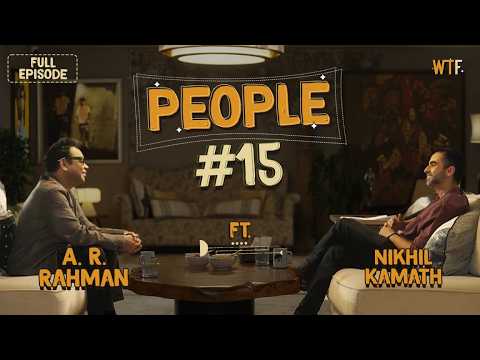
A.R. Rahman: The Genius Who Took Indian Music Global | Nikhil Kamath | People by WTF | Ep 15
A.R. Rahman (guest), Nikhil Kamath (host)
In this episode of Nikhil Kamath, featuring A.R. Rahman and Nikhil Kamath, A.R. Rahman: The Genius Who Took Indian Music Global | Nikhil Kamath | People by WTF | Ep 15 explores a.R. Rahman on craft, faith, technology, and global ambition today Rahman recounts an upbringing shaped by his father’s early death, financial instability, and a studio-centered childhood—crediting his mother’s strength and entrepreneurial grit for keeping the family afloat and pushing him into music early.
A.R. Rahman on craft, faith, technology, and global ambition today
Rahman recounts an upbringing shaped by his father’s early death, financial instability, and a studio-centered childhood—crediting his mother’s strength and entrepreneurial grit for keeping the family afloat and pushing him into music early.
He explains how building Panchathan (home) studio gave him privacy to experiment, leading to Mani Ratnam’s discovery and the overnight impact of Roja (1991), which he frames as a deliberate attempt to make Indian songs “world-ready” in production, vibe, and recording.
The discussion expands into how artists must keep evolving—especially in an AI era—by being contrarian to predictive models, investing in mastery, and prioritizing sincerity over speed or formulas.
Rahman also shares a purpose-driven outlook: founding KM Music Conservatory, advocating responsible AI to reduce harm, embracing live/immersive entertainment as the future, and grounding his life in Sufi-inspired spirituality, service, and humility despite global fame.
Key Takeaways
Rahman’s mother functioned as the ‘first institution’ behind his career.
After his father died when he was nine, his mother rented out musical equipment to survive, refused to sell his father’s gear, and later pushed Rahman to start playing professionally—turning crisis into a pathway.
A private sandbox accelerates originality.
He describes Panchathan Studio as empowering because nobody judged his experiments; unlike big studios where peers watched, his home studio let him iterate until the music matched his standards.
Roja’s “trend change” was intentional global positioning, not luck.
Rahman aimed to solve why Indians listened to Pink Floyd/Queen/John Williams but “they don’t listen to us,” citing language, production, recording quality, and vibe—then engineered his sound accordingly.
Sustained relevance comes from resisting overproduction and constantly re-learning.
He limited film output early (contrasting peers doing “thirty movies a year”) to protect creative growth, later “escaped” to London/Hollywood to study and refresh his artistic vocabulary.
In an AI world, winning means being creatively contrarian.
Rahman argues AI learns patterns from the past, so artists must surprise the predictive model—changing structure, keys, rhythms, or narrative pacing to create what cannot be easily averaged or replicated.
AI needs human-set ‘rules,’ because economic harm can mirror physical harm.
He compares uncontrolled AI to handing out a gun: even without violence, it can “pull the carpet off” workers by erasing livelihoods, so leaders must constrain deployment and create alternatives before disruption.
Live and immersive experiences will gain value as content becomes cheap.
As screens flood daily life, Rahman expects concerts, musical theatre, symphonies, and immersive venues (Sphere-like formats, domes, scent/haptics/ambisonic sound) to matter more because they restore community and sensory awe.
Notable Quotes
“School is not just about education. It's about understanding humanity.”
— A.R. Rahman
“Each Tamil song I do should go around the world.”
— A.R. Rahman
“You have to be contrarian to whatever the predictive model is.”
— A.R. Rahman
“Don’t make people lose jobs… you can pull the carpet off, make them jobless.”
— A.R. Rahman
“That is the irony of my life… nobody allows you to eat… ‘Can I take a photograph?’”
— A.R. Rahman
Questions Answered in This Episode
On Panchathan Studio: what specific gear/workflow in 1989–91 gave you an edge, and what would be the modern equivalent ‘unfair advantage’ for a young composer today?
Rahman recounts an upbringing shaped by his father’s early death, financial instability, and a studio-centered childhood—crediting his mother’s strength and entrepreneurial grit for keeping the family afloat and pushing him into music early.
You said Roja addressed ‘language, production, vibe, feel, recording.’ Which one mattered most, and what are 2–3 concrete production choices you made that Indian film music wasn’t doing then?
He explains how building Panchathan (home) studio gave him privacy to experiment, leading to Mani Ratnam’s discovery and the overnight impact of Roja (1991), which he frames as a deliberate attempt to make Indian songs “world-ready” in production, vibe, and recording.
You limited output early to avoid being ‘consumed’ like your father. What boundary-setting rules do you follow today (team structure, time blocks, number of films) to protect creativity and health?
The discussion expands into how artists must keep evolving—especially in an AI era—by being contrarian to predictive models, investing in mastery, and prioritizing sincerity over speed or formulas.
On AI: what exact ‘rules’ would you want—copyright training limits, disclosure, revenue-sharing, job-transition funds, or something else—and who should enforce them?
Rahman also shares a purpose-driven outlook: founding KM Music Conservatory, advocating responsible AI to reduce harm, embracing live/immersive entertainment as the future, and grounding his life in Sufi-inspired spirituality, service, and humility despite global fame.
You suggested AI should do what humans can’t, not what humans do better. What are 3 examples in music/film where AI genuinely adds new capability rather than replacing a person?
EVERY SPOKEN WORD
Install uListen for AI-powered chat & search across the full episode — Get Full Transcript
Get more out of YouTube videos.
High quality summaries for YouTube videos. Accurate transcripts to search & find moments. Powered by ChatGPT & Claude AI.
Add to Chrome