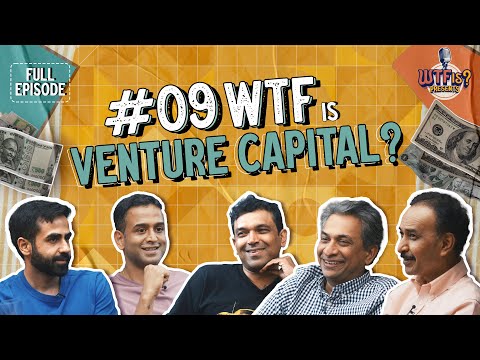
Ep #9 | WTF is Venture Capital? Ft. Nikhil, Nithin, Rajan A., Prashanth P. & Karthik R.
Nikhil Kamath (host), Nithin Kamath (guest), Karthik Reddy (guest), Prashanth Prakash (guest), Rajan Anandan (guest), Karthik Reddy (guest), Karthik Reddy (guest), Rajan Anandan (guest), Nikhil Kamath (host)
In this episode of Nikhil Kamath, featuring Nikhil Kamath and Nithin Kamath, Ep #9 | WTF is Venture Capital? Ft. Nikhil, Nithin, Rajan A., Prashanth P. & Karthik R. explores demystifying venture capital: how funds work, returns, and founder fit Nikhil and Nithin Kamath host a “friends’ conversation” with leading Indian investors (Accel’s Prashanth Prakash, Peak XV’s Rajan Anandan, Blume’s Karthik Reddy) to clarify what venture capital is and how it differs from angel investing and private equity.
Demystifying venture capital: how funds work, returns, and founder fit
Nikhil and Nithin Kamath host a “friends’ conversation” with leading Indian investors (Accel’s Prashanth Prakash, Peak XV’s Rajan Anandan, Blume’s Karthik Reddy) to clarify what venture capital is and how it differs from angel investing and private equity.
They break down fund structure (AIF categories, 10–12 year fund life, 2% management fee, 20% carry, dry powder, LP expectations of ~20%+ net dollar IRR) and why VC is a power-law business where a few winners drive most returns.
The group debates current vs long-term sector “trends,” concluding founders shouldn’t chase what’s hot; instead they should build from unique insight, founder-market fit, and conviction about a 10-year opportunity—while still acknowledging capital-market realities.
They explore India-specific business building: omni-channel consumer brands (online discovery + offline scale), export opportunities (“build for the world”), manufacturing tailwinds (PLI, supply-chain digitization), and the importance of governance, pricing discipline, and IPO/OFS integrity.
The episode ends with a charity commitment segment, collectively pledging significant donations to climate and child/education-focused nonprofits.
Key Takeaways
VC is institutional, long-duration risk capital with strict return expectations.
Funds are typically 10 years (+ extensions), charge ~2% management fee and ~20% carry, and need to target ~20%+ net dollar IRR for global LPs—especially after currency and fees.
Get the full analysis with uListen
Venture returns follow a power law; portfolio construction matters more than “average outcomes.”
They repeatedly note that ~2–5% (or “five companies in a cycle”) can drive ~80–90% of returns, so one breakout can define a fund.
Get the full analysis with uListen
“Dry powder” is committed capital, not cash sitting in a bank account.
LPs commit amounts; funds call capital only when investing because IRR clocks when money is drawn down. ...
Get the full analysis with uListen
Angel investing is often a poor “returns-only” strategy unless you have edge and value-add.
Most angels don’t have superior dealflow or diligence; founders will go to VCs if capital is the only value. ...
Get the full analysis with uListen
Don’t build a startup by chasing what’s funded this year; think in 10-year arcs.
They argue annual funding charts are cyclical and lagging; by the time you raise, the ‘hot’ sector may have cooled. ...
Get the full analysis with uListen
India consumer brands increasingly need an omni-channel playbook (online discovery → offline scale).
Online CAC has risen, while offline distribution is getting “democratized” via new B2B platforms; many brands now go offline earlier (50–100 Cr revenue) and often find offline can be more profitable.
Get the full analysis with uListen
Pure marketplaces are harder; platforms need deeper value-add or full-stack control.
Simple aggregation/GMV narratives have weakened; winning models increasingly require vertical focus, margin control, brands/manufacturing, logistics or other defensible value creation. ...
Get the full analysis with uListen
India’s next leap may come from exports and globally competitive products, not only domestic consumption.
They cite a rise in “built for the world” startups (notably SaaS/infra/cyber/data/AI) and argue India must build world-class from day one—no ‘catch up later’—especially in tech products.
Get the full analysis with uListen
Strategic industrial policy (PLI/duties) can bootstrap manufacturing capability—but patriotism won’t beat product-market fit.
They accept temporary protection/incentives can help India move from assembly to components/IP, but insist consumers ultimately buy best value; long-term wins require superior product and execution.
Get the full analysis with uListen
Founder quality signals: mission obsession, resilience, adaptability, team balance, authenticity.
Investors emphasize ‘founder-market fit,’ ability to survive near-death moments, evolve strategy while holding core values, communicate clearly, and avoid dominating the room while sidelining co-founders.
Get the full analysis with uListen
Mispricing and OFS-heavy IPOs damaged trust; alignment with public investors matters.
They criticize using IPOs mainly for investor exits (OFS) after inflated private rounds; a healthier standard is pricing so investors (private/public) aren’t left underwater for years.
Get the full analysis with uListen
To raise VC money in India, incorporate as a Private Limited company.
They state fundraising flexibility and shareholder structure effectively require a Pvt Ltd; LLP/partnership fits ‘lifestyle/service’ models where owners extract profits directly.
Get the full analysis with uListen
Breaking into VC often requires startup or consulting experience; pay varies by role tier.
Analyst programs (often ex-consulting) pay less than associate roles; Prashanth mentions ~₹60–70L for associates (firm-dependent), while others note lower bands at smaller funds.
Get the full analysis with uListen
Big future themes they’re bullish on: climate, upstream/preventive health, AI, and skilling.
Climate includes materials and supply chain shifts; health includes earlier detection/“Medicine 3. ...
Get the full analysis with uListen
Trust is the core currency for fundraising—and governance lapses are global, not only Indian.
They argue referrals and reputation drive LP access; scandals (India and globally, e. ...
Get the full analysis with uListen
Notable Quotes
“Anybody who's starting a company in the next few years, if they were to watch this, they will learn something.”
— Nikhil Kamath
“It’s usually two to 3% of a portfolio that will return 80% of your returns.”
— Prashanth Prakash
“International investors won’t touch an early-stage India VC if they can’t imagine a world where you can deliver twenty-five percent compounded.”
— Karthik Reddy
“One of two things will happen to you: either you become very hateful or you become very grateful.”
— Rajan Anandan
“As an angel… every time there's a round, you ask yourself: Can it 5X from here or not?”
— Rajan Anandan
Questions Answered in This Episode
When you say LPs expect “20%+ net dollar IRR,” what does that translate to in rupee terms for Indian LPs after taxes and currency effects?
Nikhil and Nithin Kamath host a “friends’ conversation” with leading Indian investors (Accel’s Prashanth Prakash, Peak XV’s Rajan Anandan, Blume’s Karthik Reddy) to clarify what venture capital is and how it differs from angel investing and private equity.
Get the full analysis with uListen AI
You discussed ‘European waterfall’ vs ‘American waterfall’ carry—what’s the most common structure in India today, and how does it change GP behavior during exits?
They break down fund structure (AIF categories, 10–12 year fund life, 2% management fee, 20% carry, dry powder, LP expectations of ~20%+ net dollar IRR) and why VC is a power-law business where a few winners drive most returns.
Get the full analysis with uListen AI
Peak XV cited ~$2.5B dry powder: how much is realistically earmarked for follow-ons vs new deals, and how do you decide that split during downturns?
The group debates current vs long-term sector “trends,” concluding founders shouldn’t chase what’s hot; instead they should build from unique insight, founder-market fit, and conviction about a 10-year opportunity—while still acknowledging capital-market realities.
Get the full analysis with uListen AI
Rajan’s ‘5X at every new round’ rule for angels: what are the concrete signals that a company can’t 5X anymore (market, unit economics, competition, founder)?
They explore India-specific business building: omni-channel consumer brands (online discovery + offline scale), export opportunities (“build for the world”), manufacturing tailwinds (PLI, supply-chain digitization), and the importance of governance, pricing discipline, and IPO/OFS integrity.
Get the full analysis with uListen AI
You claim offline is becoming “democratized” for D2C brands—what specific B2B distribution models/platforms are making this easier, and where do they still break?
The episode ends with a charity commitment segment, collectively pledging significant donations to climate and child/education-focused nonprofits.
Get the full analysis with uListen AI
Transcript Preview
[upbeat music] My aspiration for this particular session is anybody who's starting a company in the next few years, if they were to watch this, they will learn something.
[upbeat music] An entrepreneur, I mean, should go build a business solving a problem which he cares most about.
Look, the excitement in India is higher than it's ever been.
We were trying to establish how much VC money has come into India.
It's roughly around sixty, sixty billion.
Are they really investing in you, the fund manager, or are they investing in India?
I'm looking ten years out. I want to see what's a billion-dollar opportunity ten years from now.
And what are the typical pays when you start off at a VC firm?
Uh, sixty, seventy lakh.
What is he saying? Really? [upbeat music] Hi, guys. Thank you everyone for, uh, coming here. Uh, first thing I want to say is, this is not me interviewing you or moderating a conversation. Uh, this is more five friends trying to have a conversation. I think, uh, all of you have a lot of experience in the venture world and, uh, in the investing world. A lot of people want to create businesses, startup, entrepreneurship in India, and they will do so in the next decade. So we want to cover all things startup: what sector to focus on, where would-- it would be easiest to raise funding, which sectors are growing fast, what you guys think are sectors with, uh, tailwinds, which one have headwinds. And we will also kind of talk about the problems of the venture capital world, compare venture capital to PE and angel, talk about what happened in the last decade, what went wrong, and what can we fix to make sure the next decade is better, not just for us here, but, uh, every single guy who's looking to start a company tomorrow. Uh, so maybe start off with introductions. Uh, I'll come to Prashant last. Maybe Nithin can start.
[chuckles] Okay, I'm Nithin, his brother. [laughing]
What is Nithin doing here? [laughing] He just does not like VCs.
Yeah. [chuckles]
So we were chatting with each other.
Yeah.
Genuine, authentic story. And I was like, "You diss VCs so much on Twitter." [laughing]
Right.
"Like, tell me, like, give me some questions to ask." And then we chatted-
So I'll come do it personally. [chuckles]
Yeah. [chuckles] Then we chatted for twenty minutes, and then I'm like, "Why don't you just come join?" [chuckles]
Yeah, I'm, I'm zero prepared, you know. I'm actually wearing his shirt right now. [laughing] So, uh, from 2016, we started this thing called Rainmatter, um, which is... It started off as a fund incubator, I don't know what you can call it. But, uh, we said we can't solve for all capital market problems, and we need to associate, partner, et cetera. And then startups came. So we had built a bunch of APIs for startups to build on top of us. Uh, so Smallcase was the first startup that came out of the, uh, of the, of the Rainmatter initiative. So the Rainmatter intake, uh, kind of extended into Rainmatter Health, which I'm very passionate about, and then Rainmatter Climate, um, you know, which we are supporting through our foundation. So we've now invested in eighty, eighty-five startups.
Install uListen to search the full transcript and get AI-powered insights
Get Full TranscriptGet more out of YouTube videos.
High quality summaries for YouTube videos. Accurate transcripts to search & find moments. Powered by ChatGPT & Claude AI.
Add to Chrome