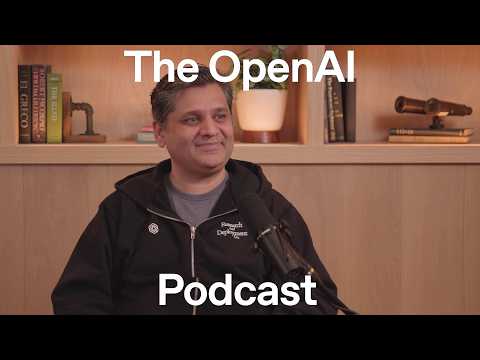
Episode 13 - The Thinking Behind Ads in ChatGPT
Asad Awan (guest)
In this episode of OpenAI, featuring Asad Awan, Episode 13 - The Thinking Behind Ads in ChatGPT explores openAI outlines trustworthy ads in ChatGPT without influencing answers ever Asad Awan explains why OpenAI is adding ads to ChatGPT: to fund higher free-tier usage limits and broaden access in line with the mission to bring powerful AI to everyone.
OpenAI outlines trustworthy ads in ChatGPT without influencing answers ever
Asad Awan explains why OpenAI is adding ads to ChatGPT: to fund higher free-tier usage limits and broaden access in line with the mission to bring powerful AI to everyone.
He emphasizes a hard separation between ads and model answers—both visually and technically—so the model does not know what ad is shown unless the user explicitly chooses to ask about it.
The ad system is framed around a rubric prioritizing user trust over user value, advertiser value, and revenue, with strong privacy promises (no sharing conversations with advertisers; no ads in sensitive conversations).
Ads will initially be limited and shown only to Free and Go tiers, with Plus/Pro/Enterprise remaining ad-free, and with extensive user controls for personalization and data use.
Key Takeaways
Ads are positioned as a funding model for broad access.
OpenAI argues ads help deliver “the best version” of ChatGPT to hundreds of millions of users by supporting higher limits and more capable experiences for people who can’t or won’t pay.
Get the full analysis with uListen
Answers and ads are designed to be independent by default.
The model won’t be trained/conditioned on the ad being shown and won’t even know an ad exists in the UI. ...
Get the full analysis with uListen
Trust is explicitly ranked above revenue in decision-making.
Awan describes a simple-but-strict rubric: user trust > user value > advertiser value > revenue. ...
Get the full analysis with uListen
Ads will not appear for paying tiers and enterprise contexts.
Ads are planned only for Free and Go users; Plus, Pro, and Enterprise remain ad-free, reflecting different product contexts and expectations—especially around enterprise data stewardship.
Get the full analysis with uListen
Users get meaningful controls over ad personalization and data sources.
Controls include viewing what data is used for ads, choosing whether past chats can be used (with sensitive chats never used), clearing history, turning off personalization, and opting out of ads entirely by upgrading.
Get the full analysis with uListen
Sensitive conversations are filtered out from ad matching entirely.
Health, politics, violence, and other defined sensitive verticals are identified via rigorous internal policies and model-based classification; in those contexts, ads are not shown and the data isn’t used even for matching.
Get the full analysis with uListen
The rollout is intentionally conservative: fewer ads, only when useful.
OpenAI claims it won’t optimize for time-spent or “empty calories. ...
Get the full analysis with uListen
Notable Quotes
“We are in the business of trust.”
— Asad Awan
“The answers need to be independent from the ads—both visually, but also in how the models are trained and how the system works.”
— Asad Awan
“Your conversations are private… the conversations are never shared with advertisers.”
— Asad Awan
“Is creepy okay if it is good? It’s not.”
— Asad Awan
“User trust is the most important thing. User trust more than user value… more important than advertiser value… more important than revenue.”
— Asad Awan
Questions Answered in This Episode
What exactly qualifies as the “Go tier,” and how will ad experiences differ between Free and Go?
Asad Awan explains why OpenAI is adding ads to ChatGPT: to fund higher free-tier usage limits and broaden access in line with the mission to bring powerful AI to everyone.
Get the full analysis with uListen AI
How will OpenAI technically guarantee the model cannot infer ad presence indirectly (e.g., via UI text, layout signals, telemetry, or tool outputs)?
He emphasizes a hard separation between ads and model answers—both visually and technically—so the model does not know what ad is shown unless the user explicitly chooses to ask about it.
Get the full analysis with uListen AI
What specific categories fall under “sensitive conversations,” and will OpenAI publish the taxonomy/policy definitions used for ad filtering?
The ad system is framed around a rubric prioritizing user trust over user value, advertiser value, and revenue, with strong privacy promises (no sharing conversations with advertisers; no ads in sensitive conversations).
Get the full analysis with uListen AI
When a user clicks “Ask ChatGPT about this ad,” what data is shared with the model, and how is that interaction stored/used (e.g., for personalization, evaluation, or training)?
Ads will initially be limited and shown only to Free and Go tiers, with Plus/Pro/Enterprise remaining ad-free, and with extensive user controls for personalization and data use.
Get the full analysis with uListen AI
What does “see what data we have on you for ads” look like in practice—what fields, what granularity, and how often is it updated?
Get the full analysis with uListen AI
Transcript Preview
Hello, I'm Andrew Main, and this is the OpenAI Podcast. Today, we're talking to Asad Awan about ads in ChatGPT, how they'll look, who will see them, and how the company will preserve user trust.
Ads are shown to people who are on the free and the go tier. For Pro and Plus and for Enterprise, there are no ads. Is creepy okay if it is good? It's not. We are in the business of trust, so I think if we have to say what is our core business, it's like to win users' trust.
So from a consumer point of view, why ads? Why now?
It goes back to our mission, which is bringing AGI to all of humanity and, um, to benefit all of humanity. Uh, so when you have a consumer product, which, like, you know, eight hundred million plus people were using this, then how do you take the best version of that product to everyone? Uh, um, uh, and, and ads is one of the most proven models to be able to do that for consumer products. Uh, and I think the other part of that mission is: how do you benefit all of humanity? Which is like you want to take the best model, you want to give the highest limits, usage limits to people. You want to, uh, a- for the ads to be actually helpful, both to the users and the businesses as well. Um, so, so I think it, it's a very natural fit for a company whose ambition is actually to take the best AI to all of, all of humanity.
It's a very interesting decision, because on one hand, you could say, "Hey, we're gonna take what we perceive as the high road," and say, "We're not gonna do ads, but also we're not gonna give a really good amount of usage for it and limit that, and sort of maybe use not the most capable models," but sort of, you know, say, take that approach versus embracing it.
Yeah. Yeah, I think, like, if, if, if the goal is to truly democratize access, I think ads is a good model. I think maybe what is hidden in that statement is, can ads be bad?
Mm.
And, and the reality is, how do we think about the principles of ads? Uh, how do we actually set a really high bar-
Mm-hmm
... for what ads should be on this platform? How do we make them actually useful?
Mm.
So when we were starting off, we, we thought like: Hey, what would be the core principles that we would announce to the world, that we would be proud of, that we would stand behind, and as a result, create a really great product? Um, so, so just to give the example of the principles, like, number one, the answers need to be independent from the ads-
Mm
... both visually, but also in how the models are trained and how the system works, um, so that you can always trust the answer. Like the whole product, ChatGPT product, is based on trust, so actually it needs to feed into that. Uh, the second is, your conversations are private. If you have a sensitive conversation, that will never have ads in it. Um, uh, and, and the conversations are never shared with advertisers. So while we do the matching between the best ad, that can be-
Install uListen to search the full transcript and get AI-powered insights
Get Full TranscriptGet more out of YouTube videos.
High quality summaries for YouTube videos. Accurate transcripts to search & find moments. Powered by ChatGPT & Claude AI.
Add to Chrome