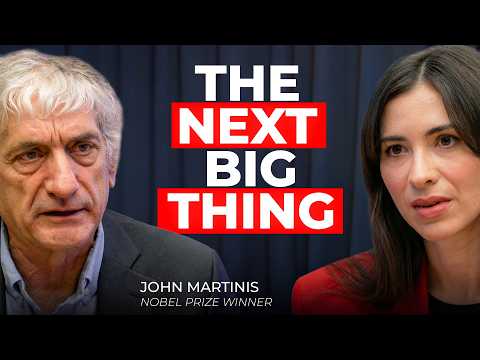
Nobel Prize Winner: Nobody Sees What's Coming After AI
Marina Mogilko (host), John Martinis (guest)
In this episode of Silicon Valley Girl, featuring Marina Mogilko and John Martinis, Nobel Prize Winner: Nobody Sees What's Coming After AI explores quantum computing’s near-term impact on hardware, crypto, and careers John Martinis explains how demonstrating macroscopic quantum tunneling in electrical circuits helped turn quantum mechanics from microscopic theory into machine-building reality, enabling today’s qubit-based quantum computing push.
Quantum computing’s near-term impact on hardware, crypto, and careers
John Martinis explains how demonstrating macroscopic quantum tunneling in electrical circuits helped turn quantum mechanics from microscopic theory into machine-building reality, enabling today’s qubit-based quantum computing push.
The discussion emphasizes that the biggest unlock for quantum computing is accurate simulation of molecules and materials, potentially delivering outsized value in chemistry and drug discovery even from modest performance gains.
Martinis argues that truly valuable, general-purpose quantum computing requires large-scale error correction—potentially on the order of a million physical qubits—making hardware scaling and fabrication the central bottleneck.
On security, he estimates a 5–10 year window in which sufficiently powerful quantum computers could threaten legacy cryptography (including older Bitcoin setups), driving urgent migration to quantum-safe protocols.
Entrepreneurially, he contrasts low-cost software/algorithm plays with the harder but potentially Nvidia-like payoff of building scalable hardware, while sharing how setbacks (including leaving Google) enabled a more focused strategy.
key_topics=[
Quantum tunneling in macroscopic circuits
Why the discovery merited a Nobel Prize
Quantum computers for chemistry/material simulation
Drug discovery and incremental insight value
Hardware vs algorithms and scaling constraints
Error correction and million-qubit scale
Crypto/Internet cryptography risk and timelines
NIST quantum-safe cryptography and industry migration
Entrepreneur strategy: definite vs indefinite optimism
Leaving Google after quantum supremacy and founding a company
Key Takeaways
Quantum “became real” when it worked at circuit scale.
Martinis’ core point is that showing tunneling behavior in a macroscopic electrical circuit proved quantum effects can be engineered in machines, laying practical groundwork for qubits and quantum processors.
Get the full analysis with uListen
The first major wins are likely in chemistry, materials, and drug R&D.
He frames quantum’s near-term value as enabling better virtual design of molecules/materials—analogous to CAD for mechanical/electronic design—where even a 1–few% improvement in insight can be worth enormous sums.
Get the full analysis with uListen
General-purpose quantum value depends on error correction, not demos.
He suggests the “real value” unlock requires large, error-corrected systems—far beyond today’s devices—potentially needing ~1M physical qubits to reliably run useful algorithms.
Get the full analysis with uListen
Hardware scaling is the bottleneck—and a potential monopoly-like advantage.
Martinis acknowledges algorithms are cheaper to start, but argues that whoever masters scalable hardware and manufacturing (moving from “artisanal” superconducting fabrication to semiconductor-style processes) could achieve Nvidia-level strategic leverage.
Get the full analysis with uListen
Quantum risk to cryptography is a planning horizon, not science fiction.
He repeatedly emphasizes a 5–10 year optimistic-but-plausible timeline for systems large enough to threaten widely used cryptography, implying organizations must begin migration and inventory of vulnerable systems now.
Get the full analysis with uListen
Bitcoin risk is nuanced: older setups may be vulnerable; mitigation exists.
He indicates older Bitcoin encryption could be breakable, while newer approaches are stronger, and holders can potentially “re-encrypt” by moving funds to updated schemes—though dormant/unclaimed coins could become targets.
Get the full analysis with uListen
Governance and standards work is already underway—use it.
He cites NIST’s decade-long quantum-safe cryptography program and notes major companies are already deploying quantum-resistant protocols, implying the actionable path is adoption, testing, and long lead-time migration rather than waiting.
Get the full analysis with uListen
Notable Quotes
“We made [an] electrical circuit about that big, and the currents and voltages in that big macroscopic electrical circuit is actually obeying quantum mechanics and showing this tunneling phenomenon.”
— John Martinis
“What we're really trying to do in our company is make a general purpose error-corrected quantum computer... you may need a million physical qubits.”
— John Martinis
“Our company is doing the exact wrong thing... investing in building hardware really well. Now, the nice thing is... you can be a extremely successful company.”
— John Martinis
“It's possible in five to 10 years to build... a big enough quantum computer... [and] to warn people that... the whole internet needs to switch over in this kind of time period.”
— John Martinis
“I was not Googly enough to stay at Google, and I had to leave.”
— John Martinis
Questions Answered in This Episode
When you say “a million physical qubits,” what error rates and architectures are you assuming, and what milestone would convince you scaling is on track?
John Martinis explains how demonstrating macroscopic quantum tunneling in electrical circuits helped turn quantum mechanics from microscopic theory into machine-building reality, enabling today’s qubit-based quantum computing push.
Get the full analysis with uListen AI
Which specific chemistry/material problems do you believe will be the first to show clear ROI, and what would a “1–3% insight improvement” look like in practice?
The discussion emphasizes that the biggest unlock for quantum computing is accurate simulation of molecules and materials, potentially delivering outsized value in chemistry and drug discovery even from modest performance gains.
Get the full analysis with uListen AI
You describe today’s superconducting qubit fabrication as “artisanal”—what concrete semiconductor manufacturing techniques (process control, packaging, metrology) matter most to change that?
Martinis argues that truly valuable, general-purpose quantum computing requires large-scale error correction—potentially on the order of a million physical qubits—making hardware scaling and fabrication the central bottleneck.
Get the full analysis with uListen AI
On the crypto side, what’s the clearest, technically accurate advice for an individual Bitcoin holder today: which addresses/usage patterns are most exposed and what exact steps reduce risk?
On security, he estimates a 5–10 year window in which sufficiently powerful quantum computers could threaten legacy cryptography (including older Bitcoin setups), driving urgent migration to quantum-safe protocols.
Get the full analysis with uListen AI
You mention engagement with the US Treasury about unclaimed/dormant Bitcoin—what policy options do you think are realistic, and what trade-offs do they create?
Entrepreneurially, he contrasts low-cost software/algorithm plays with the harder but potentially Nvidia-like payoff of building scalable hardware, while sharing how setbacks (including leaving Google) enabled a more focused strategy.
Get the full analysis with uListen AI
Transcript Preview
The skills you're building right now are for the AI era, but they have an expiration date. Every few years, something comes along that changes what's actually possible. The internet didn't make libraries faster, it made them irrelevant. AI didn't make search engines better, it made a completely different way of finding answers. And now we have something that's coming that most people haven't even heard of yet, and it does the same thing to computing itself. In December 2024, Google unveiled a quantum processor that completed a calculation in minutes. That exact calculation that would take today's supercomputers longer than the age of the universe, and that is a different category of a machine. And here's where it gets a little scary. A few days ago, Google published another paper. They say quantum computers could crack Bitcoin encryption in nine minutes using 20 times fewer resources than anyone thought. As someone who holds crypto and is curious about implications of quantum on my day-to-day life, I wanted to ask questions. So I was in Davos this January, and I met the man whose 1985 discovery made all of this possible. He just won the Nobel Prize for it, and President Donald Trump just put him on his science advisory council, alongside with Mark Zuckerberg, Sergey Brin, and Jensen Huang. He's the only scientist in that room, and he gave me a timeline, five to 10 years. And to understand why this matters for your career, you need to understand what he actually discovered. Let's talk to John Martinis. I wanted to talk to you about something that you discovered. So I don't have any experience in quantum physics, but the way I understood it, if you throw a ball against the wall, it bumps, right?
Right.
But you discovered that an electron can pass the wall without passing it-
Yes
... and be on both sides?
Yeah, so it's possible that the, the ball... You know, the wall can tunnel through the wall, uh, and, and not just bounce off-
Mm-hmm
... but every once in a while actually tunnel through it. And the way I like to say it is that, you know, people are accustomed that quantum mechanics is the physics of atoms and molecules and microscopic particles. In here, we made electrical circuit about that big, and the currents and voltages in that big macroscopic electrical circuit is actually, uh, obeying quantum mechanics-
Mm-hmm
... and showing this tunneling phenomenon.
That's the moment quantum stopped being just theory. He proved it works in machines, and that's what started everything. So before this discovery, scientists thought quantum mechanics only lived inside atoms. He proved it works in machines. So what does that unlock?
What really happened, uh, with, with this idea, and frankly, it's the reason for the Nobel Prize [laughs] , is that we took this discovery, and then people built on it, built on it, and then the idea of build... Of qu- qubits and building a quantum computer came along, which naturally... Our just physics naturally fit into this. So, uh, it's really kind of the, the c- creation of a field of discovery and innovation and technology that these experiments got developed into and why it's important today.
Install uListen to search the full transcript and get AI-powered insights
Get Full TranscriptGet more out of YouTube videos.
High quality summaries for YouTube videos. Accurate transcripts to search & find moments. Powered by ChatGPT & Claude AI.
Add to Chrome