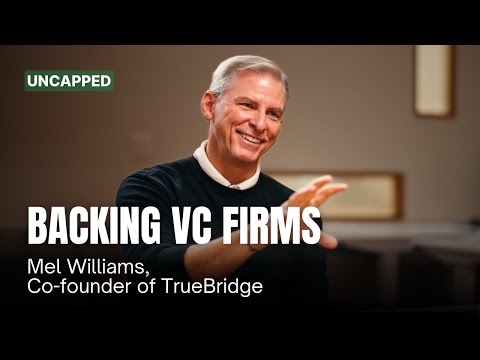
Inside the Mind of the Investor Who Backed Josh Kushner, Peter Thiel, and Marc Andreessen | Ep. 34
Mel Williams (guest), Jack Altman (host)
In this episode of Uncapped with Jack Altman, featuring Mel Williams and Jack Altman, Inside the Mind of the Investor Who Backed Josh Kushner, Peter Thiel, and Marc Andreessen | Ep. 34 explores trueBridge’s Mel Williams on AI froth, signal, and conviction Mel Williams, co-founder of TrueBridge (a major venture fund-of-funds), shares a 2025 market read: deep excitement about AI’s decade-plus opportunity alongside froth, especially at the earliest stages.
TrueBridge’s Mel Williams on AI froth, signal, and conviction
Mel Williams, co-founder of TrueBridge (a major venture fund-of-funds), shares a 2025 market read: deep excitement about AI’s decade-plus opportunity alongside froth, especially at the earliest stages.
He argues today’s power-law dynamics are intensifying—winners may be bigger than ever, even as many overcapitalized startups fail to reach product-market fit.
Williams describes how elite “signal” firms and individuals (e.g., Sequoia, Founders Fund, Andreessen, Thiel, Kushner) attract capital, talent, and customers faster, creating self-reinforcing advantages.
He also lays out TrueBridge’s manager-selection framework: prioritize contrarian/first-principles investors with the conviction to concentrate, be wary of rapid fund-size step-ups, and use deep networks to separate luck from skill.
Key Takeaways
AI is both a long-term wave and a near-term frothy market.
Williams expects AI to drive opportunities for 10–15 years, but notes valuations feel especially inflated at formation/seed where evidence of product-market fit is thin.
Get the full analysis with uListen
Growth rounds look healthier than early rounds—multiples are not at peak extremes.
He contrasts “frothy” early pricing with later-stage rounds that resemble more defensible revenue multiples relative to public comps, implying risk is front-loaded in the earliest deals.
Get the full analysis with uListen
Expect simultaneous ‘carnage’ and unprecedented value creation.
Many heavily funded companies won’t find product-market fit, yet the category’s biggest winners can still create more total value than prior venture eras—classic dot-com pattern amplified.
Get the full analysis with uListen
Signal is a competitive weapon that compounds advantages.
Top brands create signal that accelerates follow-on financing, recruiting, customer acquisition, and even regulatory posture—pulling resources toward a small set of firms and companies.
Get the full analysis with uListen
Exceptional investors share two traits: contrarian/first-principles thinking and conviction to concentrate.
TrueBridge’s pattern from decades of data is that top funds invest differently early and then “push chips in” on winners—accepting portfolio concentration many can’t stomach.
Get the full analysis with uListen
Fund size matters less than ‘size vs capability’ and the pace of size increases.
Williams cites research that trouble appears when funds more than double; firms struggle to psychologically and mechanically scale check sizes and follow-on concentration fast enough.
Get the full analysis with uListen
LP success is constrained by network quality—especially for separating luck from skill.
Because feedback loops are 7–13 years and stories are polished, TrueBridge relies on a broad industry network to verify a GP’s real contribution to portfolio wins and avoid misattribution.
Get the full analysis with uListen
Notable Quotes
“We’re gonna see a lot of carnage over the next ten years, and we will see more value created over the next ten years than we’ve seen in the venture industry previously.”
— Mel Williams
“Ninety percent of the market is chasing the heat and chasing the signal, and ten percent of the market is the signal.”
— Mel Williams
“The two characteristics... most important for exceptional investors... [are] contrarian or first principles... [and] conviction... willing to push their chips on the table.”
— Mel Williams
“It’s really difficult for LPs to distinguish between luck and skill.”
— Mel Williams
“You’re only as good as your network... My second piece of advice would be follow the signal. Try not to be the signal.”
— Mel Williams
Questions Answered in This Episode
When you say early-stage valuations are frothier than growth, what specific ‘red flags’ (terms, check sizes, ownership targets) most often signal trouble?
Mel Williams, co-founder of TrueBridge (a major venture fund-of-funds), shares a 2025 market read: deep excitement about AI’s decade-plus opportunity alongside froth, especially at the earliest stages.
Get the full analysis with uListen AI
You mentioned AI is 50–60% of venture activity—how do you think that share changes if model capability or unit economics plateau for a few years?
He argues today’s power-law dynamics are intensifying—winners may be bigger than ever, even as many overcapitalized startups fail to reach product-market fit.
Get the full analysis with uListen AI
What’s your practical diligence process for separating luck from skill—who do you call, what questions do you ask, and what evidence changes your mind?
Williams describes how elite “signal” firms and individuals (e. ...
Get the full analysis with uListen AI
In your view, what makes an investor ‘the signal’ versus merely benefiting from signal—can you give concrete behaviors you’ve observed?
He also lays out TrueBridge’s manager-selection framework: prioritize contrarian/first-principles investors with the conviction to concentrate, be wary of rapid fund-size step-ups, and use deep networks to separate luck from skill.
Get the full analysis with uListen AI
You cited fund-size doubling as a danger zone; what operating changes must a firm make (decision-making, reserves policy, partner incentives) to scale successfully?
Get the full analysis with uListen AI
Transcript Preview
The two characteristics that we've identified, uh, that are most important for exceptional investors are, number one, they approach the market from a contrarian standpoint or first principle standpoint. Number two, they have conviction. When they see it working and they see it win in their portfolio, they're willing to push their chips on the table.
Yeah.
And, um, that's hard to do.
[upbeat music] All right. I'm very excited to have Mel Williams, the co-founder of TrueBridge, here. Mel, thank you very much for doing this with me.
It's great to be here, Jack. Thanks for having me.
So you started TrueBridge like seventeen or eighteen years ago.
Yep.
And today it's like one of the premier fund of funds in venture, and you've got eight billion under management. You were very early to funds like Thrive, Founders Fund, and you also like provide the data that powers the Forbes Midas List. So like you're very in the know about top venture firms and how the ecosystem has been working. And so my goal with you today really is to understand your vantage point on venture, where we're at, what it looks like, and sort of, um, you know, how you're, how you're seeing things. Because for us as, uh, venture investors, our job is to like, pick companies. Your job is basically to figure out how to pick investors. And so that's kinda what I want to open up with you about today.
Sure.
The first place I'd love to start is just getting your overall pulse check on it's twenty twenty-five, AI is obviously very important. Companies are growing quickly. They're valued, you know, more highly than ever. We just came out of these doldrums post-ZIRP, but now we've had a couple years of like very exciting time. How are you overall feeling as somebody who allocates exclusively to venture? Like, what's your sentiment?
I think overall our sentiment is, um, is excitement. Um, you know, we think we are at the, at the leading stages of an AI wave, um, that will, that will power business opportunities and return generation over the next ten to fifteen years. Um, we're in the early stages of that. Um, there's evidence that it's working, right? And it's working at scale, and so I think all of those things are very exciting. Um, I think at the same time, um, it feels like a very, um, frothy investment environment. Um, valuations are relatively high, and they're very high at the earliest stages, it feels.
Like they're higher at the early stages than at the late stages?
I think so. I think so. I think-- So I think if you look at some of the more recent growth rounds, they've been done at, at revenue multiples that are not peak revenue multiples.
Yeah, and don't look that different than public multiples or something.
That's right, that's right. So what's the... You know, I think Palantir's trading at a thousand times-
Mm-hmm
Install uListen to search the full transcript and get AI-powered insights
Get Full TranscriptGet more out of YouTube videos.
High quality summaries for YouTube videos. Accurate transcripts to search & find moments. Powered by ChatGPT & Claude AI.
Add to Chrome