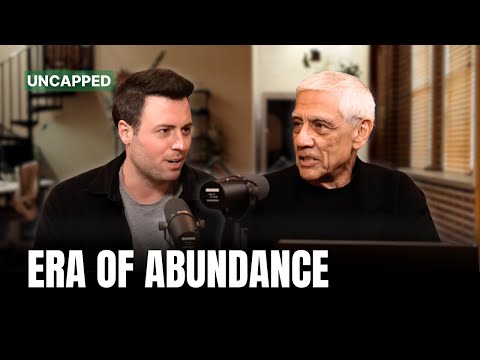
Vinod Khosla Predicting the Future | Ep. 15
Vinod Khosla (guest), Jack Altman (host), Jack Altman (host)
In this episode of Uncapped with Jack Altman, featuring Vinod Khosla and Jack Altman, Vinod Khosla Predicting the Future | Ep. 15 explores vinod Khosla on AI abundance, disruption, and venture-first principles ahead Khosla argues the current AI cycle is unlike anything in his 40 years in venture: most jobs and products will be reinvented, with AI able to perform “80% of 80%” of economically valuable work within about five years (with a few exceptions).
Vinod Khosla on AI abundance, disruption, and venture-first principles ahead
Khosla argues the current AI cycle is unlike anything in his 40 years in venture: most jobs and products will be reinvented, with AI able to perform “80% of 80%” of economically valuable work within about five years (with a few exceptions).
He forecasts a near-term phase of productivity gains through the 2020s, followed by far more disruptive 2030s dynamics—rapid Fortune 500 decline, labor displacement, and a potential “dystopic” transition period—yet ultimately a 2040+ world of extreme abundance where work becomes optional.
He frames dystopia largely as a societal choice (distribution, governance, geopolitical strategy), while emphasizing that Western leadership in AI is strategically critical given China’s potential to wield AI for warfare, cyber operations, and cultural influence.
The conversation also covers Khosla’s investing philosophy (avoid herd mentality, follow data/exponentials, favor first-principles founders over “experts,” maximize consequence of success), plus concrete bets: general-purpose robotics, fusion and superhot geothermal, new high-throughput transit, and AI-led healthcare and drug discovery.
Key Takeaways
AI will function as “interns” for every professional—then surpass them.
Khosla expects near-term AI to amplify individual productivity (e. ...
Get the full analysis with uListen
The 2030s could be a chaotic reset for incumbents, especially Fortune 500s.
He predicts an accelerated demise rate because most large enterprises will still be organized around outdated assumptions (labor scarcity, paid expertise, legacy workflows) rather than redesigning around “free” intelligence.
Get the full analysis with uListen
Abundance is likely; dystopia is mainly about governance and distribution choices.
Khosla separates the inevitability of cheap, plentiful goods/services from the risk of social instability during displacement. ...
Get the full analysis with uListen
Geopolitical competition may matter more than “AI doomer” extinction scenarios.
While he doesn’t dismiss existential AI risks, he prioritizes the strategic risk of authoritarian states using AI to project power—especially via “socially good AI” (free doctors/tutors/entertainment) to spread political philosophy.
Get the full analysis with uListen
Robotics’ breakthrough is primarily an intelligence problem, not hardware.
He views today’s robots as impressive but brittle; the “ChatGPT moment” in robotics is a robot that learns and adapts without task programming. ...
Get the full analysis with uListen
Energy abundance can come from making clean tech cheaper than fossil fuels.
His bullish case centers on fusion and “superhot geothermal” at ~450°C, where physics/efficiency could make it cheaper than natural gas—removing the need for climate-aligned buying behavior.
Get the full analysis with uListen
Healthcare costs can collapse if medical expertise becomes free and ubiquitous.
Khosla claims physician “expertise” spend could approach zero as AI delivers primary care and specialty guidance at near-zero marginal cost, while automation (imaging, MRI/ultrasound) removes technician bottlenecks and enables earlier intervention.
Get the full analysis with uListen
His investing edge is contrarian conviction built on exponentials, talent flows, and first principles.
From TCP/IP vs ATM (Juniper) to OpenAI, he emphasizes ignoring expert consensus and herd behavior, tracking progress rates and talent concentration, and placing “too important not to try” bets even when timing is uncertain.
Get the full analysis with uListen
Notable Quotes
“We’re gonna be in a era of abundance that’s so large, it’s very hard for people to imagine. The simplest way to say it is the need to work will go away.”
— Vinod Khosla
“Within the next five years, any economically valuable job humans can do, AI will be able to do eighty percent of it.”
— Vinod Khosla
“The dystopian views will be a choice society makes. The utopian view is going to happen anyway.”
— Vinod Khosla
“Experts are terrible at predicting the future. They extrapolate the past. Entrepreneurs invent the future they want.”
— Vinod Khosla
“Most people reduce risk to increase the probability of success. I do the opposite. Start with, ‘I want high consequences of success.’”
— Vinod Khosla
Questions Answered in This Episode
You say AI will do “80% of 80% of jobs” in five years—what are the concrete exceptions beyond surgery, and what makes them structurally resistant?
Khosla argues the current AI cycle is unlike anything in his 40 years in venture: most jobs and products will be reinvented, with AI able to perform “80% of 80%” of economically valuable work within about five years (with a few exceptions).
Get the full analysis with uListen AI
In your “interns for every professional” framing, what’s the key technical milestone that turns interns into autonomous replacements (reasoning, agency, memory, tool use, regulation)?
He forecasts a near-term phase of productivity gains through the 2020s, followed by far more disruptive 2030s dynamics—rapid Fortune 500 decline, labor displacement, and a potential “dystopic” transition period—yet ultimately a 2040+ world of extreme abundance where work becomes optional.
Get the full analysis with uListen AI
You predict accelerated Fortune 500 demise in the 2030s—what early-warning indicators should boards track to know they’re on the wrong trajectory?
He frames dystopia largely as a societal choice (distribution, governance, geopolitical strategy), while emphasizing that Western leadership in AI is strategically critical given China’s potential to wield AI for warfare, cyber operations, and cultural influence.
Get the full analysis with uListen AI
If abundance is inevitable but dystopia is a policy choice, what specific social-contract changes (e.g., UBI, wage insurance, new tax bases) do you think are most plausible by country?
The conversation also covers Khosla’s investing philosophy (avoid herd mentality, follow data/exponentials, favor first-principles founders over “experts,” maximize consequence of success), plus concrete bets: general-purpose robotics, fusion and superhot geothermal, new high-throughput transit, and AI-led healthcare and drug discovery.
Get the full analysis with uListen AI
On AI geopolitics: how would “free doctors/tutors” realistically become a vehicle for ideological influence, and what counter-strategies should democracies pursue?
Get the full analysis with uListen AI
Transcript Preview
We're gonna be in a era of abundance that's so large, it's very hard for people to imagine. The simplest way to say it is the need to work will go away. People will work on things because they wanna work on things, not because they need to work on things to pay their mortgage. [upbeat music]
All right. I am super excited to be here with Vinod. Thank you so much for doing this with me today. I really am looking forward to this conversation.
Look forward to it.
When you first walked in here, uh, before we got started, you were saying, "Wow, you know, the world's crazy," um, and you've invested through many periods of time. Obviously, you know, there have been a lot of ups and downs, but, um, you said the world's particularly crazy now. Can you share why you said that or why you're feeling that way?
I've been doing venture capital for forty years, so I've gone through every large innovation cycle. Uh, I've never seen a cycle like this. To put a order of magnitude on it, almost every job is being reinvented. Every material thing is being reinvented differently, with AI as a driver. Probably the best way to describe it, if you look fifteen years hence, and that's too far to look, we'd have to look back at least fifty years-
Hmm
... maybe in the 1960s, to see the delta in change. And so we're going to see this large change in, in sort of such a short time. Uh, it's almost hard to imagine how society adjusts. And if I go even further, almost certainly within the next five years, any economically valuable job humans can do, AI will be able to do eighty percent of it, with a few exceptions like heart surgery or brain surgery. But by and large, eighty percent of, eighty percent of all jobs can be done by an AI. And if that's happening in the next five years, the world is gonna be a very different place. So I see this sort of like invention happening at a frenetic pace that is so large compared to even the dot-com phase when the internet first came, and there was Netscape and TCIP and all that. It's almost hard to imagine. No matter where you look, everything's being reinvented in some fundamental way, using often, uh, the, the, the, the innovations from AI and the capability from AI, uh, but also a few other vectors, like stuff happening in biology, stuff happening in fusion and other areas. Uh, so-
Yeah
... everything's up for grabs.
So, so I guess that's then leading to a frenzied pace of investment, companies being created, you know, new ideas getting tried all at once. Is your overall read based on, you know, on one hand, it's crazy and frenetic, on the other hand, everything you just said about, yeah, about like maybe a billion jobs are gonna be, you know, done by an AI in the next couple years or several years, or something like that. Do you net out to being very optimistic about this moment in time for tech? Or do you think there's gonna be a lot of carnage, or how do, how do you think?
Install uListen to search the full transcript and get AI-powered insights
Get Full TranscriptGet more out of YouTube videos.
High quality summaries for YouTube videos. Accurate transcripts to search & find moments. Powered by ChatGPT & Claude AI.
Add to Chrome