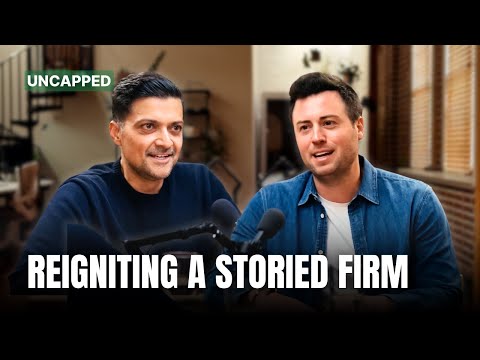
The Next Generation of Software | Mamoon Hamid, Partner at Kleiner Perkins | Ep. 16
Mamoon Hamid (guest), Jack Altman (host)
In this episode of Uncapped with Jack Altman, featuring Mamoon Hamid and Jack Altman, The Next Generation of Software | Mamoon Hamid, Partner at Kleiner Perkins | Ep. 16 explores mamoon Hamid on AI investing, VC cycles, and Kleiner’s revival Hamid recounts entering Silicon Valley during the dot-com boom, learning how hype can detach from fundamentals, and how the best investors keep an open mind while being rigorous about timing. He then walks through the emergence of Web 2.0, cloud/SaaS adoption (which took longer than people remember), and mobile’s maturation from wrappers to native apps driven by games and killer apps.
Mamoon Hamid on AI investing, VC cycles, and Kleiner’s revival
Hamid recounts entering Silicon Valley during the dot-com boom, learning how hype can detach from fundamentals, and how the best investors keep an open mind while being rigorous about timing. He then walks through the emergence of Web 2.0, cloud/SaaS adoption (which took longer than people remember), and mobile’s maturation from wrappers to native apps driven by games and killer apps.
He argues AI is a “super cycle” with a potential $60T labor opportunity, shifting value toward AI-levered companies and creating space for generational startups. Kleiner’s AI investing framework focuses on applications that map to real jobs—starting with copilots for highly skilled professions, moving to autonomous agents for mid-skilled roles, and eventually robotics for physical labor (but later due to cost/complexity).
On firm-building, he describes joining Kleiner in 2017 as a “refounding moment,” returning to a small-table early-stage model, defining a mission (“first call for founders who want to make history”), and measuring partner performance through a disciplined funnel: see, pick, win, and work. He closes with how family and faith shape his leadership style and how he tries to treat founders with respect and empathy during high-stakes fundraising moments.
Key Takeaways
Timing beats pattern-matching past bubbles.
Hamid emphasizes staying optimistic and open-minded rather than dismissing new ideas because earlier versions failed (e. ...
Get the full analysis with uListen
Cloud/SaaS wasn’t immediate consensus—even in VC.
He notes that in 2007–2009 many investors still centered on hardware/networking, and even obvious cloud apps struggled to get funded. ...
Get the full analysis with uListen
AI is framed as a $60T ‘jobs-to-be-done’ market, not just a feature wave.
Hamid ties AI’s magnitude to labor’s ~60% share of GDP, arguing AI will increasingly do work, not merely assist. ...
Get the full analysis with uListen
Start with copilots for scarce, high-skill roles—then progress to autonomy.
Kleiner’s early AI approach targeted doctors, lawyers, and engineers with copilots (e. ...
Get the full analysis with uListen
Autonomous agents shine where persistence and scale are impossible for humans.
In roles like nursing call workflows (Hippocratic), AI agents can operate at the right times, at massive parallelism, and with infinite follow-up—unlocking protocol adherence and better outcomes that are currently limited by staffing and time windows.
Get the full analysis with uListen
Robotics is inevitable but gated by economics and data complexity.
He sees physical labor automation as the bottom of the job pyramid and the hardest: the real world demands richer training data (video/actions) and current robots are too expensive and slow for many tasks. ...
Get the full analysis with uListen
Great early-stage investing is a measurable funnel: see → pick → win → work.
Hamid describes evaluating partners and firm performance by whether they meet the best Series A companies (“see”), choose correctly (“pick”), can consistently secure allocation (“win”), and then materially help companies succeed (“work”)—with “work” taking years to validate.
Get the full analysis with uListen
Kleiner’s strategy is ‘as big as possible, constrained by one table.’
He argues the firm’s edge comes from a small partnership (roughly 5–7) with intense debate, shared context, and tight culture—rather than sprawling geographies or oversized teams. ...
Get the full analysis with uListen
Notable Quotes
“AI is, to us, the super cycle of all super cycles.”
— Mamoon Hamid
“If you have that mentality, you're gonna miss everything.”
— Mamoon Hamid
“A lot of the stuff that happened in the dot-com boom, the timing was just off.”
— Mamoon Hamid
“If we want to invest in a company, we have to win it.”
— Mamoon Hamid
“Small N, high engagement, is a really good signal to invest in a company.”
— Mamoon Hamid
Questions Answered in This Episode
In your ‘job pyramid’ framework, what’s the clearest signal that a copilot should graduate into a fully autonomous agent (reliability thresholds, regulation, workflow design, liability)?
Hamid recounts entering Silicon Valley during the dot-com boom, learning how hype can detach from fundamentals, and how the best investors keep an open mind while being rigorous about timing. ...
Get the full analysis with uListen AI
You cite a $60T labor opportunity—how do you avoid overestimating what’s economically automatable versus what’s technically possible but not cost-effective?
He argues AI is a “super cycle” with a potential $60T labor opportunity, shifting value toward AI-levered companies and creating space for generational startups. ...
Get the full analysis with uListen AI
For products like clinical scribes, what are the hardest real-world adoption blockers (EMR integration, compliance, workflow change, physician trust), and how do you diligence them at Series A?
On firm-building, he describes joining Kleiner in 2017 as a “refounding moment,” returning to a small-table early-stage model, defining a mission (“first call for founders who want to make history”), and measuring partner performance through a disciplined funnel: see, pick, win, and work. ...
Get the full analysis with uListen AI
You measure ‘seeing’ 60% of peer Series A deals weekly—what qualifies as truly ‘seeing’ a deal, and what do you do differently when you’re below target?
Get the full analysis with uListen AI
Your internal goal is a 100% win rate on picks—does that ever create selection bias toward “winnable” deals over the most ambitious ones? How do you counteract that?
Get the full analysis with uListen AI
Transcript Preview
Kleiner had made history from the days of semiconductors, to then computers, to software, to the internet, those four big technology waves. If you look at the list of companies in each one of those major waves across decades, we've pretty much nailed every single m- dominant company in those waves. And so how could we make history again?
[upbeat music] All right, Mamoon, I'm super excited to have this conversation with you. Thanks for making time for it.
Thank you for having me, Jack. Really good to see you.
Um, so I wanna start by talking about your kind of history over the last couple decades or, you know, twenty-five years in Silicon Valley. And if you could just sort of take us back to when you came to tech in Silicon Valley, and maybe sort of the experience you had through the different innovation cycles.
I was really fortunate to come to Silicon Valley, uh, as a first-time engineer, first job out of college in 1997, uh, working for a semiconductor company, of all things, that was a company called Xilinx, actually a Kleiner Perkins-backed company, that, uh, was, uh, the underpinnings of lots of, uh, switching and routing equipment that was the, the backbone of the internet.
Mm.
And so I got to really see from that lens, uh, the rise and the fall of the internet and, uh, see my stock appreciate and then depreciate a lot. And so, uh, I, I look back at that sort of first few weeks in my cubicle at Xilinx in San Jose, uh, in 1997. I'm nineteen years old. I'm very, uh, influenced by all the things that were happening around me, and, um, I've got a Sun workstation, and I'm running the Netscape browser, uh, buying books on Amazon, uh, for my grad school classes at Stanford. And turns out just that a new search engine has just, just come out, uh, called Google. And, uh, so these are the kinds of influences that I had, uh, in those early, early years in Silicon Valley. And, uh, and turns out actually all those companies, uh, Xilinx, Netscape, Sun, Google, and Amazon, were all companies backed by Kleiner Perkins at the-
Mm
... Series A. So, uh, which also got me thinking about, "Who are these venture capitalists? That seems pretty interesting as a job." Nineteen ninety-seven, 'ninety-eight, 'ninety-nine were, like, these boom years. Uh, it felt a lot like probably today, uh, but a lot more parties maybe-
Mm-hmm
... at the time.
Mm-hmm.
And people forget that that was a time of, like, felt like a time of excess, actually.
Was it way different feeling than now, like, on that front?
Uh, it, it, it slightly... Because I think we still have mostly builders today.
Mm-hmm.
And, uh, by 1998, '99, non-builders had arrived to help monetize the internet, and a lot of interesting business models were sitting on top of, you know, the, the internet hype bubble. And so, uh, I feel like we're, we're still, like, a few years removed from that today here. Today's still builders.
Install uListen to search the full transcript and get AI-powered insights
Get Full TranscriptGet more from every podcast
AI summaries, searchable transcripts, and fact-checking. Free forever.
Add to Chrome