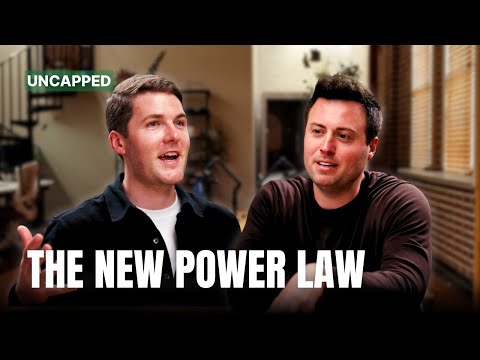
Concentrating in Winners | Vince Hankes, Partner at Thrive Capital | Ep. 27
Vince Hankes (guest), Jack Altman (host)
In this episode of Uncapped with Jack Altman, featuring Vince Hankes and Jack Altman, Concentrating in Winners | Vince Hankes, Partner at Thrive Capital | Ep. 27 explores thrive Capital’s playbook for concentrated, conviction-led venture investing at scale Thrive grew from a small, New York-based outsider fund into a platform capable of writing billion-dollar checks, while trying to preserve its contrarian, high-conviction culture.
Thrive Capital’s playbook for concentrated, conviction-led venture investing at scale
Thrive grew from a small, New York-based outsider fund into a platform capable of writing billion-dollar checks, while trying to preserve its contrarian, high-conviction culture.
Hankes argues that concentration requires “dogmatic conviction,” built through long wind-up periods of relationship-building, deep qualitative diligence, and then quantitative validation.
He details Thrive’s barbell approach (early + platform/growth) and explains why mid-stage “large check venture” can be the most perilous due to competition and capital-loss risk.
The conversation also covers Thrive’s Carvana trade, conflict management in a concentrated portfolio, and where AI value accrues—plus why life sciences and robotics may be the biggest long-term AI opportunities.
Key Takeaways
Concentration demands near-absolute conviction—and time is the price.
Thrive’s biggest checks come after long relationship “wind-ups” (e. ...
Get the full analysis with uListen
Start qualitative, then use numbers to confirm—not to inspire.
Hankes says leading with metrics can create fragile confidence when growth decelerates. ...
Get the full analysis with uListen
Thrive’s growth funds are intentionally designed to be small-N portfolios.
He describes an “ideal growth fund” as ~10 companies, aiming to map fund construction to the power law. ...
Get the full analysis with uListen
The best odds may be backing $10B companies on the path to $100B+, not picking unicorns early.
Hankes cites a growing number of $100B+ outcomes and argues it can be easier to identify “generational platform” trajectories at scale than to select a breakout from thousands of earlier-stage contenders.
Get the full analysis with uListen
Mid-stage ‘large-check venture’ is a danger zone when $100M checks meet uncertain PMF.
He’s skeptical of the heavily funded $500M–$2B segment where many companies are priced like they have PMF even when it’s unproven. ...
Get the full analysis with uListen
Carvana illustrates Thrive’s culture: ride volatility, re-underwrite, then press when risk-reward flips.
Thrive’s conviction was anchored in product/logistics advantage and an operational turnaround lens, not just near-term numbers. ...
Get the full analysis with uListen
In AI, follow where profit pools can realistically land—today it’s mostly ‘down the stack’.
Using codegen as an example, he traces subscription dollars from apps to model providers to cloud to data centers—arguing NVIDIA captures disproportionate profits today. ...
Get the full analysis with uListen
Life sciences may be the most underappreciated AI frontier—despite regulatory bottlenecks.
He’s especially bullish on AI-driven drug development (Isomorphic), aiming to simulate wet-lab experimentation computationally. ...
Get the full analysis with uListen
Vertical AI workspaces are oddly early in the cycle—and unusually competitive.
He finds it ‘ironic’ that vertical software is a first-wave AI focus (law, medicine), but acknowledges adoption fits LLM strengths and “fear of missing out. ...
Get the full analysis with uListen
Robotics could be the biggest market, but timing is the crux.
Hankes frames the question as whether robotics is at a ‘2015 self-driving’ moment (promising but long runway) or near a breakthrough. ...
Get the full analysis with uListen
Notable Quotes
“When you write a billion dollars into a company, you have to have conviction… almost dogmatic conviction.”
— Vince Hankes
“Our philosophy is we start with the qualitative… and then the hypothesis has to be confirmed by the quantitative.”
— Vince Hankes
“It’s a lot easier to predict the long term than it is the short term.”
— Vince Hankes
“The vast majority of dollars of enterprise value that get created are in the second or third decade of a company.”
— Vince Hankes
“Today… 120% of the profit in AI is from NVIDIA.”
— Vince Hankes
Questions Answered in This Episode
On the ‘qualitative first, quantitative second’ framework: what are the specific qualitative signals that most reliably predict long-term platform outcomes?
Thrive grew from a small, New York-based outsider fund into a platform capable of writing billion-dollar checks, while trying to preserve its contrarian, high-conviction culture.
Get the full analysis with uListen AI
You mentioned the ‘wind-up period’ can be years—how do you operationalize that without creating confirmation bias or relationship-based overcommitment?
Hankes argues that concentration requires “dogmatic conviction,” built through long wind-up periods of relationship-building, deep qualitative diligence, and then quantitative validation.
Get the full analysis with uListen AI
Thrive targets ~10 growth positions—what’s the internal bar for adding the 11th, and what metrics or thesis-breakers cause you to exit instead?
He details Thrive’s barbell approach (early + platform/growth) and explains why mid-stage “large check venture” can be the most perilous due to competition and capital-loss risk.
Get the full analysis with uListen AI
In the Stripe 2023 round, what were the 2–3 key objections other investors raised, and what evidence most changed their minds (or didn’t)?
The conversation also covers Thrive’s Carvana trade, conflict management in a concentrated portfolio, and where AI value accrues—plus why life sciences and robotics may be the biggest long-term AI opportunities.
Get the full analysis with uListen AI
Carvana: what were the concrete operating ‘levers’ you tracked to decide the turnaround was real before doubling down near the lows?
Get the full analysis with uListen AI
Transcript Preview
There's a different way of thinking about concentration, which is when you write a billion dollars into a company, you have to have conviction. You can't be, like, on the fence about is this gonna work or not? You have to have almost dogmatic conviction it's gonna work. So how do you build up that level of conviction? The wind-up period to doing these investments is super long.
Like years?
It could be years. I mean, Stripe, we made our first investment almost 10 years before we made this big $2 billion investment. Or I invested in a company called Isomorphic at the beginning of this year. We spent 18 months getting to know them. [upbeat music]
I'm very excited to be here today with Vince Hankes, who is a partner at Thrive Capital. He's, uh, worked on most of the major investments at Thrive, including OpenAI, SpaceX, Databricks, Stripe, a lot of, a lot of ones people have heard about. So, uh, very impressive run you've had there, and I appreciate you doing this with me.
Thanks for having me, Jack.
All right, Vince, I wanna start with the evolution of Thrive. So the firm was founded in 2009 when you and I are not yet in, in, not yet out in the world. Um, and it was a $10 million fund. You fast-forward to today, it's a $5 billion fund. Thrive invested in Lattice in 2016. At the time, it was, like, 700, so it's been, it's been an incredible sort of rise. You joined in 2019. Feels like in the last few years, like a huge amount has happened that's been sort of, you know, skyrocketed into new echelons. So can you just kinda, like, give your overview of, like, what this journey has been, both while you were there and maybe even kinda like the broader history back?
Yeah. I mean, it's been a really fun journey to be on. When I... So when I joined, we were, I was the 25th or 26th person. We had just raised a billion-dollar fund, which was really a early-stage fund of 400 million and a growth fund of 600 million, so still kind of small in today's dollars. And I think we were just starting to get into some of the bigger bets we were making.
When you joined, did it feel small at the time, or at the time, were you like, "This is clearly-
It-
... becoming one of the platforms?"
It felt, it, it felt small-
Mm.
- because I'd say I was coming from Tiger. We were investing in an almost $3 billion private fund.
Yeah.
We had a $15 billion hedge fund, and so coming from that pool of capital to then a billion-dollar fund felt smaller.
Yeah.
And I think the biggest funds at that time were much bigger than we were, and so we weren't kind of in the position of we're always thinking about leading or doing the biggest, you know, checks into a round. We were just trying to really get into the great companies-
Install uListen to search the full transcript and get AI-powered insights
Get Full TranscriptGet more out of YouTube videos.
High quality summaries for YouTube videos. Accurate transcripts to search & find moments. Powered by ChatGPT & Claude AI.
Add to Chrome