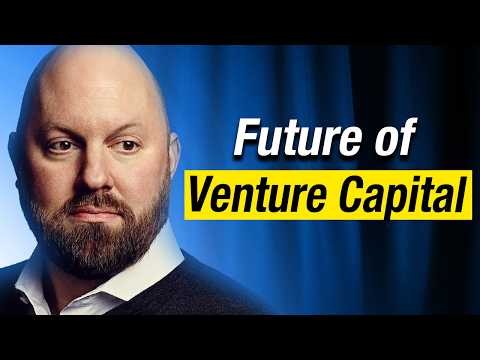
Marc Andreessen: Will a16z Go Public & Why Labour Displacement with AI is Wrong?
Marc Andreessen (guest), Harry Stebbings (host)
In this episode of The Twenty Minute VC, featuring Marc Andreessen and Harry Stebbings, Marc Andreessen: Will a16z Go Public & Why Labour Displacement with AI is Wrong? explores marc Andreessen on founders, venture discipline, AI myths, and centralization Andreessen argues introspection and “learning from mistakes” can be dangerous in venture because it encourages avoiding repeat patterns that may actually be the next Google-like opportunity.
Marc Andreessen on founders, venture discipline, AI myths, and centralization
Andreessen argues introspection and “learning from mistakes” can be dangerous in venture because it encourages avoiding repeat patterns that may actually be the next Google-like opportunity.
He outlines a founder-quality framework—high IQ as table stakes, plus courage and primal ambition/drive—and rejects the idea that investors must personally like founders to back them.
He contends venture remains fundamentally an early-stage business, with growth-stage investing serving mainly to double down on winners and keep Silicon Valley-style risk tolerance on the cap table.
Andreessen says a16z has no pressing reason to go public, emphasizing public-market burdens and noting supportive LP relationships reduce the need for structural change.
He calls AI labor-displacement theory a “lump of labor fallacy,” attributing recent layoffs to rate shocks and COVID overhiring, while predicting AI’s benefits will diffuse globally with massive consumer surplus.
Key Takeaways
In venture, ‘learning from mistakes’ can create systematic blind spots.
Andreessen says investors often avoid categories or founder archetypes that previously burned them (the “hot stove” problem), leading to costly mistakes of omission when the next breakout matches an old failure pattern.
Get the full analysis with uListen AI
Optimize for omission risk, not just loss avoidance.
He frames venture as uniquely skewed: losing $10M is painful, but missing a Google-sized outcome is far worse, so firms should encourage a risk-forward mindset and resist emotional overcorrection.
Get the full analysis with uListen AI
Great founders break rules—so screens should overweight the person.
Citing Arthur Rock, Andreessen suggests investors would do better focusing on the founder “resume” than pitch materials; exceptional founders can make “bad-looking” opportunities work and invalidate standard checklists.
Get the full analysis with uListen AI
Founder evaluation: IQ is necessary, courage and ambition are differentiators.
His personal signal is whether he’s taking lots of notes (learning from the founder), then he looks for “embrace the suck” resilience and a primal drive to build and prove capability beyond polished presentation.
Get the full analysis with uListen AI
Trauma can fuel founders, but it’s not required.
He acknowledges the ‘broken founders’ theory as sometimes explanatory (a primal reason to persist), but points to Zuckerberg and Gates as counterexamples who were driven without obvious trauma.
Get the full analysis with uListen AI
Overfunding and inflated valuations can harm companies operationally and financially.
Andreessen warns companies can die from “indigestion” (too much money) and that high-priced rounds set future hurdles; down rounds are socially and cap-table toxic, making “priced too high” a structural risk.
Get the full analysis with uListen AI
‘Diamonds in the rough’ is often investor ego, not edge.
He argues most true venture-worthy opportunities will be discovered by many hungry VCs; when a company is ‘rough,’ it’s frequently due to real defects (structure, location, founder disagreeableness) rather than hidden brilliance.
Get the full analysis with uListen AI
You don’t need to like founders—professional trust can be enough.
Andreessen says many great builders aren’t personally likable; investing should not be a substitute for friendship, and strong working relationships can succeed without personal closeness.
Get the full analysis with uListen AI
a16z doesn’t need an IPO because it lacks a ‘missing capability’ public markets solve.
He emphasizes the costs of being public (constant scrutiny, hostile incentives like shorting) and notes their LP base has been supportive and aligned with venture time horizons.
Get the full analysis with uListen AI
AI will centralize creation but democratize usage, producing massive consumer surplus.
He predicts frontier AI building remains clustered near Silicon Valley, yet the best AI is increasingly delivered via consumer apps worldwide—driving value mostly to users (99%+) rather than AI builders.
Get the full analysis with uListen AI
AI job-loss narratives confuse cyclical corrections with technological displacement.
Andreessen attributes layoffs to rapid rate increases and COVID-era overhiring, calling current ‘AI-driven layoffs’ a convenient justification; he argues productivity tools historically increase output and often hours worked.
Get the full analysis with uListen AI
Large companies are materially overstaffed post-COVID.
In a highly controversial claim, he estimates many large firms are 25–75% overstaffed, suggesting workforce reductions are normalization rather than evidence of imminent AI-driven labor collapse.
Get the full analysis with uListen AI
Notable Quotes
“Life just gets a lot simpler if you just assume everything is your own fault.”
— Marc Andreessen
“In venture, you're always much more worried about the mistake of omission than the mistake of commission.”
— Marc Andreessen
“Don’t ever do diamonds in the rough, only do diamonds.”
— Marc Andreessen
“There’s nothing that we’re missing today that we could solve by going public.”
— Marc Andreessen
“This entire labour displacement thing is 100% incorrect… It’s the lump of labor fallacy.”
— Marc Andreessen
Questions Answered in This Episode
On introspection: What practical decision process do you use to prevent ‘hot stove’ bias without repeating genuinely bad patterns?
Andreessen argues introspection and “learning from mistakes” can be dangerous in venture because it encourages avoiding repeat patterns that may actually be the next Google-like opportunity.
Get the full analysis with uListen AI
Founder assessment: Can you give 3–5 specific interview questions or exercises you use to test ‘courage’ and ‘ambition’ beyond IQ?
He outlines a founder-quality framework—high IQ as table stakes, plus courage and primal ambition/drive—and rejects the idea that investors must personally like founders to back them.
Get the full analysis with uListen AI
Valuations: If ‘passing over price’ was often a mistake, what concrete valuation signals (or terms) still make you walk away today?
He contends venture remains fundamentally an early-stage business, with growth-stage investing serving mainly to double down on winners and keep Silicon Valley-style risk tolerance on the cap table.
Get the full analysis with uListen AI
Overfunding: What operating symptoms most reliably show a company is suffering from ‘indigestion,’ and what interventions actually work?
Andreessen says a16z has no pressing reason to go public, emphasizing public-market burdens and noting supportive LP relationships reduce the need for structural change.
Get the full analysis with uListen AI
Diamonds vs diamonds-in-the-rough: What are the rare conditions where a ‘rough’ company is actually the right contrarian bet?
He calls AI labor-displacement theory a “lump of labor fallacy,” attributing recent layoffs to rate shocks and COVID overhiring, while predicting AI’s benefits will diffuse globally with massive consumer surplus.
Get the full analysis with uListen AI
Transcript Preview
I'm competing with myself. Life just gets a lot simpler if you just assume everything is your own fault. Everybody's feeling very tense and nervous and anxious and fearful, but everybody's pretending they're not feeling that way.
It has taken me 10 years, it has taken me 3,000 shows, but finally today I'm so proud to have Marc Andreessen on the show.
I think every time we've passed on a promising venture company over price, I think it's been a mistake. There's nothing that we're missing today that we could solve by going public.
The man who has built one of the greatest firms of our time. They manage over $90 billion.
The tech industry is more centralized in Silicon Valley than it has been in its entire existence, and I think it's AI.
And have invested in some of the most generational companies.
This entire labour displacement thing is 100% incorrect. [laughs] It's completely wrong. Essentially, every large company is overstaffed. It's at least overstaffed by 25%. I think most large companies are overstaffed by 50%. I think a lot of them are overstaffed by 75%.
This was a very special one for me, and I hope you enjoy the episode. Ready to go? [upbeat music] Marc, y-you probably don't know this, but I started this show when I was 18 years old, and you were one of three names that I wanted to have on the show back in 2015. I have to admit, I've ticked off the other two, and so I'm a bit worried that I'm gonna have to stop after doing this show.
[laughs]
But I'm so touched that you agreed to join me, so thank you for joining me.
Good. I'm thrilled to be here.
Now, I was running listening to every show that you've done before, and you recently said that you don't introspect and introspection is potentially overrated. I really struggled with this 'cause I thought we learnt from mistakes, and I valued experience in that way. Can you help me understand the lack of value placed on introspection, and do we not learn from mistakes?
Y-you know, we do learn from mistakes, uh, but the problem is learning from mistakes sometimes is good and sometimes it's bad, right? Um, and if, if we just talk business for a moment, like in the venture mindset, this is a very big problem. There's a founder version of the mistake, there's a venture version of the mistake. The founder version of the mistake is if a founder starts a company in a category and the founder doesn't work, the founder is then emotionally angry at that category for the rest of his life, um, and will not acknowledge, uh, when there's something that's gonna work in that category. Um, and I, I've just seen that like over and over and over again. Um, and, and, and that's fine 'cause most founders go on to do other things, and that's fine and good, and it, it generally doesn't damage them from a business standpoint. In venture, the same thing, [laughs] the same thing happens. If you invest in a category, or if, if you invest in a kind of company, uh, or you invest in a kind of founder, um, and it doesn't go well, it's extremely easy to learn from the mistake, right, and to basically say, "All right, I touched that hot stove. I'm never doing it again." And then, you know, y-you can tell me what happens next, right? Which is the next thing shows up and pattern matches, and it's the thing that you should invest in, and you have the chance to invest in, and... But, but you touch the scalded, scalded stove, and you know you're, you know you're learning from your mistakes, right? You're doing the responsible thing, and so you don't do it. And so I think there's something that's particularly pernicious [laughs] about learning from your mistakes in venture capital. And then I, I think that's also somewhat true about life. You get married multiple times. As they say, it's the triumph of hope over experience. Like, I think probably you want hope to triumph over experience, um, in, in that domain, and, and I think there's a lot of other domains of life in which that's probably true.
Install uListen to search the full transcript and get AI-powered insights
Get Full TranscriptGet more from every podcast
AI summaries, searchable transcripts, and fact-checking. Free forever.
Add to Chrome