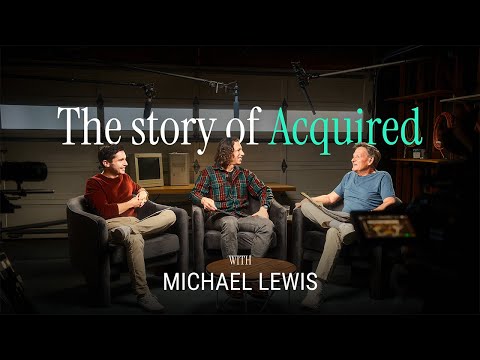
10 Years of Acquired (with Michael Lewis)
Ben Gilbert (host), David Rosenthal (host), Michael Lewis (guest), David Rosenthal (host)
In this episode of Acquired, featuring Ben Gilbert and David Rosenthal, 10 Years of Acquired (with Michael Lewis) explores michael Lewis helps Acquired unpack its decade-long podcast success formula Ben Gilbert and David Rosenthal mark Acquired’s 10th anniversary by letting Michael Lewis interview them about how the show evolved from short M&A chats into four-hour, thesis-level company narratives.
Michael Lewis helps Acquired unpack its decade-long podcast success formula
Ben Gilbert and David Rosenthal mark Acquired’s 10th anniversary by letting Michael Lewis interview them about how the show evolved from short M&A chats into four-hour, thesis-level company narratives.
They describe learning to embrace constraints (scarcity, handcrafted production, timeless topics), developing a rigorous research process (reading everything, then extensive expert calls), and protecting audience trust through obsessive editing and low ad load.
The discussion also unpacks Acquired’s unusual business model: direct-sold “Switzerland” B2B sponsors, deep partner integrations via events, and an investing flywheel aligned with sponsors—while resisting expansion that would dilute quality.
They close by applying Hamilton Helmer’s “7 Powers” to Acquired (especially scale economies, brand, counterpositioning, and process power) and reflecting on the biggest long-term risk: losing curiosity and delight in learning new things.
Key Takeaways
Make the product scarce to increase demand and perceived value.
Acquired intentionally publishes far fewer episodes than typical podcasts, reframing each release as an “event” (NFL-style scarcity). ...
Get the full analysis with uListen AI
Lean into constraints and handcraft the work—then build the business around it.
Like Hermès’ artisan-made Birkin model, Acquired decided every episode would be “made-with-love” by the two hosts (plus one editor), rather than scaling via teams, volume, or templated production.
Get the full analysis with uListen AI
Trust and churn-risk discipline drive quality in subscription media.
They view every minute “in the feed” as a churn opportunity; betraying listener trust is existential. ...
Get the full analysis with uListen AI
Introduce real risk and improvisation to create energy and authenticity.
Early episodes were “stale” because both hosts shared one research doc, eliminating surprise. ...
Get the full analysis with uListen AI
Timelessness is a strategic moat for back-catalog compounding.
They choose institutions likely to remain important years later, aiming for episodes to retain ~80% relevance after five years. ...
Get the full analysis with uListen AI
Use a ‘too hard pile’ to protect opportunity cost and focus.
Borrowing from Buffett/Munger, they say no to tempting distractions (Hollywood projects, certain topics like “the Fed” at times) because the best use of time is usually “make another episode.”
Get the full analysis with uListen AI
Depth research shifts from ‘internet spidering’ to human sources at scale.
Pre-2023 they rarely made calls; now dozens of interviews per series (e. ...
Get the full analysis with uListen AI
Editing is the hidden production engine—and a competitive advantage.
They record 8–9 hours with many retakes, receive an editor’s cut, then do days of transcript-based and listening-based trimming (hundreds of additional cuts) to reach a tight 3. ...
Get the full analysis with uListen AI
Direct-sold, selective sponsorships preserve brand integrity and economics.
They refuse agencies and keep ad load low, choosing “Switzerland” B2B partners whose products match the audience and can be ROI-positive from one deal. ...
Get the full analysis with uListen AI
Spectacle and events create ‘heat and light’ beyond the audience in the room.
Live shows (Chase Center, Radio City) are a tiny fraction of listeners but disproportionately build the franchise, attract elite guests, deepen sponsor ROI, and turn Acquired into a cultural moment for its niche.
Get the full analysis with uListen AI
Underperforming episodes can be strategically priceless.
Nintendo and IPL Cricket “underperformed” in downloads but became entry points for influential listeners that later unlocked major opportunities (e. ...
Get the full analysis with uListen AI
The biggest existential threat isn’t platforms—it’s losing delight.
They believe Acquired will fail if the hosts stop being surprised and energized by new understanding. ...
Get the full analysis with uListen AI
Notable Quotes
“You created the environment with the podcast that I try to create with a book… get them to the state of mind where they'll let you take them anywhere.”
— Michael Lewis
“Maybe if we just admit that we are heavily constrained, and then try to just lean into that constraint… every episode is gonna be entirely handcrafted by us.”
— Ben Gilbert
“We looked at each other, and you could burn cigarettes on our arms, and we wouldn't flinch.”
— David Rosenthal (quoting Doug Leone)
“Every minute is a churn opportunity.”
— Ben Gilbert
“If you feel a lot, someone's gonna feel it.”
— Michael Lewis
Questions Answered in This Episode
What specific workflow rules do you use to preserve surprise between hosts (what’s allowed to be shared vs kept separate), and how did that change the show’s “energy”?
Ben Gilbert and David Rosenthal mark Acquired’s 10th anniversary by letting Michael Lewis interview them about how the show evolved from short M&A chats into four-hour, thesis-level company narratives.
Get the full analysis with uListen AI
You said ‘timelessness’ means ~80% relevance in five years—what’s your concrete checklist for screening companies/topics against that bar?
They describe learning to embrace constraints (scarcity, handcrafted production, timeless topics), developing a rigorous research process (reading everything, then extensive expert calls), and protecting audience trust through obsessive editing and low ad load.
Get the full analysis with uListen AI
On the ‘Too Hard pile’: what would have to be true for you to revive the Fed episode, and what made it fail the first time (structure, fun, access, or timelessness)?
The discussion also unpacks Acquired’s unusual business model: direct-sold “Switzerland” B2B sponsors, deep partner integrations via events, and an investing flywheel aligned with sponsors—while resisting expansion that would dilute quality.
Get the full analysis with uListen AI
You moved from mostly desk research to dozens of calls per series—how do you decide which interviews are ‘must-have’ vs ‘nice-to-have,’ and how do you prevent source bias?
They close by applying Hamilton Helmer’s “7 Powers” to Acquired (especially scale economies, brand, counterpositioning, and process power) and reflecting on the biggest long-term risk: losing curiosity and delight in learning new things.
Get the full analysis with uListen AI
What are the most common ‘fact traps’ you’ve found in canonical business books, and how do you verify claims when primary sources disagree?
Get the full analysis with uListen AI
Transcript Preview
Happy ten years!
Happy ten-year anniversary, Ben.
It's crazy it's been ten years.
I know. Here we are. I brought you down here to Silicon Valley to, uh, record our ten-year anniversary holiday special here. I wanted a special place.
Yeah, what are we doing?
Home of, uh-
You keep, like, teeing up-
Yeah
... "Oh, just come down. Oh, we'll just record it here," and, like, clearly, we're not at your house.
I was actually thinking, uh, we should try and find the Silicon Valley house, the Ehrlich Bachman Aviato. [laughing]
It's Aviato.
Aviato! Aviato. No, the reason I brought you down here is I booked us a very special place to record. It's actually right over here.
It's a house. Is this the Google house?
It's the house.
The- where they had their first office in the garage?
This is Google's first office right here. They gave it to us for the day.
Like, we can do our holiday special in it?
Come on in. [upbeat music]
Who got the truth? Is it you, is it you, is it you? Who got the truth now? Is it you, is it you, is it you? Sit me down. Say it straight. Another story on the way. Who got the truth?
Welcome to the Fall 2025 season finale of Acquired, the podcast about great companies and the stories and playbooks behind them. I'm Ben Gilbert.
I'm David Rosenthal.
And we are your hosts. Well, listeners, today we're gonna do something very different than our holiday specials of years past. We've received a bunch of requests over the years to do an Acquired episode on Acquired itself, and to unpack why Acquired worked when 99% of podcasts do not. But it's always felt a little bit strange to me, and we've always shied away from analyzing our own company.
Yep. But then this year, we turned 10 years old and thought, "Well, maybe it's time for something," [laughing]
[laughing]
At least a sort of, uh, pause and reflection, you know, to shout out the Coca-Cola episode-
Oh!
... on our journey to this point and why Acquired has worked.
And so we thought, "Well, if we're gonna do something, we should bring someone in to do it with us," and we'd want someone who is great at dissecting the mechanics behind teams or companies, someone who distills complexity into simplicity, someone who himself knows how to tell a great story.
And there was really only one choice: Michael Lewis, author of Moneyball, Liar's Poker, The Blind Side, The Undoing Project, going infinite on and on and on, and of course, host of his own podcast, Against the Rules. And Ben, you and I have looked up to Michael forever, so this was really special.
Yes, and then, of course, there's the venue. We thought it'd be a fitting way to cap off the year of our three-part Google series to record in the literal garage where that nearly $4 trillion company got started.
Install uListen to search the full transcript and get AI-powered insights
Get Full TranscriptGet more from every podcast
AI summaries, searchable transcripts, and fact-checking. Free forever.
Add to Chrome