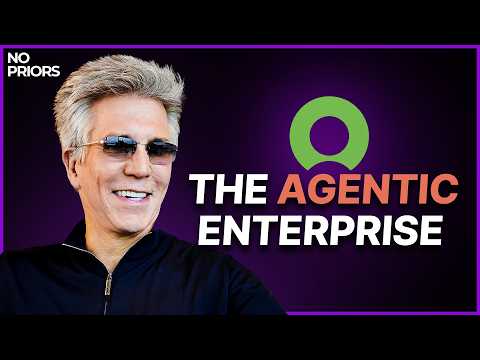
Scaling Global Organizations in the Age of AI with ServiceNow CEO Bill McDermott
Bill McDermott (guest), Sarah Guo (host), Sarah Guo (host)
In this episode of No Priors, featuring Bill McDermott and Sarah Guo, Scaling Global Organizations in the Age of AI with ServiceNow CEO Bill McDermott explores serviceNow CEO Bill McDermott on AI, platforms, and leadership mindset McDermott argues that enterprises won’t replace core workflow platforms with LLMs because rebuilding deterministic, trusted systems would be dramatically more expensive and risk-prone.
ServiceNow CEO Bill McDermott on AI, platforms, and leadership mindset
McDermott argues that enterprises won’t replace core workflow platforms with LLMs because rebuilding deterministic, trusted systems would be dramatically more expensive and risk-prone.
He frames ServiceNow as an “AI control tower” that connects systems of record, hyperscalers, data lakes, and language models so AI can think while workflows act and close cases.
He emphasizes leadership fundamentals—customer obsession, human connection, resilience, and agency—claiming these matter more as AI accelerates change and uncertainty.
He predicts agentic systems will absorb a large share of routine work, slowing net new headcount growth while raising the bar for uniquely human skills like judgment, innovation, and trust-building.
He describes enterprise AI adoption as moving from experiments to mainstream unevenly by industry and geography, with customers now demanding prescriptive, fast, ROI-proven deployments.
Key Takeaways
Customer obsession is the transferable core of leadership.
McDermott ties his deli experience to enterprise software: the customer “alone determines whether you win or lose,” and high-frequency customer interaction builds the EQ needed to lead at scale.
Get the full analysis with uListen
Agency can be taught, but it must be practiced and coached.
He argues confidence often comes from work and repeated real-world interaction; organizations should train, simulate, certify, and coach people to build presence and initiative beyond “mobile-phone-first” habits.
Get the full analysis with uListen
Enterprises want AI to be a force multiplier, not a replacement for accountability.
He claims businesses will tolerate human error but not software error, implying that trust, determinism, and support/escalation paths are central to enterprise adoption of AI-driven systems.
Get the full analysis with uListen
LLMs are powerful for guidance; platforms are essential for execution and closure.
His compensation-case example distinguishes between generating steps (LM) and orchestrating cross-department data/workflows to remediate and close the case (platform), summarized as “AI thinks but workflow acts.”
Get the full analysis with uListen
“SaaSpocalypse” is constrained by economics, switching costs, and context.
McDermott argues rebuilding platform functionality with generated code is a hidden 10× cost when you include replacement effort, opportunity cost of engineers, and ongoing GPU/token economics—especially without decades of enterprise context.
Get the full analysis with uListen
The winning posture is integration: become the orchestration layer across clouds, models, and records.
He positions ServiceNow as the “control tower” that connects hyperscalers, language models, and systems of record via a workflow data fabric (including “zero copy” claims) to enable agentic business end-to-end.
Get the full analysis with uListen
Agent adoption shifts workforce growth from headcount expansion to productivity expansion.
He predicts far fewer incremental hires in support functions as agents take workload, while investment concentrates on human innovation and relationship-based roles; he also forecasts massive agent proliferation (billions) and tougher skill differentiation for people.
Get the full analysis with uListen
Notable Quotes
““It is fast, but it'll never move this slow again.””
— Bill McDermott
““AI is to serve people and to make the human ambition greater, not to take it away from us.””
— Bill McDermott
““AI think[s] but workflow acts.””
— Bill McDermott
““People that run businesses understand that people make mistakes. They never will forgive software for making a mistake.””
— Bill McDermott
““If two people are in the same room at the same time with the same opinion, one of them is redundant.””
— Bill McDermott
Questions Answered in This Episode
You argue replicating a “simple application” from ServiceNow with an LLM is ~10× more expensive—what exact assumptions (build cost, maintenance, token usage, latency, reliability) drive that math?
McDermott argues that enterprises won’t replace core workflow platforms with LLMs because rebuilding deterministic, trusted systems would be dramatically more expensive and risk-prone.
Get the full analysis with uListen AI
When you say “AI thinks but workflow acts,” where do you draw the boundary for agents that can take actions (computer use) versus workflows that must remain deterministic and governed?
He frames ServiceNow as an “AI control tower” that connects systems of record, hyperscalers, data lakes, and language models so AI can think while workflows act and close cases.
Get the full analysis with uListen AI
You claim companies won’t forgive software mistakes—what reliability standard (error rates, auditability, rollback, human-in-the-loop) is required for agents to be trusted in mission-critical workflows?
He emphasizes leadership fundamentals—customer obsession, human connection, resilience, and agency—claiming these matter more as AI accelerates change and uncertainty.
Get the full analysis with uListen AI
You describe ServiceNow as a “control tower” across hyperscalers, LMs, and systems of record—what are the top 3 integration failures you see in practice, and how do you prevent them?
He predicts agentic systems will absorb a large share of routine work, slowing net new headcount growth while raising the bar for uniquely human skills like judgment, innovation, and trust-building.
Get the full analysis with uListen AI
Which “departmental” SaaS categories do you believe are most vulnerable to agentic automation, and what differentiates the survivors from the disrupted?
He describes enterprise AI adoption as moving from experiments to mainstream unevenly by industry and geography, with customers now demanding prescriptive, fast, ROI-proven deployments.
Get the full analysis with uListen AI
Transcript Preview
The cost to replace an enterprise platform in this SaaS apocalypse that people talk about is an extraordinary expense. Let's take that cost, and then let's take the cost associated with the human capital doing that instead of something else, 'cause the platform was doing the work for you. And then let's add up the cost of the GPU factory and the tokens that will materially affect their business model. And so for a simple application on our platform, it would be ten times greater in cost to try to replicate it with a language model. People that run businesses understand that people make mistakes. They never will forgive software for making a mistake.
[upbeat music] Hi, listeners. Welcome back to No Priors. Today, I'm here with Bill McDermott, CEO of ServiceNow, and the closest thing we have to a rock star in enterprise technology. We talk about leadership in the age of AI, what enterprise customers actually want, the difference between SaaS platforms and the SaaS apocalypse theory, and the next ten years of ServiceNow. Welcome. Thank you so much for being here.
Thank you for having me, Sarah. Thank you.
So, um, I wanna talk about your career and leadership and what's going on with ServiceNow, but I wanna start at the beginning. Um, I read Winterstream last week.
Thanks.
Uh, and you... It's an amazing book. You talk about the deli you bought when you were 16. Uh, first of all, that's a very strange thing to do.
[laughs]
Um, but it is such an amazing story. Can you tell me a little bit first about your thought process, and then we can talk about how you managed it.
Yeah. I don't, uh, I don't deserve too much credit for, um, you know, doing a strange thing buying the deli 'cause I was really trading in multiple part-time jobs.
Mm-hmm.
Uh, at the time, I was stocking shelves, pumping gas, and bussing tables, and so I had a chance to consolidate all of that into the delicatessen and have one job where I could spend all of my hours. And for a kid going to high school, that kinda made a little bit more sense. So I got lucky. I bought the business for fifty-five hundred notes, seven thousand with interest. If I make the payments, I keep it. If I miss a payment, they take everything away from me. So it was a pretty cut-and-dry moment, and I think the, the biggest thing that I've learned in my life, and especially there, is it's all about the customer. In the end, the customer and the customer alone determines whether you win or lose, and it's a very simple equation. If you ke-keep them coming back, you got a good chance, and if you don't, you lose. And, you know, back then, one of the most interesting parts about that store was knowing your customer and knowing your base. And I really had, you know, three main customers. You know, one was the blue-collar worker, like my dad, as I said in the book, was rich on Friday and dead broke by Sunday morning. There were the senior citizens, and this was the early days of DoorDash, I guess, because they never wanted to leave their house, and we delivered.
Install uListen to search the full transcript and get AI-powered insights
Get Full TranscriptGet more from every podcast
AI summaries, searchable transcripts, and fact-checking. Free forever.
Add to Chrome