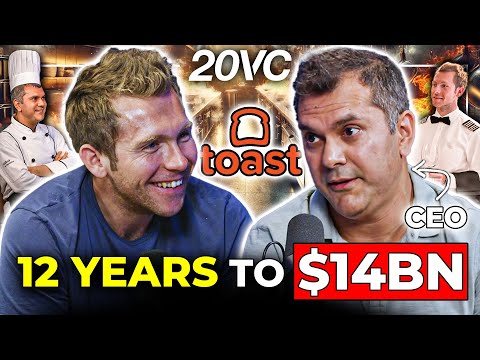
Aman Narang: 5 Lessons Scaling Toast to $14BN Market Cap | E1192
Aman Narang (guest), Harry Stebbings (host), Narrator
In this episode of The Twenty Minute VC, featuring Aman Narang and Harry Stebbings, Aman Narang: 5 Lessons Scaling Toast to $14BN Market Cap | E1192 explores aman Narang Reveals How Toast Scaled Relentlessly While Staying Scrappy Aman Narang, co‑founder and CEO of Toast, walks through Toast’s journey from an unfocused early startup to a $14B+ public company powering restaurant operations and payments.
Aman Narang Reveals How Toast Scaled Relentlessly While Staying Scrappy
Aman Narang, co‑founder and CEO of Toast, walks through Toast’s journey from an unfocused early startup to a $14B+ public company powering restaurant operations and payments.
He emphasizes the primacy of speed once you see product–market fit, the importance of hiring great people and real managers earlier, and learning when to press the growth pedal versus pause to fix foundations.
Narang explains key strategic pivots: from QR code ordering to full POS, from pure software to embedded fintech, and from mid‑market restaurants into both SMB and larger chains.
Throughout, he stresses customer obsession, grit under scarcity, disciplined product expansion, and building a culture that balances entrepreneurial generalists with seasoned specialists.
Key Takeaways
Move extremely fast once you see product–market fit, but not before.
Toast spent months flailing on ideas, but once they saw clear demand for cloud POS and handhelds, the company accelerated aggressively; Narang wishes they had added leadership and infrastructure sooner once that signal appeared.
Get the full analysis with uListen
Hire real managers and specialists earlier to gain leverage beyond founders.
Early on, the founders tried to “do all the management” and only hire doers; Narang now sees that professional managers and domain experts dramatically increase speed, quality, and scalability once there is traction.
Get the full analysis with uListen
Let customer pull, not clever ideas, guide your product direction.
The QR‑code ordering concept generated apathy, while POS discussions had restaurateurs giving Toast hours of their time—strong signal that a “non‑sexy” rebuild of POS was actually the real 10x opportunity.
Get the full analysis with uListen
Combine software with embedded fintech to make the business model work.
Pure SaaS economics on restaurant POS were challenging; adding payments and later lending (Toast Capital) created stronger unit economics, better customer value, and a richer data advantage.
Get the full analysis with uListen
Don’t overextend product and segment scope; integrated but mediocre isn’t enough.
Toast learned that simply bundling commodity products (e. ...
Get the full analysis with uListen
Fundraising deserves real preparation, but customer love still comes first.
The team initially “winged it” with decks, couldn’t answer CAC/LTV questions well, and got many rejections; Narang now advises founders to build a credible economic model and narrative without letting metrics overpower the focus on customer success.
Get the full analysis with uListen
Culture, values, and hiring quality compound more than any single deal or feature.
Narang now prioritizes defining roles clearly, running rigorous interviews, and protecting culture early, arguing that bad early leadership hires are extremely hard to unwind and shape the company for years.
Get the full analysis with uListen
Notable Quotes
“Speed matters a lot in business, a lot. Once you see signal that you've got product–market fit, you gotta move fast.”
— Aman Narang
“Toast wouldn't exist without Android and cloud and embedded payments.”
— Aman Narang
“One of the biggest mistakes was not recognizing that you don't just get leverage from hiring salespeople or engineers—you get a ton of leverage from just hiring people to help you.”
— Aman Narang
“We were trying to move very fast and trying to scale as fast as possible… I think we could have slowed down to speed up.”
— Aman Narang
“Business is about people. You can have any strategy you want on a slide, but it's about the people.”
— Aman Narang
Questions Answered in This Episode
How do you decide, in real time, that you have enough product–market fit signal to justify pressing the growth pedal hard?
Aman Narang, co‑founder and CEO of Toast, walks through Toast’s journey from an unfocused early startup to a $14B+ public company powering restaurant operations and payments.
Get the full analysis with uListen AI
What specific leading indicators would tell you today that you’re scaling too fast for your foundations and need to pause or rebalance?
He emphasizes the primacy of speed once you see product–market fit, the importance of hiring great people and real managers earlier, and learning when to press the growth pedal versus pause to fix foundations.
Get the full analysis with uListen AI
How should an early‑stage vertical SaaS founder think about when to add embedded fintech versus staying pure software?
Narang explains key strategic pivots: from QR code ordering to full POS, from pure software to embedded fintech, and from mid‑market restaurants into both SMB and larger chains.
Get the full analysis with uListen AI
Where is the line between healthy scrappiness and under‑investing in management, culture, and infrastructure?
Throughout, he stresses customer obsession, grit under scarcity, disciplined product expansion, and building a culture that balances entrepreneurial generalists with seasoned specialists.
Get the full analysis with uListen AI
How do you practically balance empowering entrepreneurial generalists with bringing in experienced specialists without losing that early‑stage spirit?
Get the full analysis with uListen AI
Transcript Preview
(instrumental music plays) Speed matters a lot in business, a lot. Once you see signal that you've got product market fit, you gotta move fast. Toast wouldn't exist without Android and cloud and, and embedded payments. Like, those were the three trends that really drove the beginnings of Toast. And one of the mistakes most founders make is you don't wanna give up any control because you're like, "Well, I need to know what the heck's going on." And the reality is, you can benefit from people that are domain experts and specialists in specific areas, but you also don't wanna lose your entrepreneurial spirit.
Ready to go? Aman, listen, I have heard so many great things from so much of your cap table, so thank you so much for joining me today, my friend.
I'm excited to be here, Harry.
Now, I always wanna go back to a little bit of the childhood actually. I was shaped by actually my mother getting MS. It was a-
Hmm.
... very hard moment in my childhood.
Mm-hmm.
When you think back to the most shaping moments of your upbringing, what are one or two that really stand out?
I had a great upbringing. I had, uh, these very committed parents, especially my mom, who really lived for me and my brother. And even today, like, I show up, you know, and she l- my parents live next door to me, and they're like, "What can we make for you right now?" (laughs) So, I've been... I was very fortunate to have been brought up in this household with lots of family and extended family that just cared deeply and made you feel so special. Um, and then in ninth grade, right, I went to boarding school because we were living in Nepal. So I was born in India and moved to Nepal when I was seven, and, uh, my parents felt like we needed to go... My dad felt like I needed to go to this boarding school because, uh, the school was too easy that I was at. I think that's what he told me. (laughs)
(laughs)
You know, I showed up. I probably didn't help myself because I was a confident kid, and, um, they put me in my place, and that was really, really tough because, you know, I was bullied, and it was, uh... I only, I only lasted a year (laughs) actually at the school. So that was, you know, a shaping experience for me. It taught me a lot about grit. It taught me a lot about, you know, working through challenges, working through, um, you know, a tough situation where you had folks that, um, um, you know, um, wanted to make your life difficult. Like, I think they had put a target on my back at one point. (laughs)
(laughs)
So that experience, I think I look back to, but I, I'm grateful for it because I d- I really do think it made me stronger.
Install uListen to search the full transcript and get AI-powered insights
Get Full TranscriptGet more from every podcast
AI summaries, searchable transcripts, and fact-checking. Free forever.
Add to Chrome