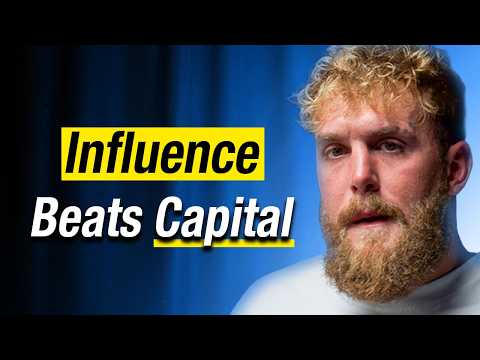
Jake Paul: Traditional VC is Toast & Attention is More Valuable than Cash
Geoffrey Woo (guest), Harry Stebbings (host), Jake Paul (guest)
In this episode of The Twenty Minute VC, featuring Geoffrey Woo and Harry Stebbings, Jake Paul: Traditional VC is Toast & Attention is More Valuable than Cash explores jake Paul argues attention beats capital, reshaping venture investing today Paul and Woo position their “Anti Fund” thesis around attention being more valuable than capital, arguing distribution, cultural fluency, and access can outcompete traditional VC playbooks.
Jake Paul argues attention beats capital, reshaping venture investing today
Paul and Woo position their “Anti Fund” thesis around attention being more valuable than capital, arguing distribution, cultural fluency, and access can outcompete traditional VC playbooks.
They describe a hybrid strategy across venture investing, selective incubation (e.g., Better), and potential expansion into late-stage and even public markets where brand can materially move outcomes.
Paul frames content creation as a hyper-engineered craft—down to milliseconds—built on emotional storytelling and pattern recognition, and he claims similar instincts transfer to investing and trend prediction.
They discuss defensibility in an AI-saturated world, debating whether sports and live competition remain uniquely resilient or get disrupted by hyper-personalized AI entertainment.
The conversation broadens into leadership and politics, with both endorsing bold, risk-taking governance, and Paul sharing personal drivers, relationship principles, and mental health management practices.
key_topics=[
Key Takeaways
Attention can be a stronger moat than money in venture.
They argue capital is increasingly commoditized, while the ability to capture and redirect attention—through brand, storytelling, and cultural relevance—can create disproportionate deal flow and growth leverage.
Get the full analysis with uListen
Creator skill sets can translate into investing “taste.”
Paul’s background optimizing short-form content trains rapid pattern recognition and audience intuition; Woo claims these instincts map to identifying winning founders and products earlier than “boomer VC” frameworks.
Get the full analysis with uListen
A founder-facing VC product should be explicit and situational.
They emphasize not promising distribution for every investment; instead, they tailor value-add per company—introductions, comms, partnerships, and specific network access—based on what will actually move the needle.
Get the full analysis with uListen
Late-stage investing may be where their brand advantage compounds most.
They agree that at pre-IPO scale, outcomes depend heavily on mass media, reputation, and narrative; a high-profile operator can substitute for (or outperform) expensive marketing hires and agencies.
Get the full analysis with uListen
Incubation offers asymmetric upside but demands focus.
They cite incubated businesses like Better as chances to own more and “promote it better,” but note company-building is labor-intensive and can’t be done at high volume without dilution of effort.
Get the full analysis with uListen
AI may fragment entertainment demand in unpredictable ways.
Paul raises the possibility that personalized, AI-generated games and films could pull attention away from shared spectacles like the NBA, challenging the assumption that sport is automatically the most AI-defensible asset.
Get the full analysis with uListen
Sustained performance depends on deliberate mind management and relationship habits.
Paul describes mental health as variable and requiring daily practice (breathwork, meditation, psychedelics/spiritual journeys), and recommends “competing to be the 60%” in relationships through over-communication and active support.
Get the full analysis with uListen
Notable Quotes
“Attention is more valuable than capital.”
— Jake Paul
“Every little millisecond is calculated and dialed and thought through.”
— Jake Paul
“Can VCs become influencers faster than native influencers like Jake and Logan can become VCs?”
— Geoffrey Woo
“I don’t care what they feel, but I know in certain videos what I’m gonna make them feel.”
— Jake Paul
“That’s my fucking president and I’m gonna back him.”
— Jake Paul
Questions Answered in This Episode
How exactly do you decide when an investment gets distribution versus when it only gets “back-channel” help (intros, comms, partnerships)?
Paul and Woo position their “Anti Fund” thesis around attention being more valuable than capital, arguing distribution, cultural fluency, and access can outcompete traditional VC playbooks.
Get the full analysis with uListen AI
What does “attention is more valuable than capital” look like in measurable KPIs for a portfolio company (CAC, activation, retention, enterprise pipeline)?
They describe a hybrid strategy across venture investing, selective incubation (e. ...
Get the full analysis with uListen AI
You said you can predict video views with ~85% accuracy—what are the leading indicators you track before publishing, and can founders apply the same framework to product launches?
Paul frames content creation as a hyper-engineered craft—down to milliseconds—built on emotional storytelling and pattern recognition, and he claims similar instincts transfer to investing and trend prediction.
Get the full analysis with uListen AI
What are the specific failure modes you’ve seen when other creators try to become investors, and what capabilities are non-negotiable to avoid being “tourist capital”?
They discuss defensibility in an AI-saturated world, debating whether sports and live competition remain uniquely resilient or get disrupted by hyper-personalized AI entertainment.
Get the full analysis with uListen AI
If AI enables everyone to generate personalized movies and games, what becomes the new scarce resource—live sport, community, identity, or something else?
The conversation broadens into leadership and politics, with both endorsing bold, risk-taking governance, and Paul sharing personal drivers, relationship principles, and mental health management practices.
Get the full analysis with uListen AI
Transcript Preview
It goes back to, like, one of our founding principles, which is attention is more valuable than capital.
Today we have such a different one for you. Jake Paul, one of the most recognizable people on the planet, is in the studio, baby. He's here with his partner, Geoffrey Woo. What you don't know about Jake, he's probably one of the best investors of the last few years with his fund, the Anti Fund. They back the likes of Ramp, Cognition, Chronosphere, and many others.
Can VCs become influencers faster than, like, native influencers like Jake and Logan can become VCs?
This is a show unlike any that Jake has done before, ranging from politics to parenting to the next generation of great investments.
You don't want a career politician running a business. The first startup in America was America. It's a fucking business. I take home, like, nearly 100%.
Well, that's pretty fucking great, isn't it? [laughs]
[laughs]
This was a fascinating discussion revealing a side to Jake that I don't think many people have seen before.
YouTube, like, I was done with it. I didn't like it anymore.
Do you think Trump's doing a good job?
Yes, I do. I, I think-
Ready to go? [upbeat music] Boys, it is so good to have you in the studio. I'm so excited that we got to do this in person, so thank you for joining me.
100%, man. Thank you for having us.
Now, I wanna start on the fund. This is a VC show first and foremost. But I actually spoke to John at Wander, who is a portfolio company of yours, and he said that you've actually got to start with just mapping out the Jake Paul business empire ecosystem to fully understand what it's like. Can you just give us, like, an overview and, wh- whoever's best for this, an overview of what the Jake Paul business empire looks like today?
Yeah, so it goes, like, anywhere from being a peanut farmer-
[laughs]
... to, uh, fighting Anthony Joshuas, um, to venture and, you know, working with OpenAI [laughs] and advising them. Um, but yeah, I have, I have a ranch where, like, I literally sell peanuts. But yeah, like, it's, it's, it's, it's entertainment mixed, yeah, obviously with, with, uh, the entrepreneurial vibes, but it's, you know, Better, which is sports gaming. It's W-
I spoke to the founder beforehand.
Okay. Joey?
Yeah.
He's great. He's great.
Yeah, I spoke to Joey. I think-
Wow, you really, you really talked to everyone. [laughs]
Dude, dude, I did. I was like, "Listen, are you Jo- Jake obviously, um, you know, invests in you guys." He's like, "No, he didn't. He co-founded it with me."
Yeah.
And, and so we had a lovely chat.
Yeah.
Oh, dude, I'm-- I, I do my work.
Yeah, you're locked in.
Yeah.
But, yeah.
This is why I like the show. I mean, maybe the way, like, 'cause I- it's easier for me to brag about Jake, but I think the highest order bit is that I think Jake represents the next generation of Americans and what they want to be like. And I think we have a unique opportunity to not just be an in-- Jake being an inspirational model, but also be a capital force and an attention force to drive a future and a culture that we wanna see. So I think if you stem from a, just a demographic perspective, right? The number one job that young people wanna have is to be an influencer.
Install uListen to search the full transcript and get AI-powered insights
Get Full TranscriptGet more from every podcast
AI summaries, searchable transcripts, and fact-checking. Free forever.
Add to Chrome