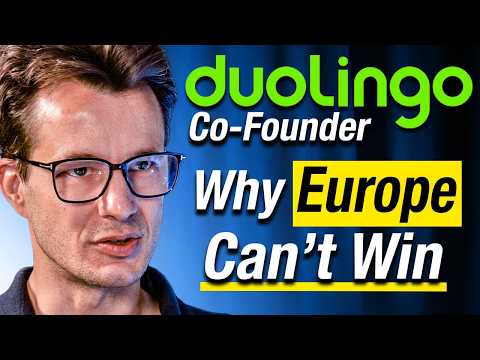
Duolingo Co-Founder, Severin Hacker: How AI Impacts the Future of Work and Education
Severin Hacker (guest), Harry Stebbings (host)
In this episode of The Twenty Minute VC, featuring Severin Hacker and Harry Stebbings, Duolingo Co-Founder, Severin Hacker: How AI Impacts the Future of Work and Education explores duolingo CTO on AI Tutors, Motivation Engines, and Future of Work Severin Hacker, Duolingo’s co-founder and CTO, explains how AI is transforming both Duolingo’s product and internal operations while reinforcing, not replacing, the company’s original mission of accessible education. He details how large language models have 10x–12x’d course creation, enabled new conversational features like “Video Call with Lily,” and reshaped engineering, customer support, and content workflows. The conversation digs into retention and motivation as Duolingo’s true moat, the future of CS careers and AGI, and how AI may alter education, work, and societal structures. Hacker also reflects on building Duolingo outside Silicon Valley, fundraising dynamics, Europe’s challenges, and his evolving role, leadership style, and relationship with money and purpose.
Duolingo CTO on AI Tutors, Motivation Engines, and Future of Work
Severin Hacker, Duolingo’s co-founder and CTO, explains how AI is transforming both Duolingo’s product and internal operations while reinforcing, not replacing, the company’s original mission of accessible education. He details how large language models have 10x–12x’d course creation, enabled new conversational features like “Video Call with Lily,” and reshaped engineering, customer support, and content workflows. The conversation digs into retention and motivation as Duolingo’s true moat, the future of CS careers and AGI, and how AI may alter education, work, and societal structures. Hacker also reflects on building Duolingo outside Silicon Valley, fundraising dynamics, Europe’s challenges, and his evolving role, leadership style, and relationship with money and purpose.
Key Takeaways
AI is an accelerant to Duolingo’s original vision, not a pivot.
Hacker stresses that Duolingo was always technology-first; modern AI simply makes the long-held dream of a one-on-one tutor for everyone actually feasible, especially through personalization and interactive, multimodal experiences.
Get the full analysis with uListen
Content generation is where AI delivers immediate, massive leverage.
By using LLMs to generate constrained example sentences while humans still design curricula, Duolingo created 148 new courses in a year—compared to ~100 over the prior 12 years—dramatically improving speed and margins.
Get the full analysis with uListen
Motivation and retention, not “AI” itself, are Duolingo’s real moat.
Hacker argues the hardest part of learning isn’t content or explanation, but getting users to come back daily; Duolingo’s gamified “motivation engine” (streaks, leagues, XP) is what keeps hyper‑casual users from drifting back to social media.
Get the full analysis with uListen
AI augments engineers and broadens who can build, but doesn’t replace deep software skills yet.
Current tools excel at small, isolated changes and simple apps (0→80%), but struggle with large, evolving codebases and architectural decisions, suggesting more software and new hybrid roles (product–engineer–designer) rather than a collapse of engineering careers.
Get the full analysis with uListen
Monetization and senior hiring were delayed too long—and both mattered.
Duolingo operated for five years with zero revenue and a flat, junior-heavy org; in hindsight, Hacker thinks they should have taken monetization and experienced management seriously 1–2 years earlier while still honoring their access-for-all mission.
Get the full analysis with uListen
Public markets reward predictability as much as performance.
Going public added significant overhead but created liquidity and ecosystem impact; Hacker notes public investors care intensely that management can accurately predict the business, which is challenging in an AI-driven, fast-changing environment.
Get the full analysis with uListen
Europe’s tech ecosystem still pushes its most ambitious founders away.
Despite wanting Europe to succeed, Hacker says he would still tell a young AI founder to move to Silicon Valley for network, capital, and culture, arguing that regulation, mindset, and support structures in Europe remain comparatively weak.
Get the full analysis with uListen
Notable Quotes
“The hardest part about learning a language is the motivation. Duolingo is a motivation engine.”
— Severin Hacker
“We didn't change to become AI-first; we've always been technology-first. AI just finally got good enough.”
— Severin Hacker
“It's harder to raise three million than it is to raise 100 million.”
— Severin Hacker
“Every investor wants a one-word secret sauce. The real answer is thousands of A/B tests.”
— Severin Hacker
“If a young European founder asked me where to build an AI company, I’d say 100% go to Silicon Valley.”
— Severin Hacker
Questions Answered in This Episode
If motivation is the main bottleneck in learning, what new mechanics (beyond streaks and leagues) could further increase user persistence without feeling manipulative?
Severin Hacker, Duolingo’s co-founder and CTO, explains how AI is transforming both Duolingo’s product and internal operations while reinforcing, not replacing, the company’s original mission of accessible education. ...
Get the full analysis with uListen AI
How far can AI realistically go in designing curricula and running fully personalized, on-the-fly courses before humans become unnecessary in instructional design?
Get the full analysis with uListen AI
What specific signals or metrics would convince Duolingo that AI is finally strong enough to handle the full lifecycle of feature development in large codebases?
Get the full analysis with uListen AI
If AI tutors become as effective as great human tutors, how should K-12 and universities redesign the role of teachers, classrooms, and credentials?
Get the full analysis with uListen AI
What concrete policy or cultural shifts would be most effective in keeping the next ‘Duolingo-scale’ AI companies headquartered in Europe instead of Silicon Valley?
Get the full analysis with uListen AI
Transcript Preview
You should always try to raise money from the best tier one VCs, even if the terms are slightly worse, because there's so much signaling. It's harder to raise three million than it is to raise 100 million. But I can guarantee you, Duolingo would not have been able to raise any money in Europe. You know, we had $0 revenue for the first five years.
How much was the series A?
Three million at, uh, 15. Yeah. I think we only had one offer. It was ... or back to university.
Ready to go? Severin, I'm so excited for this, dude. I had Luis on six or seven years ago, and I've heard so many great things before this show from Mayumi Bang, from KP, Brad and Albert from USV, many others. So thank you so much for doing this.
Thank you. Thank you for having me.
Dude, I would love to start though with basically the news of the day. Um, I don't like the, you know, the whole context of, like, tell me your life story in normal podcast intros. Uh, Duolingo came out as being AI first the other day. And I really just wanted to start with, what does that mean and what does that not mean? So people have a clear understanding.
Okay. So maybe taking a step back. Why did we start Duolingo? Like, what is our mission? So Duolingo's mission is to provide the best education and make it universally available. That's why Luis and I started this company. Okay? And from day one, if you think about it, if you wanna build the best education, um, in the past, the best education was only available to the, the richest people, the kings, the heads, you know, the private tutors for their kids. And, and, you know, that was the, the way to learn, the most efficient way. And by the way, this is still true today. If you wanna become the best tennis player, you hire a one-on-one tennis coach. Okay? Now-
You actually, you actually see this. I remember there was a US Open final, I think it was, and the two female players in the final were both daughters of billionaires.
Uh, yeah. (laughs)
Yeah.
Yeah, exactly. So, so, you know, they get the one-on-one tutor. And when we started Duolingo, we saw the, the potential of technology to do this, but for everyone, right? So we can't all afford these one-on-one tutors. That's, it's too expensive. Um, but with technology, there's a way we believe that anyone can have access to a, the equivalent of a one-on-one tutor, this, with the same efficacy. And that's why we started Duolingo. So technol- ... Duolingo was, from day one, was technology first. And, you know, back then, it was g- you know, software, we called it software. Uh, now we call it AI. Um, so in a way, not much has changed, except AI, as we now call it, has become a lot better.
Install uListen to search the full transcript and get AI-powered insights
Get Full TranscriptGet more from every podcast
AI summaries, searchable transcripts, and fact-checking. Free forever.
Add to Chrome