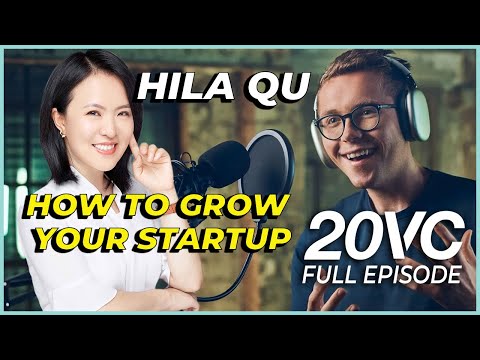
Hila Qu: The Ultimate Guide to Product Growth at Your Startup | 20VC #967
Hila Qu (guest), Harry Stebbings (host)
In this episode of The Twenty Minute VC, featuring Hila Qu and Harry Stebbings, Hila Qu: The Ultimate Guide to Product Growth at Your Startup | 20VC #967 explores from Experiments To Engines: Building Startup Growth Teams That Scale Hila Qu, former VP of Growth at Acorns and Head of Growth at GitLab, breaks down how founders should think about growth as both a business outcome and a scientific discipline driven by data and experimentation.
From Experiments To Engines: Building Startup Growth Teams That Scale
Hila Qu, former VP of Growth at Acorns and Head of Growth at GitLab, breaks down how founders should think about growth as both a business outcome and a scientific discipline driven by data and experimentation.
She explains how Acorns layered channels, built a full-funnel growth org, and systematically optimized paid acquisition (especially Facebook) through rapid creative testing and tight cross-functional collaboration.
The conversation then focuses on when and how to hire the first growth person, how to structure their first 90 days, the role and compensation of agencies and advisors, and the data infrastructure needed for product-led growth.
Qu also clarifies concepts like funnels vs. loops, B2B vs. B2C growth orgs, and stresses culture and data as the main reasons growth teams succeed or fail.
Key Takeaways
Start with a product people truly love, then layer growth channels.
Acorns’ early growth came from a beloved Roundups feature and word-of-mouth; only after that did they systematically add Facebook ads, referrals, more paid channels, and new product lines to increase LTV and support higher CAC.
Get the full analysis with uListen
Treat growth as a scientific discipline powered by data and experiments.
Growth is not just ‘more users’ but a process: form hypotheses, run A/B tests, analyze results, and iterate across acquisition, activation, revenue, and retention using robust analytics and attribution tools.
Get the full analysis with uListen
Build cross-functional, full-funnel growth teams for compounding impact.
At Acorns, marketers, growth PMs, designers, engineers, and analysts sat together and owned the entire funnel—from acquisition to retention—which unlocked more ideas, faster iteration, and bigger wins.
Get the full analysis with uListen
Hire a mid-level, analytical growth generalist as your first growth hire.
For early-stage startups, Qu recommends an experienced growth PM or marketer (often ex-analyst) who’s scrappy, data-fluent, eager to learn channels/product, and can grow into Head of Growth—rather than a VP or a junior.
Get the full analysis with uListen
Set up modern data infrastructure early, especially for product-led growth.
Founders should move beyond basic Google Analytics to tools like Amplitude or Mixpanel, solid tracking plans, and channel attribution (e. ...
Get the full analysis with uListen
Use the first 90 days to score quick wins and institutionalize experimentation.
Week 1 is for mapping tools, data, people, and customers; Month 1 should deliver quick, visible improvements (often in activation & conversion); by Quarter 1, there should be a documented growth model, experimentation cadence, system of record, weekly growth meetings, and a budding growth culture.
Get the full analysis with uListen
Loops drive compounding growth, but funnels drive daily execution.
Growth loops (paid, viral, content/SEO) explain how users or money generate more users or money; funnels break those loops into steps and conversion rates that teams can actually improve through experiments.
Get the full analysis with uListen
Notable Quotes
“Growth is both a result and a discipline.”
— Hila Qu
“Product-led growth is fundamentally data-led growth.”
— Hila Qu
“Wins change people's perception. You can get more resources, everything else becomes easier.”
— Hila Qu
“Just putting four things into a circle doesn’t make it a loop.”
— Hila Qu
“The biggest reason growth teams fail is culture.”
— Hila Qu
Questions Answered in This Episode
If my product doesn’t yet have strong word-of-mouth, what concrete signals should I wait for before making my first dedicated growth hire?
Hila Qu, former VP of Growth at Acorns and Head of Growth at GitLab, breaks down how founders should think about growth as both a business outcome and a scientific discipline driven by data and experimentation.
Get the full analysis with uListen AI
How should I adapt Hila’s ‘first 90 days’ plan if I’m a technical founder with very limited marketing experience and almost no data infrastructure?
She explains how Acorns layered channels, built a full-funnel growth org, and systematically optimized paid acquisition (especially Facebook) through rapid creative testing and tight cross-functional collaboration.
Get the full analysis with uListen AI
What’s the practical process for deciding whether my primary early growth bet should be paid, viral loops, or content/SEO?
The conversation then focuses on when and how to hire the first growth person, how to structure their first 90 days, the role and compensation of agencies and advisors, and the data infrastructure needed for product-led growth.
Get the full analysis with uListen AI
In a B2B context with low volume and messy data, how can I run experiments that are still reliable enough to inform product and go-to-market decisions?
Qu also clarifies concepts like funnels vs. ...
Get the full analysis with uListen AI
What are examples of growth experiments that looked great on short-term numbers but damaged long-term user quality or brand—and how can I avoid those traps?
Get the full analysis with uListen AI
Transcript Preview
I caused, actually, some explosions. (explosion)
The world of growth, it's a new world.
Growth advisor actually can help you figure out that growth architect, that map. A lot of founders in early stage, they use Google Analytics. It's okay, but I would say it's less generation of analytic tool. You want to have tools like...
On the equity side, is it like 0.1% or is it like 2%?
Wins change people's perception. You can get more resources, everything else become easier. Product-led growth is fundamentally data-led growth.
You are a star. Hila, I'm so excited for this. I heard so many good things from Josh before the show. So first, thank you so much for joining me today.
Thank you for having me, Harry. It's a, it's a, it'll be a fun experience.
Oh, it'll be a great chat. But I wanna start with a little bit on you and provide some context. We see Acorns, we see GitLab, and the world of growth, it's a new world. So how did you make your way into the world of growth and come to lead some incredible growth orgs at Acorns and GitLab most recently?
So believe it or not, I was a biology major, and I suck at doing experiments in the lab. I caused, actually, some explosions. Um, everyone is safe, so don't worry. But I always loved idea of scientific experiment. So I got my MBA, I transitioned into the business world initially as a data analyst. Uh, but very quickly I found that doing data analysis is awesome, but I don't get to do anything with my awesome recommendations. The PMs, the marketers, they don't take my recommendations. So I joined a very small startup called GrowthHackers.com, um, and I become a product manager, growth. And back then, that title is confusing, like, "Product manager? Growth? What do you exactly do?" Um, but I love that role. It really allow me to use my analytical background, my product manager background, my marketing background, and pretty much do everything. Uh, and from there, I become kind of this growth person. I joined Acorns, uh, and ended up leading their entire growth team as VP Growth. And most recently, I joined GitLab, building their gr- uh, growth team from scratch as well. Now I work as a growth advisor. So, like, I'm really deep into the world of growth.
I, I love it. And I, I spoke to Josh before the show, and he said that I really had to dig in on the Acorns journey because you were so instrumental to building that growth org and really making sure it worked so efficiently. He asked what tactic really worked and what did you learn from that?
Yeah, yeah. I, I think, like, I would say there are definitely some, I would say, mega learning from my Acorns experience. Um, first of all, the company really starts as a product that people love. Like, we have a feature called Roundup. Roundup your spare change so that you can invest with, with very small amount of money. Our early adopters loved it, and that powered the initial word of mouth growth. And from there, I think one thing we did right is that we layered on multiple growth channels. So, like, initially it's word of mouth. We quickly expanded to paid, like Facebook. We're very early in capturing the Facebook, uh, wave. We added paid referral and then we divide- diversified into more paid channels. We added new product lines so that we can charge more, and then that higher revenue a- allow us to unlock a higher, uh, CAC in paid channels or more paid channels. I think that layering on really helped. That's one learning. The other one I would say is, uh, we established a full funnel growth team. By full funnel, I mean marketing, growth product, analytics, design engineer, we sit together. I manage that team. So, um, I'm responsible for acquisition, how to get people download the app, but also I'm responsible for getting them to sign up, invest their money, uh, become a paid customer, retain, and maybe try other products, right? So, like that really full funnel approach allow us to unlock many opportunities and experiments and successes.
Install uListen to search the full transcript and get AI-powered insights
Get Full TranscriptGet more from every podcast
AI summaries, searchable transcripts, and fact-checking. Free forever.
Add to Chrome