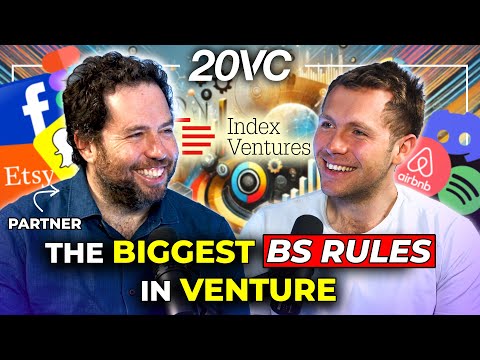
Danny Rimer: The Biggest Lessons from Missing Snap, Airbnb, Spotify and Facebook | E1166
Danny Rimer (guest), Harry Stebbings (host)
In this episode of The Twenty Minute VC, featuring Danny Rimer and Harry Stebbings, Danny Rimer: The Biggest Lessons from Missing Snap, Airbnb, Spotify and Facebook | E1166 explores danny Rimer on focus, founders, and learning from billion‑dollar misses Danny Rimer, partner at Index Ventures, reflects on two decades of venture investing, emphasizing ruthless focus, founder quality over theses, and disciplined decision-making. He shares painful stories of missing or underweighting Facebook, Snapchat, Spotify, Airbnb and others, and how those scars reshaped Index’s approach to TAM, valuation, and reserves. The conversation dives into Index’s internal mechanics—voting, thesis ‘majors and minors,’ multi-stage reserving, exit discipline, and scaling globally while staying a “scaled artisan” rather than an asset gatherer. Rimer also explores founder psychology, brand and scarcity, cultural differences between US and European entrepreneurs, and the personal tradeoffs of building a global firm while maintaining family priorities.
Danny Rimer on focus, founders, and learning from billion‑dollar misses
Danny Rimer, partner at Index Ventures, reflects on two decades of venture investing, emphasizing ruthless focus, founder quality over theses, and disciplined decision-making. He shares painful stories of missing or underweighting Facebook, Snapchat, Spotify, Airbnb and others, and how those scars reshaped Index’s approach to TAM, valuation, and reserves. The conversation dives into Index’s internal mechanics—voting, thesis ‘majors and minors,’ multi-stage reserving, exit discipline, and scaling globally while staying a “scaled artisan” rather than an asset gatherer. Rimer also explores founder psychology, brand and scarcity, cultural differences between US and European entrepreneurs, and the personal tradeoffs of building a global firm while maintaining family priorities.
Key Takeaways
Keep the main thing the main thing—focus over optionality.
Rimer credits Jim Barksdale’s mantra for Index’s refusal to chase every geography, sector, or fund flavor. ...
Get the full analysis with uListen
Back extraordinary founders even when the market or thesis looks wrong.
Experiences like passing on Spotify due to prior music scars led to a core rule: if the founder is truly exceptional at seed/Series A, suspend disbelief about TAM or category and back the person.
Get the full analysis with uListen
TAM and early valuations are often misleading and should be down-weighted.
Index now treats market-size estimates as “noise” after consistently underestimating outcomes (e. ...
Get the full analysis with uListen
Build institutional discipline around both investment and exit decisions.
The partnership uses a structured voting scale (no 5–6s) to force conviction and unanimity for best deals, and separates the “deal partner” from ultimate exit decisions to avoid emotional attachment and optimize LP outcomes.
Get the full analysis with uListen
Thesis work is for clarity and speed, not for filtering out anomalies.
Index’s ‘major/minor’ thesis system (e. ...
Get the full analysis with uListen
Brand and scarcity must be designed early, not treated as afterthoughts.
In tech, most ‘brands’ are accidental byproducts of great products; Rimer argues that true brands are rare, require deliberate focus on scarcity and meaning (Rolex, Apple, Airbnb), and are very hard to retrofit mid-journey.
Get the full analysis with uListen
Venture success depends more on a few critical forks than daily activity.
Rimer frames a career as a series of forks in the road; it’s the one or two big decisions per year—like over- or under-weighting a Facebook or Snap—that dominate returns, making humility and post-mortem learning essential.
Get the full analysis with uListen
Notable Quotes
“The main thing is to keep the main thing the main thing.”
— Jim Barksdale, as quoted by Danny Rimer
“If the person’s extraordinary, throw all theses out the window and just back the founder.”
— Danny Rimer
“One of our tenets is definitely that market-size TAM is noise.”
— Danny Rimer
“Most companies create brands as a byproduct of a great product. So scarcity and brand really go hand-in-hand.”
— Danny Rimer
“We’re not much better, if any better, at this game. All you can do is learn from your partners and from the history of mistakes that you’ve done prior.”
— Danny Rimer
Questions Answered in This Episode
How can emerging managers practically balance thesis discipline with the need to back outlier founders who don’t fit any predefined pattern?
Danny Rimer, partner at Index Ventures, reflects on two decades of venture investing, emphasizing ruthless focus, founder quality over theses, and disciplined decision-making. ...
Get the full analysis with uListen AI
Given how often TAM and valuation are mis-estimated, what concrete metrics or signals should early-stage investors prioritize instead?
Get the full analysis with uListen AI
What specific practices can founders adopt to intentionally build real brands—and scarcity—early, before scale and dilution make it harder?
Get the full analysis with uListen AI
How should investors and founders recognize when sunk-cost emotion is driving continued support of a struggling company, and how do they constructively ‘let go’?
Get the full analysis with uListen AI
In a world of asset-gathering mega-funds and lean boutiques, what operational and cultural choices are required to sustain a ‘scaled artisan’ venture firm like Index?
Get the full analysis with uListen AI
Transcript Preview
The main thing is to keep the main thing the main thing. If the person's extraordinary, throw all theses out the window and just back the founder. One of our tenets is definitely that market-sized TAM is noise. I do believe that the best companies, at that stage when they are ready to go public, can go public in any market. I'm not a huge fan of sector funds. With sectors, you're not looking for the best companies, you're looking for the best company in that sector. Most companies create brands as a byproduct of a great product. So scarcity and brand really go hand-in-hand.
Ready to go? Danny, I am so excited for this. I just said to you beforehand, you know, I'm the luckiest guy ever because I would pay to have discussions like this. And, and also, you say incredible wisdom and I get the credit for a lot of it.
Of course.
So first, thank you for joining me.
Thanks for having me back. Um, you know, it was such a pleasure last time, I can't wait for being under, under this interview process this time.
(laughs) D- you know, I was, I was much younger then. But I wanna start with a little bit of actual, kind of, real background context. But when you think back to a 10-year-old Danny, how would your parents or teachers have described you?
They would have described me as s- probably very close to my mom, at my mom's side very consistently.
You can always trust a mama's boy. (laughs)
Exactly. So definitely a mama's boy. Um, already into art. I was definitely already sort of, like, looking at art books and talking about art and trying to sort of learn as much about artists as possible. And then, um, hanging out and, and watching as many James Bonds as I could-
(laughs) I love James Bond.
... on a couch.
So favorite James Bond?
Uh, prob- well, you know, they're impossible to watch now. I'm trying to show them to my kids and they are so canceled, it's absurd.
Really?
But... Oh, yeah.
Oh, wow.
Yeah, yeah. They're- you can't, you can't watch them. But at the time, Goldfinger was, was really pretty amazing.
Hi there, Sean Connery is my favorite by far.
Yeah. Oh, yeah.
Um, no, I'm totally with you. Weird one, did you know that you would be successful? I know that sounds strange but when you were younger, did you kind of have this inevitability of success?
I haven't really thought about it. Uh, I would say probably I knew that I was comfortable in being a little different and odd, but I didn't really thinking about it in terms of success. I was just gonna my- do my own thing, uh, which was slightly difficult to do when I had three elder brothers who were really focused on, on also doing their own thing.
Install uListen to search the full transcript and get AI-powered insights
Get Full TranscriptGet more from every podcast
AI summaries, searchable transcripts, and fact-checking. Free forever.
Add to Chrome