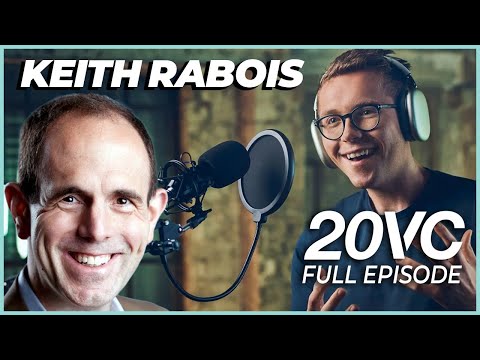
Keith Rabois: The End of Woke Capitalism; Time Allocation Tips; Silicon Valley vs Miami | 20VC #891
Harry Stebbings (host), Keith Rabois (guest)
In this episode of The Twenty Minute VC, featuring Harry Stebbings and Keith Rabois, Keith Rabois: The End of Woke Capitalism; Time Allocation Tips; Silicon Valley vs Miami | 20VC #891 explores keith Rabois Dissects Venture Cycles, Woke Culture, And Silicon Valley’s Decline Keith Rabois explains why classic “buy low, sell high” logic breaks in venture capital beyond seed and early Series A, emphasizing probabilistic outcomes, dependency on future financings, and the rarity of true information asymmetry in growth rounds.
Keith Rabois Dissects Venture Cycles, Woke Culture, And Silicon Valley’s Decline
Keith Rabois explains why classic “buy low, sell high” logic breaks in venture capital beyond seed and early Series A, emphasizing probabilistic outcomes, dependency on future financings, and the rarity of true information asymmetry in growth rounds.
He discusses how to think about upside scenarios, time allocation across a portfolio, and the discipline required to avoid overpaying or relying on paper markups and liquidation preferences as signals of success.
Rabois argues that economic stress is killing “woke capitalism,” that in-person companies will outperform remote ones, and that Silicon Valley has shifted from a key advantage to an actual disadvantage versus places like Miami.
He also reflects on aging as an investor, hiring and mentoring the next generation of VCs, and why only a small handful of venture capitalists truly add value at scale.
Key Takeaways
Early-stage venture is inherently ‘buy low, sell high,’ but that’s not a strategy.
At seed and early Series A, companies are messy and unproven, so any success will inherently be at a much higher valuation; the real work is picking the right teams and markets, not gaming entry price.
Get the full analysis with uListen
Growth-stage investing requires true information asymmetry or disciplined pricing.
From Series C onward, most investors share the same information, so paying high prices is effectively betting someone else will overpay later; without asymmetry or tight entry discipline, returns compress and exit timing becomes critical.
Get the full analysis with uListen
You should consciously model the upside case from the first meeting.
Rabois argues you can usually see a 50–100B upside scenario within minutes if it exists, and that explicitly articulating the largest possible outcome is more important than focusing on base cases.
Get the full analysis with uListen
Time is your scarcest resource; don’t let weak companies consume it.
Underperforming startups will naturally demand more time but rarely drive fund returns, so Rabois structures conversations around realistic “best destinations” and filters his involvement by where he can create high leverage.
Get the full analysis with uListen
Relying on other investors’ judgments is a structural mistake in venture.
Most investors are mediocre, so following consensus or syndicate signals tends to drag down your results; Rabois emphasizes forming independent views and being comfortable looking ridiculous for long periods.
Get the full analysis with uListen
Wokeness at companies is correlated with excess, entitlement, and lack of pressure.
He contends that in stressed markets with real performance demands and scarce capital, ideological distractions fade, power shifts back to companies, and leaders can behave more like Brian Armstrong at Coinbase.
Get the full analysis with uListen
In-person, non-remote startups will likely generate outsized returns going forward.
Rabois now uses physical co-location as an investment filter, arguing that in-person teams execute better and create more “alpha” than fully remote companies, particularly in early-stage environments.
Get the full analysis with uListen
Notable Quotes
“People systematically undervalue their time.”
— Keith Rabois
“Every time you get your money back as a VC, it means you made a mistake in some ways.”
— Keith Rabois
“I now believe Silicon Valley’s a disadvantage, not even neutral.”
— Keith Rabois
“Wokeness is a function of entitlement… distractions fill up a vacuum.”
— Keith Rabois
“There are probably only five to ten VCs that actually add value at scale.”
— Keith Rabois
Questions Answered in This Episode
How should early-stage investors practically distinguish between truly massive upside and optimistic storytelling in a first meeting?
Keith Rabois explains why classic “buy low, sell high” logic breaks in venture capital beyond seed and early Series A, emphasizing probabilistic outcomes, dependency on future financings, and the rarity of true information asymmetry in growth rounds.
Get the full analysis with uListen AI
What concrete criteria would you use to decide when to stop supporting or funding a founder you’ve lost faith in?
He discusses how to think about upside scenarios, time allocation across a portfolio, and the discipline required to avoid overpaying or relying on paper markups and liquidation preferences as signals of success.
Get the full analysis with uListen AI
How can younger VCs who have only seen one bull cycle build the psychological resilience and pattern recognition you describe?
Rabois argues that economic stress is killing “woke capitalism,” that in-person companies will outperform remote ones, and that Silicon Valley has shifted from a key advantage to an actual disadvantage versus places like Miami.
Get the full analysis with uListen AI
What structural changes would be required for most venture firms to credibly manage public positions instead of distributing to LPs?
He also reflects on aging as an investor, hiring and mentoring the next generation of VCs, and why only a small handful of venture capitalists truly add value at scale.
Get the full analysis with uListen AI
If Silicon Valley is now a disadvantage, what specific ecosystem ingredients must a city like Miami or others develop to become the next true startup hub?
Get the full analysis with uListen AI
Transcript Preview
(beeping) Three, two, one, zero. You have now arrived at your destination. Keith, this is such a joy to do. As we were saying, I tweeted, and then you commented, and then I, I incredibly regretted my tweet. But my tweet... And we're starting straight off. This is exciting. We don't have to do the normal BS intro. My tweet was simple: "Buy low, sell high. Be g- greedy when others are fearful, and fearful when others are greedy."
(laughs)
And your response? "It doesn't work in venture." (laughs) So, you're wiser than me, Keith. Why does buy low, sell high not work in venture?
Well, let's start with definitionally what we mean by venture. If one is talking about seed investing, and potentially Series A investing, by definition, you're buying low. And if you have any liquidity, you're gonna be selling high. When you invest in a seed company or a Series A, the startup is a mess. It's not really even a company usually. It barely has financials, probably has maybe some user metrics or product metrics, may only have a team in the slide. So there is no company, and there's no sort of value. It's all art. If you're right, and the company works out and turns into a company that produces financials with revenue, and ideally with contribution dollars and maybe even one-day profits, then by definition, that company's gonna be worth more than what any price you pay to seek round B, or almost surely any price in Series A. So you are effectively buying low and selling high, but it's more you're just doing any version of venture. There's no, like, strategy there. Um, I think it's very difficult though in later stages to pursue anything like that kind of strategy, because ultimately, that's the greater fool's theory. Basically, it means that 90% of the time, you're betting that someone else will pay a higher price than what you perceive. Now, if you have asymmetric information, that strategy could be a coherent one. Like, I have asymmetric information about this market, this company, this technology, this person, then there might be some coherence to a, even a series B or C, buying low and selling higher. But typically, people who are leading these Series C and later rounds have no asymmetry of information. Um, they may have asymmetry of closing, asymmetry of deal flow, but there's no asymmetry of information. And so the only thing you're doing is a risk-adjusted probabilistic bet, which really means you're not really buying low. Uh, you may be q- fooling yourself that you're buying low. But if you adjust for the probability of success, you're actually paying a fairly high price. More importantly, at the end of the day, any early stage investor, unless they ha- are running a billion-dollar-plus fund, has to do, depend on future financings. Almost no company you or I will ever finance will be profitable on the first traunch of investment. Um, prob never. I once joked and quipped, quipped that I've never invested in a profitable company, or that... (laughs) You know, and I, and, and I'm sure that's true. And I'm, I'm not even sure that almost any of the companies I've invested in have ever become profitable. Um, actually, some have, but, you know, like, I'm sure Opendoor actually is profitable, Affirm will be profitable. But usually, it's a 10 to 15, 20-year journey by the time that happens. So if you're not gonna become profitable, the only way you can buy low and sell high is to persuade the rest of the world to buy high. And that means you have to be pretty derivative. Now, if you're running a multi-stage, multi-billion dollar fund, in theory, you could fund a company from beginning to end. But 99% of the VCs on Twitter are not running a multi-stage, multi-billion dollar company. So your tweet would be very, uh, misleading or dangerous for anybody who's not running a multi-billion dollar fund. I mean, we at Founders Fund do, and so in theory, I could invest at a, what I think is low price. And if I'm right, we can continue to power money in the company and not really care what anybody else in the world thinks about that for a very long time. But if I was a seed investor, I need to know what the world of Series A investors is willing to fund and pay. And then if I was a Series A investor, like let's say Benchmark, a very typical Series A-only fund, they need to know who's gonna fund the company next and what price they're willing to pay. So you have to move from somewhat, in Peter Thielian terms, contrarian consensus pretty fast to get a company financed subsequently, unless you're working with a partner like Founders Fund that wants to be contrarian and is willing to back you up for many years in a contrarian mode.
Install uListen to search the full transcript and get AI-powered insights
Get Full TranscriptGet more from every podcast
AI summaries, searchable transcripts, and fact-checking. Free forever.
Add to Chrome