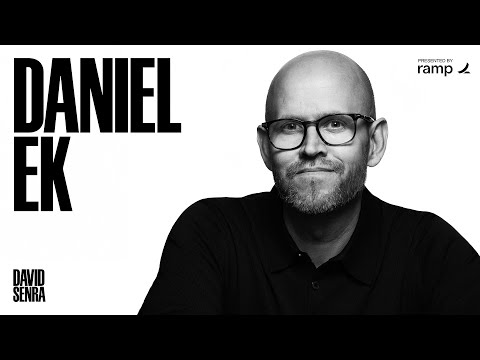
Daniel Ek, Spotify | David Senra
David Senra (host), Daniel Ek (guest)
In this episode of David Senra, featuring David Senra and Daniel Ek, Daniel Ek, Spotify | David Senra explores daniel Ek on impact, trust, learning, and founder self-mastery Ek argues that happiness is a “trailing indicator” of impact: fleeting happiness comes in moments, but durable happiness follows meaningful contribution defined personally.
Daniel Ek on impact, trust, learning, and founder self-mastery
Ek argues that happiness is a “trailing indicator” of impact: fleeting happiness comes in moments, but durable happiness follows meaningful contribution defined personally.
They discuss how founders must build in ways that are authentic to their temperament and “archetype,” warning against mimicking iconic leaders without adapting to one’s own nature and context.
Ek emphasizes trust as a compounding but fragile economic force, intellectual humility (including “shadowing” other leaders), and cultivating honest mirrors who tell the truth.
The conversation closes with themes of energy (not time) management, patience, quality through focus, and the meta-skill of choosing the right “game” to play in life and business.
Key Takeaways
Happiness follows impact, not the other way around.
Ek frames happiness as a trailing indicator: sustained fulfillment tends to come from solving hard problems that matter, and only feels fully “happy” in reflection after impact is made.
Get the full analysis with uListen
Contentment can be the enemy of greatness.
Ek’s advice to Dara Khosrowshahi (and Senra) is that being comfortable may mask untapped potential; the rare chances to test yourself at the highest level often feel uncomfortable by definition.
Get the full analysis with uListen
“Impact” is personal—there’s no universal scoreboard.
Ek rejects one-size-fits-all life advice: impact might mean building a company, being a great parent, or serving a community; the key is choosing deliberately rather than defaulting to comfort or status.
Get the full analysis with uListen
Build a company that is natural to the founder’s temperament.
They argue most founder advice is useless unless tied to personality; copying Jobs/Musk-style leadership without matching traits leads to misfit decisions and organizational dysfunction.
Get the full analysis with uListen
You need “mirrors” who tell you the truth—even when it stings.
From Sony’s “paid critic” to Ek’s own circle (mom, wife, longtime friends, key colleagues), high performance requires trusted people who can puncture self-deception and reveal blind spots.
Get the full analysis with uListen
Trust is an undervalued superpower—and extremely fragile.
Trust compounds slowly through repeated positive interactions but can collapse in one breach; organizations often replace missing trust with process and bureaucracy, which slows everything down.
Get the full analysis with uListen
Intellectual humility enables rapid learning at elite levels.
Ek describes shadowing leaders like Mark Zuckerberg—sitting in meetings, taking notes, even “getting coffee”—to internalize culture and practices that can’t be learned from books alone.
Get the full analysis with uListen
Taste and metrics aren’t opposites; they’re a spectrum.
Ek warns against literalism (“all taste” vs “all testing”): early-stage products may rely heavily on founder taste, but scale demands feedback loops; taste improves as judgment + curiosity with more feedback.
Get the full analysis with uListen
Your job changes as the company grows—like parenting stages.
Ek compares company evolution to raising a child: early on you keep it alive and decide everything; later you guide; later still you’re mostly “there when needed,” while protecting fragile new ideas inside the larger system.
Get the full analysis with uListen
Manage energy more than minutes.
Ek critiques ritualized productivity culture (4 a. ...
Get the full analysis with uListen
Quality is built by focus, subtraction, and long-term obsession.
Ek defines quality as “less but better”: distill to the essence, improve daily, and accept that brilliance is rare; AI may raise the average, making true . ...
Get the full analysis with uListen
Progress requires “unreasonable” persistence and patience.
From protecting early ideas to multi-year bets (e. ...
Get the full analysis with uListen
Notable Quotes
“Happiness is a trailing indicator of impact.”
— Daniel Ek
“Since when is life about happiness? It’s about impact.”
— Daniel Ek (as quoted by Dara Khosrowshahi)
“Trust is one of the most under-talked-about things… If you had 100% trust, you wouldn’t need any of this stuff.”
— Daniel Ek
“In life, the challenge is not so much to figure out how best to play the game. The challenge is to figure out what game you’re playing.”
— Kwame Anthony Appiah (quoted by David Senra)
“I’m not obsessed about time… I’m more obsessed about energy management.”
— Daniel Ek
Questions Answered in This Episode
How do you personally define “impact” at different stages of life (founder, spouse, parent, investor), and how has that definition changed since your early 20s?
Ek argues that happiness is a “trailing indicator” of impact: fleeting happiness comes in moments, but durable happiness follows meaningful contribution defined personally.
Get the full analysis with uListen AI
You said happiness trails impact but impact is personal—what signals tell you you’re pursuing “real impact” versus status, momentum, or external validation?
They discuss how founders must build in ways that are authentic to their temperament and “archetype,” warning against mimicking iconic leaders without adapting to one’s own nature and context.
Get the full analysis with uListen AI
When does “contentment” become a warning sign rather than a healthy equilibrium—and how do you diagnose it in yourself or in leaders you coach?
Ek emphasizes trust as a compounding but fragile economic force, intellectual humility (including “shadowing” other leaders), and cultivating honest mirrors who tell the truth.
Get the full analysis with uListen AI
What are the main founder archetypes you’ve observed, and what failure modes happen when a founder adopts the wrong archetype (e.g., imitates Jobs/Musk)?
The conversation closes with themes of energy (not time) management, patience, quality through focus, and the meta-skill of choosing the right “game” to play in life and business.
Get the full analysis with uListen AI
On trust: what specific behaviors build “deserved trust” fastest inside a scaling org, and what are the most common accidental trust-breakers leaders commit?
Get the full analysis with uListen AI
Transcript Preview
[upbeat music] So I wanna consider this conversation like a continuation of the conversation we had last year-
Right
... in New York. It was by far the most impactful conversation I had the entire year.
Wow.
It is, in large part, the reason we're sitting down and actually recording this conversation. And what I loved was, I was th- I thought about how the advice you gave and the stories you told, uh, really fundamentally changed my approach to my work, and then also, like, my philosophy of how I'm living my life.
Wow.
And because you- it's, it's very rare, like, this year I'm gonna hit over four hundred biographies, uh, read for the podcast, right? And somebody asked me recently, he's like: "Do you ever u- uncover new ideas?"
Mm.
It's like, no, I feel like I'm telling the same story, the same personality type over, and over, and over again.
Mm.
And you'll get a, a new idea or a novel idea, you know, every once in a while, but certainly not-
Right
... all the time.
Yeah.
But you shared something at the dinner-
Mm
... that was a truly novel idea. And then a few months later, I read this interview, and I was like, "Oh, I'm not the only one-
Mm
... that Daniel's advice changed their career." So I'm gonna read something. There was an interview given by the CEO of Uber-
Mm
... who's a friend of yours, Dara.
Yeah.
And I'm gonna read this excerpt, which was absolutely perfect, and he was talking about, uh, contemplating, "Should I take this job or not?"
Mm.
Like, this is a huge opportunity, but also, like, kinda scary. And this is tied to your idea that you should optimize for impact over happiness.
Mm.
Which is very- I haven't heard anybody else, uh, articulate that. And so Dara says, "I was reading about all the issues happening in- with Uber in the news, the various challenges that were coming up there. So when I first got the call to be the CEO, I said, 'Heck, no! I'm not crazy. I'm not up for this.'"
Mm.
"But I had one particular conversation that really shifted me, which was with Daniel Ek, who's a good friend. And I still remember, I was talking to him about my career at Expedia and how happy I was, and he looks at me..." And he did this to me, too. "And he looks at me, and he goes, 'Since when is life about happiness? It's about impact. You can have an impact on Uber, which is a really important company in the world that's shaping the future of cities.' And I thought, thought to myself, 'My God, this is so obvious. I've got to take a shot.' I knew it was going to be uncomfortable." Can you just explain how you think about optimizing for impact over happiness, and why?
Well, [chuckles] it, it- first off, it's, it's incredibly kind of Dara to say that. Um, you know, I, I, I think about this: I think happiness is a trailing indicator of impact.
Install uListen to search the full transcript and get AI-powered insights
Get Full TranscriptGet more out of YouTube videos.
High quality summaries for YouTube videos. Accurate transcripts to search & find moments. Powered by ChatGPT & Claude AI.
Add to Chrome