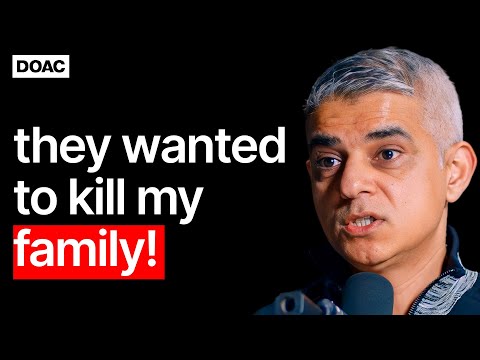
Sadiq Khan: The Dark Side Of The Police. How Safe Are We REALLY? | E216
Sadiq Khan (guest), Steven Bartlett (host)
In this episode of The Diary of a CEO, featuring Sadiq Khan and Steven Bartlett, Sadiq Khan: The Dark Side Of The Police. How Safe Are We REALLY? | E216 explores sadiq Khan On Fear, Policing And Power: London’s Safety Reckoning London Mayor Sadiq Khan discusses his immigrant family background, his motivations for entering law and politics, and how those experiences shape his approach to public service. He and host Steven Bartlett examine London’s safety, knife crime, and the impact of austerity, as well as serious cultural failings within the Metropolitan Police, especially around violence against women. Khan details reforms he is pushing—more officers, youth investment, tougher vetting, and structural changes—while acknowledging public perceptions that London feels unsafe. The conversation also explores racism, Islamophobia, the emotional toll of leadership, COVID-era mental health, political authenticity, Labour’s challenges, climate targets, housing, and Khan’s personal regrets and family life.
Sadiq Khan On Fear, Policing And Power: London’s Safety Reckoning
London Mayor Sadiq Khan discusses his immigrant family background, his motivations for entering law and politics, and how those experiences shape his approach to public service. He and host Steven Bartlett examine London’s safety, knife crime, and the impact of austerity, as well as serious cultural failings within the Metropolitan Police, especially around violence against women. Khan details reforms he is pushing—more officers, youth investment, tougher vetting, and structural changes—while acknowledging public perceptions that London feels unsafe. The conversation also explores racism, Islamophobia, the emotional toll of leadership, COVID-era mental health, political authenticity, Labour’s challenges, climate targets, housing, and Khan’s personal regrets and family life.
Key Takeaways
Violent crime requires a 'public health' approach, not just tougher policing.
Khan argues you must simultaneously 'be tough on crime and tough on the causes of crime. ...
Get the full analysis with uListen
Austerity has materially weakened safety by cutting police and youth services.
Since 2010 there have been roughly 21,000 fewer police officers across England and Wales, alongside widespread closures of youth clubs and after-school programs. ...
Get the full analysis with uListen
Met Police failures around violence against women are systemic, not just 'bad apples.'
Using the cases of Sarah Everard and David Carrick, Khan says there are 'systemic cultural issues' in the Met, including vetting failures and a culture that tolerated abusers. ...
Get the full analysis with uListen
Perceptions of safety, especially among women, are as critical as crime statistics.
Although homicides, knife crime, gun crime and teenage homicides have fallen in London under his tenure, Khan accepts many people still feel unsafe: 'If you don’t feel it’s safe, it’s not safe. ...
Get the full analysis with uListen
Islamophobia and online hate profoundly shape the experience of minority politicians.
Khan links Donald Trump’s attacks on him and far-right threats to his identity as a Muslim mayor, noting even terrorists like the Christchurch and Finsbury Park attackers referenced him. ...
Get the full analysis with uListen
Leadership at this level extracts a personal and psychological cost.
Khan works effectively seven days a week, describing the mayoralty as a 'privilege' he must maximize before voters may remove him. ...
Get the full analysis with uListen
Policy detail must be balanced with emotional communication and authenticity.
Bartlett challenges Khan on political inauthenticity and voters’ emotional decision-making. ...
Get the full analysis with uListen
Notable Quotes
“If you don’t feel it’s safe, it’s not safe.”
— Sadiq Khan
“I’m not excusing it, I’m explaining it. It has to come, consequences.”
— Sadiq Khan
“My view is you can’t mark your own homework. You need somebody else to look into things, tell you how bad things are, make recommendations, and follow them through.”
— Sadiq Khan
“Let’s be frank. Donald Trump was obsessed with me.”
— Sadiq Khan
“Enjoy the experience. Often you’re so busy you don’t get to enjoy it.”
— Sadiq Khan
Questions Answered in This Episode
You’ve framed crime as a 'public health' issue—what specific metrics or milestones would convince you this approach is definitively working in London, and what would make you abandon or radically change it?
London Mayor Sadiq Khan discusses his immigrant family background, his motivations for entering law and politics, and how those experiences shape his approach to public service. ...
Get the full analysis with uListen AI
On Met Police reform, how far are you realistically prepared to go—would you support breaking up or re-founding the Met if the Casey review’s final report suggests the culture is irredeemable?
Get the full analysis with uListen AI
Given your admission that austerity has driven crime, what concrete compromises on other parts of London’s budget are you willing to make to fund additional youth services and policing if national funding doesn’t increase?
Get the full analysis with uListen AI
You said being so pugilistic with central government may have cost Londoners; can you give a specific example where your stance likely changed the outcome of a negotiation or lost the city a tangible benefit?
Get the full analysis with uListen AI
Your net-zero-by-2030 ambition depends heavily on a future Labour government—if the general election delivers either a different administration or a weak mandate, what is your fallback plan for hitting climate and air quality targets with only London-level powers?
Get the full analysis with uListen AI
Transcript Preview
Let's be frank. Donald Trump was obsessed with me. If the mayor of London wasn't somebody of my background, my faith, he wouldn't have responded the way he did, would he? Mayor of London, Sadiq Khan is the first Muslim mayor.
Has made some powerful opponents. And the new image of Britain's multicultural society. The mayor is with us. Do you think London's safe?
Uh, uh, well, we've reduced homicides, knife crime, gun crime.
I don't think people feel safe in London.
I'm not excusing it, I'm explaining it. It has to come, consequences.
There's been a lot of instances of police officers who have attacked, raped women and girls on the streets of London. What are you doing about that?
We're doing it now.
How?
I've been criticized for this.
Since you were elected mayor, what are the things you look at and go, "Do you know what? I failed there."
Well, that's a good question, but I'm running for re-election in 467 days time. I'm not going to answer that question honestly because the answer's going to be used against me.
You can't tell the truth because someone might use it against you?
I think most MPs have got to be inauthentic. I'll tell you why, because...
What's been your hardest day as London mayor?
There's been a few.
At least 58 people were killed in the fire at Grenfell Tower.
I, I, I still remember the images. I still remember the heat. You know, one family, six people wiped out and a number of terror attacks in London, London Bridge, Westminster Bridge, Finsbury Park. I went to a lot of funerals. That summer was hard. Yeah.
I just want to start this episode with a message of thanks. A thank you to everybody that tunes in to listen to this podcast. By doing so, you've enabled me to live out my dream, but also for many members of our team to live out their dreams too. It's one of the greatest privileges I could never have dreamed of or imagined in my life to get to do this, to get to learn from these people, to get to have these conversations, to get to interrogate them from a very selfish perspective, trying to solve problems I have in my life. So, I feel like I owe you a huge thank you for being here and for listening to these episodes and for making this platform what it is. Can I ask you a favor? I can't tell you how much, um, you can change the course of this podcast, the, the course of the guests we're able to invite to the show, and to the course of everything that we do here just by doing one simple thing. And that simple thing is hitting that subscribe button. Helps this channel more than I could ever explain. The guests on this platform are incredible because so many of you have hit that button. And I know when we think about what we want to do together over the next year on this show, a lot of it is going to be fueled by the amount of you that are subscribed and that tune into this show every week. So, thank you. Let's keep doing this. And I can't wait to see what this year brings for this show, for us as a community, and for this platform. (instrumental music plays) Sadiq, give me your context. I, I spent a long time reading through your backstory, and I think it's an im- especially important place to start, because it appears to be much of your, your reason for being and your reason for doing. So, can you take me right back? Um, I want to hear about Pakistan. I want to hear about your, your earliest years in London.
Install uListen to search the full transcript and get AI-powered insights
Get Full TranscriptGet more from every podcast
AI summaries, searchable transcripts, and fact-checking. Free forever.
Add to Chrome