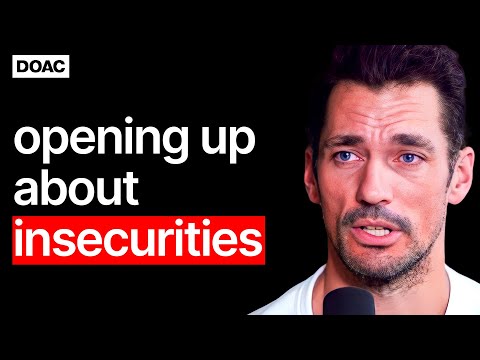
David Gandy: Highest Paid Male Model Opens Up About Insecurities & Imposter Syndrome | E102
Steven Bartlett (host), David Gandy (guest), Narrator, Narrator
In this episode of The Diary of a CEO, featuring Steven Bartlett and David Gandy, David Gandy: Highest Paid Male Model Opens Up About Insecurities & Imposter Syndrome | E102 explores david Gandy On Strategy, Self-Doubt, Mental Health And Reinventing Masculinity David Gandy reveals how his rise from catalogue work to global superstardom with Dolce & Gabbana was driven less by luck and more by deliberate strategy, sacrifice, and long-term goal-setting. He challenges assumptions about male models by opening up about imposter syndrome, insecurities, social anxiety, and periods of low mood, and how these experiences inform his work on men’s mental health.
David Gandy On Strategy, Self-Doubt, Mental Health And Reinventing Masculinity
David Gandy reveals how his rise from catalogue work to global superstardom with Dolce & Gabbana was driven less by luck and more by deliberate strategy, sacrifice, and long-term goal-setting. He challenges assumptions about male models by opening up about imposter syndrome, insecurities, social anxiety, and periods of low mood, and how these experiences inform his work on men’s mental health.
Gandy explains the business-thinking behind his modeling career, his refusal to “fit in” both at school and in fashion, and how he used observation and positioning to create a male equivalent of the supermodel era. He also details his discomfort with fame rituals like red carpets, despite being one of the most recognizable male models in the world.
Now an entrepreneur, he discusses launching his brand David Gandy Wellwear, focused on wellbeing-driven clothing that uses fabric science and design to impact mood, confidence, and sustainability. Throughout, he stresses thick skin, integrity, calculated risk-taking, and the importance of genuinely listening when people talk about their mental health.
Key Takeaways
Treat your career like a business, not a lucky break.
Gandy studied top female supermodels, noticing they had full business infrastructures—teams, PRs, PAs, clear positioning—while most male models just felt lucky to be there. ...
Get the full analysis with uListen
You can manufacture ‘luck’ through clear goals and proactive outreach.
Key turning points like Dolce & Gabbana’s Light Blue campaign weren’t random; his agency strategically targeted Dolce when others said he was more ‘Armani’ or ‘Ralph Lauren’. ...
Get the full analysis with uListen
Never fully believe your own hype, especially when you’re successful.
Despite awards, front-page campaigns, and global recognition, Gandy insists he “never believed his own hype,” which kept him grounded among friends who constantly roasted him and treated him normally. ...
Get the full analysis with uListen
Imposter syndrome can coexist with achievement and be channeled productively.
Even 20 years into his career, Gandy says he’s still “waiting to be found out,” often wondering if he’s bitten off more than he can chew. ...
Get the full analysis with uListen
Not fitting in can become a strategic advantage if you own it.
Gandy never felt he fit in—at school, in model “packs,” or in fashion trends. ...
Get the full analysis with uListen
Male image, trolling, and aging pressures affect men more than people assume.
He acknowledges physical insecurities (about his nose, ears, aging, wrinkles) and notes how age is increasingly used as a ‘weapon’ online. ...
Get the full analysis with uListen
Wellbeing and sustainability can be built into products, not just messaging.
With David Gandy Wellwear, he’s trying to fuse comfort, confidence, and mental wellbeing using fabric technology (e. ...
Get the full analysis with uListen
Notable Quotes
“Everything that people say, 'Oh, you're lucky to work with Dolce & Gabbana.' And I can say that wasn't luck, it was strategy.”
— David Gandy
“I never believed my own hype. It's very easy once you see yourself in articles and winning awards and everyone's telling you how amazing you are, but I suppose I never really did.”
— David Gandy
“You're always waiting to be found out, I think, at the end of the day. Even 20 years in, I'm still thinking that today.”
— David Gandy
“If you haven't got a thick skin, you shouldn't be in this game.”
— David Gandy
“Sometimes actually achieving what you want is a bit... sometimes the journey is the exciting bit.”
— David Gandy
Questions Answered in This Episode
You consciously refused to shrink your physique to match the androgynous trend early in your career; did you ever have a moment where you nearly gave in to that pressure, and how do you advise younger people today to judge when to adapt versus hold their ground?
David Gandy reveals how his rise from catalogue work to global superstardom with Dolce & Gabbana was driven less by luck and more by deliberate strategy, sacrifice, and long-term goal-setting. ...
Get the full analysis with uListen AI
You described Light Blue as the moment that ‘changed everything’; looking back now, is there anything about how your life and mental state shifted after that launch that you would handle differently if you could relive it?
Gandy explains the business-thinking behind his modeling career, his refusal to “fit in” both at school and in fashion, and how he used observation and positioning to create a male equivalent of the supermodel era. ...
Get the full analysis with uListen AI
You’ve seen severe bipolar episodes up close and also had your own ‘dark periods’; what concrete signs do you now look for in yourself or others that signal, ‘this is beyond a rough patch, we need professional help’?
Now an entrepreneur, he discusses launching his brand David Gandy Wellwear, focused on wellbeing-driven clothing that uses fabric science and design to impact mood, confidence, and sustainability. ...
Get the full analysis with uListen AI
With Wellwear, you’re linking fabric science to mood and confidence; what specific metrics or experiments are you using (or planning to use) to prove that your clothing meaningfully improves wellbeing beyond just feeling ‘nice’?
Get the full analysis with uListen AI
You admit that achievement highs are short-lived and that you’re driven by relentless striving; if a psychologist told you that this pattern was undermining your long-term happiness, would you actually be willing to change it, and what would changing it realistically look like for you day-to-day?
Get the full analysis with uListen AI
Transcript Preview
The Diary of a CEO Live, my live show, my live reincarnation of this podcast is coming on tour. And it's coming to a city near you. There's a link in the description below, put your email address in and I will email you when tickets go on sale. Can't wait to see you. (upbeat music)
Everything that people say, "Oh, you're lucky to work with Dolce & Gabbana." And I can say that wasn't luck, it was strategy.
Cut. What's that impostor voice saying is gonna be found out?
It's a good question, I suppose.
Do you have insecurities?
Yeah, of course I do.
Has that ever had a impact on you?
I never believed my own hype. It's very easy once you see yourself in articles and winning awards and everyone's telling you how amazing you are, but I- I suppose I never really did. (dramatic music) I didn't fit in particularly well, and I've seen the extremities of mental health. Me, myself, going to dark periods when nothing would, nothing would suffice, nothing would cheer you up. If you haven't got a thick skin, you shouldn't be in this game. (upbeat music)
David Gandy. At one point he was one of the highest paid male models in the entire world. A beautiful, beautiful man. And so hearing that and seeing how beautiful he is, would understandably make you assume a lot of things about him. But what you're gonna hear today is that those things are wrong and that you should never judge a book by its cover. How is it possible that someone that looks like David Gandy can describe themselves as having impostor syndrome, being low in confidence, and waiting to be found out? He's now become an entrepreneur. He's focused on launching his brand new brand David Gandy Wellwear, and he's taking on a completely different industry. It's crazy, 'cause when you open people's diaries you never know what you'll find, and what I found in David's today was truly fascinating, unexpected, vulnerable, and extremely surprisingly relatable. So without further ado, I'm Steven Bartlett, and this is The Diary of a CEO. I hope nobody's listening, but if you are, then please keep this to yourself. (upbeat music) There's a lot of very beautiful people in the world, right? Um, but they don't manage to achieve what you've achieved across multiple disciplines. Whether it's within your modeling career, which is an incredibly competitive-
Mm-hmm.
... space to play and one with, shrouded with huge amounts of uncertainty, or whether it's now in business with what you're doing with your brands there and your investments. So my, my question is, what is it about you in your sort of self-diagnosis that has made you rise to the top in those pursuits?
That's a, a good question to start off with.
And also where did it come from?
The easiest one to say is, is probably the modeling one to, to start off with. And that was, um, I questioned why men weren't in the same position as the female supermodels. And you had the equivalent of the, the male supermodels at the time, and you always have that, but they were never to the l- you know, to that level, um, of fame, of, you know, sort of financial rewards of, uh, as, as the female supermodels. And I questioned it. That, that was all. And thought, "Is there a possibility? Is there almost, I suppose, a gap in the market?" The first five years, no one actually realizes that I, I really didn't do that much for the first five or six years. It was, you know, I... Of course we didn't struggle and it was a lot of, um, k- you know, sort of, uh, catalog work. Earning really good money, but it wasn't what I wanted to do. But I got to work with the likes of Chrissy Teigen and Naomi Campbell and those people. And I literally just observed them and asked them questions.
Install uListen to search the full transcript and get AI-powered insights
Get Full TranscriptGet more from every podcast
AI summaries, searchable transcripts, and fact-checking. Free forever.
Add to Chrome