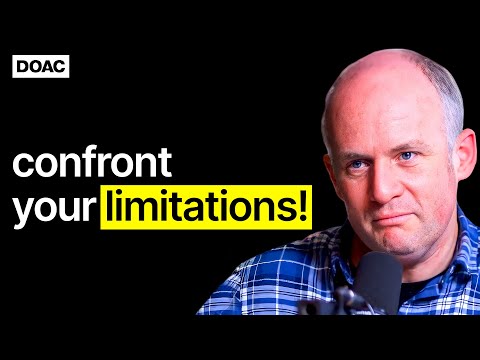
How To Finally Stop Procrastinating: Oliver Burkeman | E125
Oliver Burkeman (guest), Steven Bartlett (host), Steven Bartlett (host), Steven Bartlett (host)
In this episode of The Diary of a CEO, featuring Oliver Burkeman and Steven Bartlett, How To Finally Stop Procrastinating: Oliver Burkeman | E125 explores why Embracing Limits Beats Hustle Culture In Overcoming Procrastination Journalist and author Oliver Burkeman discusses why our obsession with productivity, happiness, and efficiency often backfires, leaving us more anxious and unfulfilled. Drawing on his book "Four Thousand Weeks," he argues that accepting our radical finitude—limited time, control, and importance—is the starting point for a saner, more meaningful life.
Why Embracing Limits Beats Hustle Culture In Overcoming Procrastination
Journalist and author Oliver Burkeman discusses why our obsession with productivity, happiness, and efficiency often backfires, leaving us more anxious and unfulfilled. Drawing on his book "Four Thousand Weeks," he argues that accepting our radical finitude—limited time, control, and importance—is the starting point for a saner, more meaningful life.
He dismantles popular self-help myths around positive thinking, passion, morning routines, and Inbox Zero, showing how they can become avoidance strategies that keep us from facing our limitations. Procrastination, distraction, and over-commitment are reframed as emotional avoidance of imperfection and vulnerability, not moral failings.
Burkeman proposes practical alternatives: focus on a few genuinely meaningful priorities, embrace "radical incrementalism," accept discomfort as part of important work, and cultivate patience in a speed-addicted culture. By seeing ourselves as "already enough," ambition can become an authentic expression rather than a desperate quest for self-worth.
Key Takeaways
Stop aiming directly at happiness; aim at meaningful, reality-based activity instead.
Burkeman argues that making happiness the central goal backfires: you scrutinize your feelings and treat every negative emotion as failure. ...
Accept your finitude: you have roughly 4,000 weeks and cannot do it all.
We live as if time and opportunities are infinite, continually deferring fulfillment to the future (“when I finally…”). ...
Beware the efficiency trap: more efficiency often just creates more work.
Improving your email speed or output tends to increase incoming volume and expectations—like being the fast writer editors always call, or the person known for doing 50 meetings a day. ...
Treat procrastination as fear of limitation, not laziness, and act anyway.
Procrastination often protects your idealized fantasy of a project from real-world imperfection. ...
Say no to “middling priorities,” not just obvious time-wasters.
Using the Warren Buffett-style exercise, Burkeman emphasizes that the true threat to your top priorities is not junk, but the many pretty-good opportunities: decent work projects, okay friendships, or side ventures that matter “a bit. ...
Use radical incrementalism: small, regular sessions beat heroic binges.
Research on prolific academic writers shows that those who write modestly but consistently—short daily sessions—produce far more over time than those who binge around deadlines. ...
Train patience and tolerance for discomfort in a speed-addicted culture.
Our environment encourages an “addiction to urgency,” where feeling overwhelmed leads us to speed up, which then invites even more input. ...
Notable Quotes
“Happiness is the kind of thing that seems to arise as a byproduct of certain kinds of meaningful activity. But if you make it the goal of your life, you can sort of bear down on it too much, and then it goes away.”
— Oliver Burkeman
“People talk all the time about the importance of learning to say no. They think what that means is if you just learn to say no to all the stuff you don't want to do, you can spend your time doing stuff you do want to do. It's way harder than that. You have to say no to things that you do want to do.”
— Oliver Burkeman
“Any action that actually brings things into the world involves a confrontation with your limitations… the imperfection is guaranteed. That ship has sailed. So now can we just move forward and do our imperfect things?”
— Oliver Burkeman
“The world that has 747s in it and microwaves in it and the internet in it ought, by rights, to feel much calmer, because all this time is saved. But it doesn’t. It makes everybody feel more impatient and rushed.”
— Oliver Burkeman
“Realizing that I’m enough is actually the foundation for real ambition. When I was insecure enough to believe that a Lamborghini might make me more, I was striving for things that weren’t my real ambitions.”
— Steven Bartlett
Questions Answered in This Episode
You argue that happiness should be a byproduct of meaningful activity, not a direct goal. How would you advise someone who feels their entire current life structure (job, relationships, location) offers them very little sense of meaning—where should they practically start changing things?
Journalist and author Oliver Burkeman discusses why our obsession with productivity, happiness, and efficiency often backfires, leaving us more anxious and unfulfilled. ...
In your own life, can you describe a concrete example where you consciously said no to a genuinely attractive ‘middling priority’ and what surprising benefits—or regrets—came from that decision?
He dismantles popular self-help myths around positive thinking, passion, morning routines, and Inbox Zero, showing how they can become avoidance strategies that keep us from facing our limitations. ...
You frame procrastination as avoiding our limitations and guaranteed imperfection. For someone whose procrastination is tied to real external stakes (e.g., a single high-pressure exam or funding deadline), how can they psychologically reframe that pressure without pretending the stakes don’t exist?
Burkeman proposes practical alternatives: focus on a few genuinely meaningful priorities, embrace "radical incrementalism," accept discomfort as part of important work, and cultivate patience in a speed-addicted culture. ...
You’re critical of hustle culture’s addiction to speed, yet some environments (like startups or medicine) are built on urgency and rapid response. How can people in structurally fast-paced fields apply your ideas without jeopardizing their performance or careers?
If most of what we do is cosmically insignificant, how do you distinguish between a healthy, liberating acceptance of that fact and a slide into quietism or apathy—what concrete indicators would tell someone they’ve gone too far in the direction of ‘nothing really matters’?
EVERY SPOKEN WORD
Install uListen for AI-powered chat & search across the full episode — Get Full Transcript
Get more out of YouTube videos.
High quality summaries for YouTube videos. Accurate transcripts to search & find moments. Powered by ChatGPT & Claude AI.
Add to Chrome