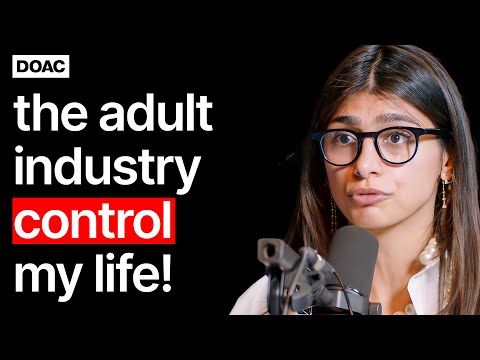
Mia Khalifa Opens Up About The Dark Side Of The Adult Entertainment Industry | E248
Sarah Joe Chamoun (Mia Khalifa) (guest), Steven Bartlett (host)
In this episode of The Diary of a CEO, featuring Sarah Joe Chamoun (Mia Khalifa) and Steven Bartlett, Mia Khalifa Opens Up About The Dark Side Of The Adult Entertainment Industry | E248 explores from Exploitation To Empowerment: Sarah Joe Rewrites Mia Khalifa’s Story In this candid conversation, Sarah Joe (publicly known as Mia Khalifa) unpacks her journey from a traumatizing stint in the mainstream porn industry to building a life grounded in therapy, accountability, and entrepreneurial purpose.
From Exploitation To Empowerment: Sarah Joe Rewrites Mia Khalifa’s Story
In this candid conversation, Sarah Joe (publicly known as Mia Khalifa) unpacks her journey from a traumatizing stint in the mainstream porn industry to building a life grounded in therapy, accountability, and entrepreneurial purpose.
She traces how childhood colorism, post‑9/11 racism, and low self-esteem funneled her into abusive relationships, grooming, and ultimately the adult industry, where predatory contracts and public shaming left lasting scars.
Sarah explains how therapy, medication, building a supportive community, and taking incremental risks rebuilt her confidence and allowed her to reclaim her narrative, career, and even her name.
She now uses her platform to critique unethical porn practices, advocate for vulnerable young women, and channel her experiences into business ventures, content creation, and a more secure, unapologetic sense of self.
Key Takeaways
Confidence is built through evidence, not mantra—by doing hard things and surviving them.
Sarah emphasizes that confidence didn’t appear magically; it came from taking risks, making decisions that aligned with her values, and then watching herself follow through. ...
Get the full analysis with uListen
Low self-esteem and people-pleasing dramatically increase vulnerability to grooming and exploitation.
She breaks down how insecurity can manifest as either extreme people-pleasing or being 'insufferable,' but in both cases it involves poor boundaries, chronic lying to keep everyone happy, and ignoring one’s own discomfort. ...
Get the full analysis with uListen
Mainstream porn contracts and culture can be structurally predatory, especially toward 18-year-olds.
Sarah repeatedly highlights the danger of 'in perpetuity' clauses—lifetime control of content—and the fact that these multi-page legal documents are put in front of barely-legal women who cannot reasonably grasp the implications. ...
Get the full analysis with uListen
Therapy, when combined with medication and community, can be life-saving—but it is emotionally brutal work.
Sarah describes therapy as 'time traveling superpowers' that let her connect present triggers to childhood experiences, but also as a period in which she cried more than during the traumas themselves. ...
Get the full analysis with uListen
Leaving a harmful environment often begins with a single, 'tiny' boundary decision.
Her departure from Miami and porn wasn’t the result of a grand plan; it started with recognizing, 'I do not want to do porn, ever,' and acting on that one conviction. ...
Get the full analysis with uListen
Public recognition feels completely different when you’re ashamed of your narrative versus proud of your work.
In the early post-porn years, being recognized in public sent her into a visceral shame response—like being 'punched in the stomach'—because she knew men were seeing her as a porn character, not a person. ...
Get the full analysis with uListen
Reclaiming identity requires both language and forgiveness—especially forgiving yourself for past boundary breaches.
Sarah prefers to be called her real name, 'Sarah,' and explicitly says she forgives herself, not the people who exploited her. ...
Get the full analysis with uListen
Notable Quotes
“Confidence comes from just accomplishing things that you wanna accomplish and being proud of yourself.”
— Sarah (Mia Khalifa)
“When your relationship with yourself isn’t right, you are not going to find the right person.”
— Sarah (Mia Khalifa)
“You’re putting contracts in front of 18-year-old girls that have the words ‘in perpetuity’ on them. Do you know how dangerous and predatory that is?”
— Sarah (Mia Khalifa)
“I felt like a prisoner in my own body and in the world… I couldn’t scream loud enough. There’s nothing I could do to make it go away or to make them stop.”
— Sarah (Mia Khalifa)
“I am not the sum of the things I’ve been through or the adversities I’ve faced.”
— Sarah (Mia Khalifa)
Questions Answered in This Episode
You argue that major porn companies are structurally predatory—what specific legal or policy changes (beyond banning 'in perpetuity') do you believe would meaningfully protect young performers who still choose to enter the industry?
In this candid conversation, Sarah Joe (publicly known as Mia Khalifa) unpacks her journey from a traumatizing stint in the mainstream porn industry to building a life grounded in therapy, accountability, and entrepreneurial purpose.
Get the full analysis with uListen AI
You’ve described deepfakes and AI as triggering the same helplessness you felt when footage was re-released; have you considered any concrete strategies (legal, technological, or advocacy-based) to push back against non-consensual AI porn?
She traces how childhood colorism, post‑9/11 racism, and low self-esteem funneled her into abusive relationships, grooming, and ultimately the adult industry, where predatory contracts and public shaming left lasting scars.
Get the full analysis with uListen AI
Looking back with your current self-awareness, is there a single interaction or red flag in your teen relationship that you now recognize as the moment grooming began, and how would you coach a 16-year-old today to spot and respond to that?
Sarah explains how therapy, medication, building a supportive community, and taking incremental risks rebuilt her confidence and allowed her to reclaim her narrative, career, and even her name.
Get the full analysis with uListen AI
You’ve said therapy gave you 'time traveling superpowers'—for someone who can’t currently afford consistent therapy, what specific self-reflection practices or tools would you prioritize to approximate that effect?
She now uses her platform to critique unethical porn practices, advocate for vulnerable young women, and channel her experiences into business ventures, content creation, and a more secure, unapologetic sense of self.
Get the full analysis with uListen AI
As you build Shaytan and other businesses, how do you practically ensure that your companies don’t replicate the power imbalances and exploitation you experienced—even in subtle ways like contracts, marketing, or internal culture?
Get the full analysis with uListen AI
Transcript Preview
I, I couldn't scream loud enough. There's nothing I could do to make it go away or to make them stop. I, I didn't ...
Are you okay talking about this?
Um. Can we take a break? Mia Khalifa. Mia Khalifa. Mia Khalifa. Mia Khalifa. I'm Sarah. I'm Sarah f-ing Joe. Sarah Joe. The former adult film star ...
Now business owner and social media activist.
With over 50 million followers.
Where should this story start?
I lived through a lot of conflict in Lebanon, and then I moved to America, and I was bullied for being Middle Eastern. It was around the time of 9/11. That was pretty difficult. Made a lot of choices that I can't take back.
Your husband, when you're 18 years old, is encouraging you towards the adult entertainment industry. What did they stand to gain from that?
Fetishization. I fucked up, because I signed a contract that says, "In perpetuity," on it. Do you know how dangerous and predatory that is?
When, when was your anxiety at its highest?
The company going after me publicly. The major production companies prey on vulnerable young women. Didn't shower, didn't brush my teeth, didn't eat, didn't leave my bed. It's following me for the rest of my life, but I am not the sum of the things I've been through or the adversities I've faced.
For people that are really struggling, how did you get out of that phase? I have some breaking news. And th- no, this is an emergency. I've spent the last two years writing a book, and I've written 33 laws for business, marketing, and life that I derived from all of these conversations I've had here. I traveled the world to write this book. I interviewed some of the most incredible people. I did six months of an- extensive research on scientific studies and principles to corroborate everything that I wrote into these 33 laws. And ladies and gentlemen, that book called The Diary of a CEO: The 33 Laws for Business, Marketing, and Life is now available for pre-order, and there are 5,000, only 5,000, signed copies, and it's first come first serve. The link is in the bio right now, so if you want that book... Honestly, it's the best book I've ever written. It's the book I always should've written. It's the book I also wish someone had written for me when I was starting out in my career. I'm really proud of it. I'm really, really proud of it. Really, really proud of it. And I can't wait for all of you to get to read it. It's out in August. I couldn't be more excited about this, as you can probably tell. I don't know what to sa- to say other than the words I've said to emphasize my excitement 'cause I think it's important, and I think it's really valuable. Um, link in the description. Where should this story start? Where, where should, where does your story start? What is the most sort of pertinent moment that you recall from your memory that has shaped the woman that is sat in front of me today?
Install uListen to search the full transcript and get AI-powered insights
Get Full TranscriptGet more from every podcast
AI summaries, searchable transcripts, and fact-checking. Free forever.
Add to Chrome