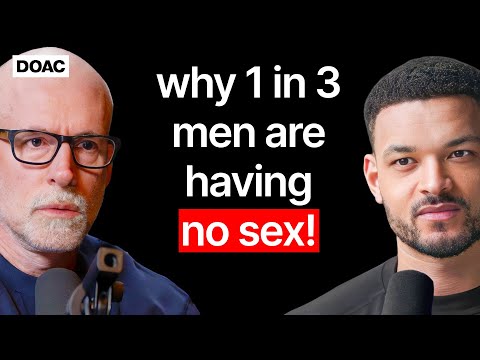
“It’s An Emergency!” The Number Of Men Having No Sex Increased 180%! - The Relationships Professor
Steven Bartlett (host), Scott Galloway (guest), Narrator, Narrator, Narrator, Narrator
In this episode of The Diary of a CEO, featuring Steven Bartlett and Scott Galloway, “It’s An Emergency!” The Number Of Men Having No Sex Increased 180%! - The Relationships Professor explores modern Masculinity Meltdown: Why Young Men Are Failing And Lonely Scott Galloway argues there is an under‑acknowledged crisis among young men driven by biology, a school system biased against boys, collapsing economic opportunity, and vanishing male role models.
Modern Masculinity Meltdown: Why Young Men Are Failing And Lonely
Scott Galloway argues there is an under‑acknowledged crisis among young men driven by biology, a school system biased against boys, collapsing economic opportunity, and vanishing male role models.
He warns this is feeding loneliness, sexlessness, suicide, political extremism, and a coming wave of men choosing digital substitutes—porn, AI companions, and sex bots—over real relationships.
Galloway also explains how this male crisis is shrinking the pool of viable partners for women and driving female loneliness, even as women progress educationally and economically.
He outlines practical solutions at both the personal and policy level: male mentorship, moderated tech and porn use, deliberate risk‑taking and rejection, disciplined financial habits, higher minimum wages, and a clearer, healthier vision of modern masculinity.
Key Takeaways
Treat the male crisis as a real social problem, not a character flaw.
Men are vastly overrepresented in suicide, addiction, and incarceration (e. ...
Get the full analysis with uListen
Male role models are the single biggest protective factor for boys.
Galloway repeatedly stresses that if you had to identify one ‘point of failure’ for a derailing young man, it is when he no longer has a male role model. ...
Get the full analysis with uListen
Digital life, porn, and AI companions are crowding out real‑world risk and growth.
Online dating severely disadvantages average men: an average‑attractiveness man needs around 1,000 right swipes to get one actual coffee. ...
Get the full analysis with uListen
Women’s gains plus male stagnation are shrinking the viable dating pool for both sexes.
Women are now better educated and often outearn men, especially under 30 in urban centers. ...
Get the full analysis with uListen
Young men need a concrete playbook: earn, save, socialize, and get fit.
Galloway proposes three immediate reallocations of a young man’s time and energy: (1) start making any money—gig work, delivery, ride‑share—to build skills and hunger; (2) deliberately join activities that put you in the path of random strangers for friendships, mentors, and dating; (3) invest 4–6 hours weekly in physical fitness, which boosts mood, attractiveness, and kindness, and rivals medication and therapy for mental health. ...
Get the full analysis with uListen
Redefine masculinity around protector, provider, and procreator—without cruelty or passivity.
Galloway critiques the far right for equating masculinity with cruelty (e. ...
Get the full analysis with uListen
Policy levers—especially higher minimum wages and stronger regulation—can ease the crisis.
Galloway sees macroeconomic design at the root of much male despair: older people (70+) are 72% wealthier than 40 years ago, while under‑40s are 24% less wealthy; first‑time homebuyer age has risen from 29 to 47; wealth as a share of GDP controlled by under‑40s has halved. ...
Get the full analysis with uListen
Notable Quotes
“The most dangerous person in the world is a lonely, young, broke male. And we’re producing millions of them.”
— Scott Galloway
“If you were to point to a single point of failure where all of this starts, it would be when the boy no longer has a male role model.”
— Scott Galloway
“Every digital version of your life is a shittier version of the analog life that could happen.”
— Scott Galloway
“If you want to punch above your weight class economically or romantically, then get out a spoon and get ready to eat shit. That is a prerequisite to that kind of success.”
— Scott Galloway
“The number one solution for what ails young men is other men. If we want better men, we have to be better men.”
— Scott Galloway
Questions Answered in This Episode
You argue that the ‘single point of failure’ is when a boy loses a male role model—what would a scalable, realistic national program to pair boys with vetted male mentors actually look like, and how do we avoid the cultural suspicion you described?
Scott Galloway argues there is an under‑acknowledged crisis among young men driven by biology, a school system biased against boys, collapsing economic opportunity, and vanishing male role models.
Get the full analysis with uListen AI
If online dating is structurally stacked against the bottom 90% of men, what concrete, step‑by‑step offline strategy would you give an average 25‑year‑old man this week to improve his romantic prospects without becoming resentful?
He warns this is feeding loneliness, sexlessness, suicide, political extremism, and a coming wave of men choosing digital substitutes—porn, AI companions, and sex bots—over real relationships.
Get the full analysis with uListen AI
You propose tripling the minimum wage as a key lever against deaths of despair—how do you respond to small business owners who insist this would bankrupt them, and what transitional policies (if any) would you put in place to minimize unintended damage?
Galloway also explains how this male crisis is shrinking the pool of viable partners for women and driving female loneliness, even as women progress educationally and economically.
Get the full analysis with uListen AI
Your masculinity framework includes ‘procreator’ and male romantic initiation, which you say will ‘get you in the most trouble’—how would you teach adolescent boys the line between confident pursuit and predatory behavior in a way that both feminists and traditionalists could accept?
He outlines practical solutions at both the personal and policy level: male mentorship, moderated tech and porn use, deliberate risk‑taking and rejection, disciplined financial habits, higher minimum wages, and a clearer, healthier vision of modern masculinity.
Get the full analysis with uListen AI
You’re optimistic that AI will ultimately create more jobs, yet you also predict an AI‑driven ‘misinformation Lollapalooza’ in elections—what specific regulatory mechanisms (e.g., watermarking, liability changes, ad transparency) do you believe are both technically feasible and politically passable in the next 3–5 years?
Get the full analysis with uListen AI
Transcript Preview
Someone dies in the UK every 90 minutes. 76% of these are male. What is going wrong?
If you were to point to a single point of failure, it would be the- Scott Galloway. Entrepreneur. Best-selling author.
Professor.
One of the most desired minds when it comes to business and life. He is about the obsession of how to be better as individuals and as a society.
Society tells you, especially, I think, as a man, that your worth is highly correlated to your economic success. But for the first time, a 30-year-old isn't doing as well as his or her parents. Men under the age of 40 are 24% less wealthy. The average age of a first-time homebuyer is 47 now. So, on online dating, you have to swipe right 1,000 times to get a single coffee. It's one in seven men doesn't have a single friend. We're gonna have men having relationships with machines. The most dangerous person in the world is a lonely, young, broke male. And we're producing millions of them, and that can lead to very ugly places for the economy and society.
What is the impact this is having on women?
Women have become better educated and they're making more money. It means that the, quote-unquote, "pool" of viable mates for women is going down every year.
And a lot of these men are finding role models online.
Yeah. This is a real issue, that this is a group that's struggling. On the far right, people like Trump, a criminal. Putin, murderer. On the far left, as far as I can tell, their vision of masculinity is to act more like a woman. I don't think that's right either. We need a new vision for modern masculinity.
Do we need individual solutions, or do we need societal solutions?
My solutions are pretty straightforward, and this is the one I'm working through and will definitely get me in the most trouble.
(Instrumental music)
Scott, it's quite clear that there is a crisis in society in different areas.
Mm-hmm.
I called a friend of mine who is called Simon Gunning before this conversation, literally 10 minutes ago.
Mm-hmm.
He heads up one of the largest mental health charities in the UK, and they specifically focus on suicide, they do a lot of work with men. And I said to him, "Can you tell me the latest stats on suicidality amongst men-
Mm-hmm.
... and purposeless and those kind- kinds of things?" And he said to me, "Someone dies by suicide in the UK every 90 minutes. 76% of these are male. Th- there's 25 attempts for every death. It's the single biggest cause of death for men under 45, and it's the single biggest cause of death for 15 to 49-year-olds. And the category of 19 to 35-year-olds is twice as likely to report being in a crisis, personally, than any other group. And lastly, 16 to 24-year-olds are currently the fastest growing group in history to exhibit suicidality."
Install uListen to search the full transcript and get AI-powered insights
Get Full TranscriptGet more from every podcast
AI summaries, searchable transcripts, and fact-checking. Free forever.
Add to Chrome