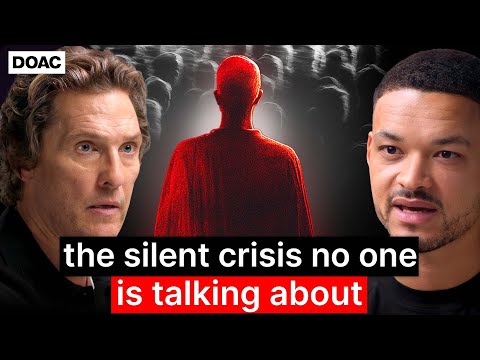
Matthew McConaughey: The Silent Crisis No One Is Talking About! I Sabotaged My Own Career!
Matthew McConaughey (guest), Steven Bartlett (host)
In this episode of The Diary of a CEO, featuring Matthew McConaughey and Steven Bartlett, Matthew McConaughey: The Silent Crisis No One Is Talking About! I Sabotaged My Own Career! explores matthew McConaughey Exposes Comfort Culture, Commitment Crisis, And Real Success Matthew McConaughey reflects on how tough love, hard work, and deliberately embracing resistance shaped his character, career, and spirituality. He argues that modern culture’s obsession with comfort, options, and ‘plan Bs’ is quietly sabotaging relationships, ambition, and mental health, especially for young men. Through stories from his childhood, Australia exchange year, Hollywood career pivot, and spiritual journey, he shows how commitment, ownership, and enduring discomfort create meaning and opportunity. The conversation ends with a focus on redefining success around fatherhood, responsibility, faith, and playing the ‘immortal game’ rather than just chasing medals and status.
Matthew McConaughey Exposes Comfort Culture, Commitment Crisis, And Real Success
Matthew McConaughey reflects on how tough love, hard work, and deliberately embracing resistance shaped his character, career, and spirituality. He argues that modern culture’s obsession with comfort, options, and ‘plan Bs’ is quietly sabotaging relationships, ambition, and mental health, especially for young men. Through stories from his childhood, Australia exchange year, Hollywood career pivot, and spiritual journey, he shows how commitment, ownership, and enduring discomfort create meaning and opportunity. The conversation ends with a focus on redefining success around fatherhood, responsibility, faith, and playing the ‘immortal game’ rather than just chasing medals and status.
Key Takeaways
Stop pulling the parachute too early; commit like an owner, not a renter.
McConaughey argues that modern culture gives us too many exits—plan Bs in careers, relationships, and self-development. ...
Get the full analysis with uListen
Deliberately choose resistance and discomfort to build form, meaning, and direction.
He frames resistance as necessary ‘gravity’: without it, there’s no form, no art, just floating. ...
Get the full analysis with uListen
Know what’s in your DNA, then hustle to turn it into marketable talent.
McConaughey tells young people to first identify innate abilities (what’s truly in your DNA), then decide what you’re willing to study and grind for, and finally align that with what the world actually demands. ...
Get the full analysis with uListen
Redefine success around fatherhood, responsibility, and character—not just status.
As a child, he equated becoming a father with ‘making it’; that goal still sits at the top of his life list. ...
Get the full analysis with uListen
Treat faith and ethics as practical tools, even if you doubt the author.
McConaughey addresses skeptics directly, suggesting science is the ‘practical pursuit of God’ and that belief is a verb, not a provable noun. ...
Get the full analysis with uListen
For young men, being needed and having real stakes is protective against despair.
He and Steven discuss the epidemic of male loneliness, suicidality, and ‘independent’ lifestyles with no one to care for and no one relying on them. ...
Get the full analysis with uListen
Endurance and conviction—staying with a hard choice—create inflection points in life and career.
He recounts turning down a $14. ...
Get the full analysis with uListen
Notable Quotes
“Too many people quit too early. We give ourselves the options and the parachutes, and we pull it when we can still be flying, even though it may be a rocky flight.”
— Matthew McConaughey
“Most relationships that we make don’t last a whole life, but if you go in with an owner’s mentality, you and that person can be everything you can be in this relationship.”
— Matthew McConaughey
“When you accept the challenge, that is when you are big man in this village. It was not about the win or the lose.”
— Matthew McConaughey (recounting Issa in Mali)
“Words are momentary. Intent is momentous.”
— Matthew McConaughey
“If you have any ambition, resistance is gonna come.”
— Matthew McConaughey
Questions Answered in This Episode
You argue that too many people ‘pull the parachute’ early—how can someone practically distinguish between a situation that truly requires an exit (like a toxic relationship) and one where they’re just bailing because it’s uncomfortable?
Matthew McConaughey reflects on how tough love, hard work, and deliberately embracing resistance shaped his character, career, and spirituality. ...
Get the full analysis with uListen AI
In your Australia year, you refused to come home even as your mental health frayed; if a young man today is in a similarly dark place, how should he balance honoring commitments with not destroying himself psychologically?
Get the full analysis with uListen AI
You turned down $14.5 million and stepped away from Hollywood’s comfort to reinvent your career—what specific internal signals told you that staying the rom‑com course would have been self-betrayal rather than just a prudent financial choice?
Get the full analysis with uListen AI
You make a strong case that men need to be depended on to stay grounded; how would you respond to someone who says that message risks trapping people—especially men—in unhealthy roles or codependent relationships just to feel ‘needed’?
Get the full analysis with uListen AI
You redefine religion as ‘re-ligare’, to bind together again, and separate it from exclusionary dogma; if you were designing a modern form of spiritual community from scratch for skeptical young people, what concrete practices and guardrails would you build in so it preserves unity and ethics without repeating institutional abuses?
Get the full analysis with uListen AI
Transcript Preview
I think too many people quit too early. And we give ourself the options and the parachutes in things like relationships and work, self-help. And we pull that to the (censored) when we can still be flying, even though it may be a rocky flight. We pull it early and, okay, it's a safe move. Got down on the ground. What I was building didn't last, but most of the time, it could if you'd have hung in there. But if you have any ambition, resistance is gonna come. And so own that (censored) .
Matthew.
Matthew.
Matthew McConaughey! You've been able to climb to the very top of the mountain again and again and again. Is this natural talent, or is there anything transferrable?
First, look at what's in your DNA. Like, I wanted to play basketball. But no matter how hard I worked, I was not the fastest nor the biggest. So look at what do you have an innate ability for? Then, what are you willing to hustle for? And this is very important 'cause some of us have innate ability, but we don't work for it. We grew up hardcore on hustle, hustle, hustle. Sleep was sin in my household. No TV. Mom would always say, "Why are you gonna watch someone doing something when you can go out in the world and do it yourself?" And then, number three, endurance. I remember this one time when I told my agent, "What I want to do is dramas. No more rom-coms." And this $8 million offer comes in for comedy. I read it and I said, "No, thank you." They come back with a $12 million offer. "No, thanks." $14.5 million offer. I said, "Let me read that again."
(laughs)
I ultimately said no, and I just bought myself a one-way ticket out of Hollywood. About 20 months after, offers came in. Would those have come if I'd have never stepped out? No. Now, number four, if you do this, you're most likely gonna have some success in life, and that is you.
And what about Admiral Bill McRaven?
So he shared great wisdom with me when I was seeking out male mentors.
We reached out to Bill, and he wrote this letter for you. He said, "Dear Matthew..."
Wow.
Are you able to share what you were seeking guidance from him about? To my regular listeners, I know you don't like it when I ask you to subscribe at the start of these conversations. I don't like saying it, I don't like it being in there. None of us like it. It's frustrating. Do you know what's also frustrating? It's also frustrating when I go into the back end of a YouTube channel and I see that 56% of you that listen frequently to this podcast haven't yet subscribed, and so many of you don't even know that you haven't subscribed, because I'll see in the comments section, you say to me, you go, "I didn't even realize I didn't subscribe." And that actually fuels the show. It's basically like you're making a donation to the show. So that's why I ask all the time, because it enables us to build and build and build and build, and we're going for the long term here. So, all I'd ask you is if you've seen this show before and you like it, help me, help my team here. Hit the subscribe button, and we'll continue to build this show for you. That's my promise. Thank you to all of you guys that do subscribe. It means the world to me. Let's get on with the show. Matthew, you're a s- particularly surprisingly artistic, creative, wise, yet materially successful individual, and it wasn't until I dove deeper into your story that I started to understand why that was, why you are, to me, in my mind, such an anomaly, because you are... You seem to be several things that don't often appear in the same place. So my first question to you is, what do I need to understand about your earliest context to understand who you are, the values you have, and the perspective that you view the world with?
Install uListen to search the full transcript and get AI-powered insights
Get Full TranscriptGet more from every podcast
AI summaries, searchable transcripts, and fact-checking. Free forever.
Add to Chrome