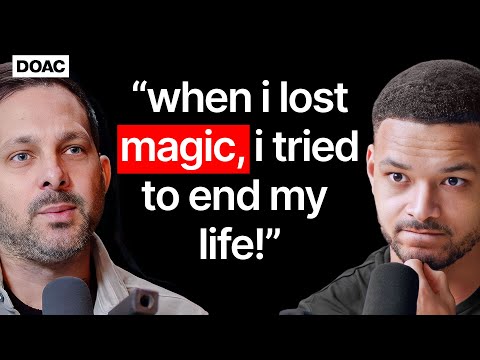
“Dynamo Is Dead!” The Heartbreaking True Story Of Why Dynamo Vanished For Years!
Dynamo (Stephen Frayne) (guest), Steven Bartlett (host), Narrator, Steven Bartlett (host), Narrator
In this episode of The Diary of a CEO, featuring Dynamo (Stephen Frayne) and Steven Bartlett, “Dynamo Is Dead!” The Heartbreaking True Story Of Why Dynamo Vanished For Years! explores dynamo Buried His Pain To Be Reborn Beyond Magic And Fame In this deeply personal conversation, magician Dynamo (Stephen Frayne) reveals the hidden story behind his disappearance from public life: severe Crohn’s disease, debilitating reactive arthritis, profound depression, suicidal crisis, and a bruising legal and identity battle over the name “Dynamo.”
Dynamo Buried His Pain To Be Reborn Beyond Magic And Fame
In this deeply personal conversation, magician Dynamo (Stephen Frayne) reveals the hidden story behind his disappearance from public life: severe Crohn’s disease, debilitating reactive arthritis, profound depression, suicidal crisis, and a bruising legal and identity battle over the name “Dynamo.”
He recounts a childhood marked by racism, bullying, an absent and criminally involved father, and unstable home life, and how magic became both his survival mechanism and later his entire sense of worth.
As his body and career collapsed, he describes reaching rock bottom in November 2020, when his wife found him after a suicide attempt, and the pivotal role of therapy, unconditional love, and a 12‑step style recovery in slowly rebuilding his life.
The episode culminates with his new Sky show “Dynamo Is Dead,” and his decision to symbolically bury himself alive to lay the ‘Dynamo’ persona to rest, reclaim his identity as Stephen, and redefine magic as healing and connection rather than just spectacle.
Key Takeaways
Magic began as a coping mechanism for bullying and exclusion.
As a mixed‑race child in a racist, violent environment, Stephen was regularly beaten and ostracized. ...
Get the full analysis with uListen
Chronic illness can silently erode identity and purpose.
Diagnosed with Crohn’s disease at 13, Stephen endured constant pain, invasive surgeries, and later reactive arthritis that made holding cards and walking difficult. ...
Get the full analysis with uListen
Suicidal thinking often comes from feeling like the problem, not from wanting to die.
At rock bottom on 6 November 2020, Stephen believed that he was the source of everyone’s problems and that his death would relieve his wife and family. ...
Get the full analysis with uListen
Unconditional support and non‑judgmental love can be life‑saving.
When his wife found him unconscious after a suicide attempt, she called his doctor, pushed for therapy, and crucially did not shame him for what had happened. ...
Get the full analysis with uListen
Recovery requires confronting buried resentments and family narratives.
Guided by 12‑step literature and therapy, Stephen revisited his past: resentment toward his absent, criminal father; toward his mother’s abusive partners; and toward his mother herself for choosing relationships that made him feel unwanted. ...
Get the full analysis with uListen
Identity built solely on a persona or talent is fragile.
Stephen’s self‑worth was fused with being ‘Dynamo’—the man who does the impossible. ...
Get the full analysis with uListen
Reinventing purpose can mean redefining what your ‘magic’ actually is.
Through therapy and meeting people who helped him without needing anything in return, Stephen began to see “magic in other people”: acts of kindness, listening, and support. ...
Get the full analysis with uListen
Notable Quotes
“If I saw myself in a mirror, I’d slam my head into the mirror and just keep slamming it to make it go away.”
— Dynamo (Stephen Frayne)
“Magic’s always been the thing that has given me hope… and suddenly I’m in a position where I don’t know what to do with myself and magic isn’t gonna fix it.”
— Dynamo (Stephen Frayne)
“I felt that I had so many problems, but I couldn’t figure out how to even solve one of them… I felt like, ultimately, I was the problem.”
— Dynamo (Stephen Frayne)
“It’s the first time that I have actually felt the love of somebody else… she became the rock. She gave me a love that I’ve never had to deal with, and that ultimately has kept me alive.”
— Dynamo (Stephen Frayne)
“I realised then that the Dynamo as we know it needed to die… and the only way to fully have closure on that part of my life was if I actually bury myself alive.”
— Dynamo (Stephen Frayne)
Questions Answered in This Episode
When your father reappeared at 19 and tried to involve you in crime, what internal dialogue stopped you from being pulled into that world, and how could someone in a similar position recognise that turning point in their own life?
In this deeply personal conversation, magician Dynamo (Stephen Frayne) reveals the hidden story behind his disappearance from public life: severe Crohn’s disease, debilitating reactive arthritis, profound depression, suicidal crisis, and a bruising legal and identity battle over the name “Dynamo.”
Get the full analysis with uListen AI
You described smashing your head into mirrors and self-harming to feel something—what are the earliest, more subtle warning signs you now recognise in yourself before you reach that level of self-destruction?
He recounts a childhood marked by racism, bullying, an absent and criminally involved father, and unstable home life, and how magic became both his survival mechanism and later his entire sense of worth.
Get the full analysis with uListen AI
Given how much the ‘Dynamo’ persona once powered your success but nearly cost you your life, what concrete boundaries or safeguards have you put in place so that future fame or pressure doesn’t collapse your identity again?
As his body and career collapsed, he describes reaching rock bottom in November 2020, when his wife found him after a suicide attempt, and the pivotal role of therapy, unconditional love, and a 12‑step style recovery in slowly rebuilding his life.
Get the full analysis with uListen AI
You found profound value in an Alcoholics Anonymous framework despite never drinking; if you were to design a ‘12 steps for people whose identity is tied to their talent,’ what would a few of those steps be and how could others practically follow them?
The episode culminates with his new Sky show “Dynamo Is Dead,” and his decision to symbolically bury himself alive to lay the ‘Dynamo’ persona to rest, reclaim his identity as Stephen, and redefine magic as healing and connection rather than just spectacle.
Get the full analysis with uListen AI
Looking back, is there anything the medical system could have done differently—around your Crohn’s diagnosis, treatment trials, or communication—that might have reduced the psychological impact and sense of powerlessness you experienced?
Get the full analysis with uListen AI
Transcript Preview
I can't turn off the noise. And if I saw myself in a mirror, I'd slam my head into the mirror and just keep slamming it to make it go away. That's why I disappeared.
But it's not the only reason why you disappeared.
Magic couldn't fix me.
Dynamo! Illusionist and magician extraordinaire.
Are you watching closely?
Was there a moment you look back on and say, "That was my rock bottom."?
The 6th of November, 2020 'cause that was the day, and I tried to kill myself.
Your wife found you unconscious?
In the dog bed. Magic's always been the thing that has given me hope, that I've used to overcome the bullying, overcome the racist abuse, and the lack of belief, and it made me stand out in a different way.
Dynamo! Shout out to my homeboy, Dynamo.
Everything you touch is turning to gold, and you become this sensation. And then in 2017, you stopped suddenly.
I got really sick. I couldn't hold the cards anymore. My body was deteriorating.
And then at that same time, your grandmother had passed away, who was your biggest supporter. I'd also heard that you'd had a legal dispute, which meant that you could no longer use the name Dynamo.
I had so many problems, but I couldn't figure out how to even solve one of them. I felt if I'm not here, then everybody else might be happier. I realized then, the Dynamo as we know it needed to die. And I'm finally feeling it again. Now I just need to get magic back in my life.
Dynamo, or should I say, Stephen, is there some magic you can show me right now? What?
Oh, my god!
I've never shared this before, but three years ago, Dynamo walked up to me when I was at a Christmas party. I'd never met him before, and he whispered something in my ear that, quite frankly, stopped me in my tracks, that I could not believe. I knew Dynamo as this incredible online magician, and what he said to me that day, I was unable to forget. He was in a dark, dark place. He was engaged in a legal battle, and he'd just lost the rights to use his own name. He could no longer call himself Dynamo. He was no longer able or allowed to do magic. And this stranger that had walked over to me at that Christmas party was suffering in a way that I've never seen before. And just a week ago, Dynamo texts me and said, "It's finally time to tell my story." And that is what you're going to hear today, the story he whispered in my ear at that Christmas party all those years ago. Where has Dynamo been? What happened? And what happens next? And before this episode starts, I want to make a deal with you. About 58% of you that watch this podcast frequently haven't yet hit the subscribe button. If you enjoy what we do here, here's the deal that I wanna make with you. If you hit that subscribe button, I promise you that we will keep making this show better in every single way. And we have huge plans to turn this into more of a documentary-style conversation, where we work incredibly hard to bring in footage of the things we're talking about to give you greater context and greater meaning. So if you hit the subscribe button, I promise you that we will deliver an even greater version of this show. I hope you choose to come along on this journey. Enjoy this episode. Dynamo, or should I say, Stephen.
Install uListen to search the full transcript and get AI-powered insights
Get Full TranscriptGet more out of YouTube videos.
High quality summaries for YouTube videos. Accurate transcripts to search & find moments. Powered by ChatGPT & Claude AI.
Add to Chrome