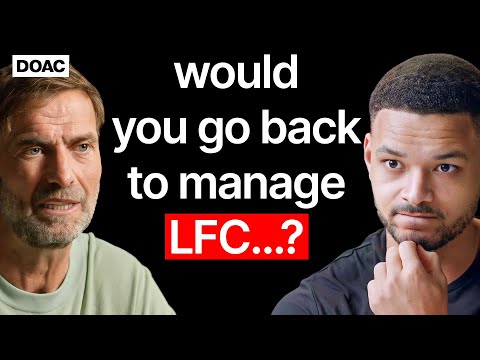
Jürgen Klopp: Would You Go Back To Manage LFC...? The Real Reason I Fell In Love With Liverpool!
Jürgen Klopp (guest), Steven Bartlett (host), Narrator, Narrator, Narrator
In this episode of The Diary of a CEO, featuring Jürgen Klopp and Steven Bartlett, Jürgen Klopp: Would You Go Back To Manage LFC...? The Real Reason I Fell In Love With Liverpool! explores jürgen Klopp Reveals Liverpool Exit, Leadership Secrets, Possible Anfield Return Jürgen Klopp reflects on his journey from modest player to world‑class manager, explaining how his upbringing, early fatherhood and deep love of people forged his leadership style. He details how he transformed Mainz, Dortmund and Liverpool by building belief, tailoring his approach to individuals, and creating a culture where teammates would “walk through fire” for each other.
Jürgen Klopp Reveals Liverpool Exit, Leadership Secrets, Possible Anfield Return
Jürgen Klopp reflects on his journey from modest player to world‑class manager, explaining how his upbringing, early fatherhood and deep love of people forged his leadership style. He details how he transformed Mainz, Dortmund and Liverpool by building belief, tailoring his approach to individuals, and creating a culture where teammates would “walk through fire” for each other.
Klopp contrasts his philosophy with big‑brand, transfer‑obsessed thinking, including why he turned down Manchester United and why culture, character and long‑term planning matter more than star names. He also explains the true reasons for leaving Liverpool: depleted energy after years of carrying huge responsibility, not a lack of affection for the club.
Throughout, he gives concrete examples of managing stars like Salah and Mané, handling social media issues, dealing with crushing near‑misses, and maintaining respect for every member of the organization, from gardeners to kitchen staff. He admits a theoretical openness to managing Liverpool again one day, but stresses he doesn’t miss day‑to‑day coaching right now and is focused on a new project.
The conversation blends football stories with broader lessons on leadership: individualized management over one‑size‑fits‑all rules, learning from defeat, building genuine togetherness, and seeing success as “giving everything” rather than constantly winning.
Key Takeaways
Treat people differently to get the best from them, but be fair in front of the group.
Klopp rejects the idea that leaders must treat everyone identically. ...
Get the full analysis with uListen
Build a team culture where people would ‘walk through fire’ for each other.
At Mainz, Dortmund and Liverpool, Klopp’s decisive success factor was forging deep bonds: players knowing staff by name, respecting gardeners and kitchen workers, and genuinely caring about teammates’ stories. ...
Get the full analysis with uListen
Belief and confidence are built by leaders who see more in people than they see in themselves.
Klopp tells players, “If you would believe as much in yourself as I do, that would be a start. ...
Get the full analysis with uListen
Stability and organization come before style; you earn the right to play beautifully.
When he arrived at Liverpool mid‑season with no training time, his first priority was defensive organization and stability, not complex attacking patterns. ...
Get the full analysis with uListen
Losses and near‑misses are information, not identity—if you learn from them.
Klopp frames defeats as vital data: “If you don’t learn from a defeat, it’s a real defeat. ...
Get the full analysis with uListen
Short‑term fixes and superstar signings can’t replace long‑term, football‑first projects.
Klopp turned down Manchester United partly because the pitch was about brand power and buying any player, not about a coherent football project. ...
Get the full analysis with uListen
Burnout is real: leaders must know when their energy can’t match the job anymore.
Klopp left Liverpool because he no longer felt he could be the relentless ‘energy giver’ the club deserved, not because he fell out of love with the job. ...
Get the full analysis with uListen
Notable Quotes
“I see myself as a constant trier, not a constant winner.”
— Jürgen Klopp
“How can we get the best out of people if we treat them all the same? It’s crazy.”
— Jürgen Klopp
“Don’t waste time with holding back. There’s no guarantee to get anything, but the only chance is to give your all.”
— Jürgen Klopp
“I’m not here to get everything. I am here to give everything.”
— Jürgen Klopp
“I didn’t leave Liverpool because I stopped loving it. I left because I didn’t have the energy to be the manager they deserved.”
— Jürgen Klopp
Questions Answered in This Episode
You turned down Manchester United partly because their pitch was about brand power and ‘getting any player we want.’ If you were advising INEOS today, what specific changes would you insist on to make United a true football project rather than a marketing one?
Jürgen Klopp reflects on his journey from modest player to world‑class manager, explaining how his upbringing, early fatherhood and deep love of people forged his leadership style. ...
Get the full analysis with uListen AI
You’ve said defeats are just ‘very important information’ if you learn from them. Can you walk through one concrete tactical or cultural change you made at Liverpool directly because of a painful loss (for example, Kiev 2018 or the one‑point title loss to City)?
Klopp contrasts his philosophy with big‑brand, transfer‑obsessed thinking, including why he turned down Manchester United and why culture, character and long‑term planning matter more than star names. ...
Get the full analysis with uListen AI
You strongly individualize how you treat players, but there’s a risk others perceive that as favoritism. Have you ever misjudged that balance and damaged a dressing room, and what did you do to repair trust when that happened?
Throughout, he gives concrete examples of managing stars like Salah and Mané, handling social media issues, dealing with crushing near‑misses, and maintaining respect for every member of the organization, from gardeners to kitchen staff. ...
Get the full analysis with uListen AI
You reject the idea that superstar signings guarantee success, yet Liverpool have just executed a galáctico‑style window under Arne Slot. In your view, what are the early warning signs that a ‘big‑name’ strategy is starting to undermine the culture you built?
The conversation blends football stories with broader lessons on leadership: individualized management over one‑size‑fits‑all rules, learning from defeat, building genuine togetherness, and seeing success as “giving everything” rather than constantly winning.
Get the full analysis with uListen AI
You said you don’t miss coaching now and don’t want to ‘die in a dressing room,’ but you also admitted you’ve only recently realized how rare your skill set is. If, five years from now, you feel the pull to return, what questions will you ask yourself to decide whether it’s truly about love for the work or just ego and nostalgia?
Get the full analysis with uListen AI
Transcript Preview
(instrumental music plays) It was an intense time. We had to win football games, but all the rest was on my plate as well. I need a break, and you cannot do that in a business. You cannot say, "Give me a year. See you later."
So it begs the question: Do you think you could ever go back and manage Liverpool again? (dramatic music plays)
It's possible.
So what would it take?
(sighs)
Jürgen, you changed a club, you changed the city. You arrived at a time when clubs were in a period of dysfunction to bring that club back to its glory, and you did that over and over and over again. How?
To win in a very decisive moment, you have to be the best team. And to be the best team, everybody has to buy into that team and walk through fire together.
How do I get people to walk through fire?
I better go back to the start. Growing up, my mom was very caring. She loved people. And my dad had expectations. The problem was I was absolutely useless in most of the things, even with football. My teammates were better than me, and I thought, "I only can get on that level if from the first until last minute, I was a warrior on the pitch." But it made me the guy I am today. And so my team plays a little bit more like a heavy metal band, because you have 90 minutes, and there's no guarantee to get anything. But the only chance to get something is to give your all. So you want to have the maximum success? Don't waste time with holding back.
I want to know why Manchester United didn't (laughs) pursue you.
No, they, they tried.
Okay.
But there are some reasons in that conversation which I didn't like.
Arne Slot coming in after you and didn't change much.
That's super smart, not changing much, and all of a sudden, you win the league by some distance.
But this year, Liverpool have spent, what, 450 odd million. You never had a transfer window like that.
Nobody ever told me that it's possible that we can spend that.
You seem to always be successful. How does someone succeed you?
You want to be able to become the best team in England? You need to. (dramatic music plays)
(instrumental music plays) I see messages all the time in the comments section that some of you didn't realize you didn't subscribe. So if you could do me a favor and double-check if you're a subscriber to this channel, that would be tremendously appreciated. It's the simple, it's the free thing that anybody that watches this show frequently can do to help us here to keep everything going and this show in the trajectory it's on. So please do double-check if you've subscribed, and, uh, thank you so much, because in a strange way, you are ... You're part of our history, and you're on this journey with us, and I appreciate you for that. So yeah, thank you. (instrumental music plays) Jürgen, to understand you and the man and the anomaly that you went on to be in your career, and still are, what do I need to understand about your very earliest context, where you came from? And how ... Can you point out to me how that very early context created the person you are today and that everybody knows you to be?
Install uListen to search the full transcript and get AI-powered insights
Get Full TranscriptGet more out of YouTube videos.
High quality summaries for YouTube videos. Accurate transcripts to search & find moments. Powered by ChatGPT & Claude AI.
Add to Chrome