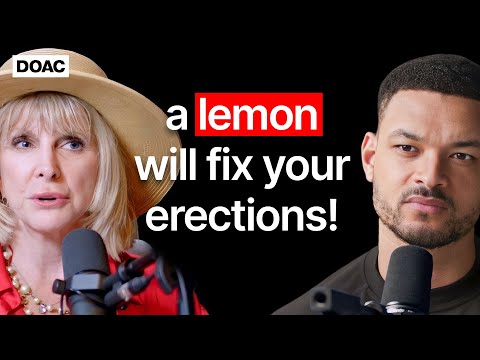
The No.1 Celebrity Therapist: The WEIRD Trick To Get Your Sex Life Back! - Marisa Peer
Marisa Peer (guest), Narrator, Narrator, Narrator, Steven Bartlett (host), Steven Bartlett (host)
In this episode of The Diary of a CEO, featuring Marisa Peer and Narrator, The No.1 Celebrity Therapist: The WEIRD Trick To Get Your Sex Life Back! - Marisa Peer explores celebrity Therapist Reveals Belief Hacks To Transform Sex, Love, Food, Life Marisa Peer explains how almost all emotional and behavioral problems stem from just three core beliefs: feeling different and unable to connect, believing what you want isn’t available, and feeling not enough. She shows how deliberately “lying” to your mind with better words, repetition, and vivid imagery can rewire these beliefs and produce real physical and emotional changes—from stronger erections to passing exams to losing sugar cravings.
Celebrity Therapist Reveals Belief Hacks To Transform Sex, Love, Food, Life
Marisa Peer explains how almost all emotional and behavioral problems stem from just three core beliefs: feeling different and unable to connect, believing what you want isn’t available, and feeling not enough. She shows how deliberately “lying” to your mind with better words, repetition, and vivid imagery can rewire these beliefs and produce real physical and emotional changes—from stronger erections to passing exams to losing sugar cravings.
A major focus is on sex and relationships: why long‑term couples lose desire, how fantasy bridges intimacy and eroticism, why calling your partner “mum” or “dad” kills attraction, and how self‑esteem and perceived value drive our dating lives. Steven shares personal stories of commitment fears, feeling unlovable as a child, rejection in his twenties, and a powerful live hypnosis session to end his sugar addiction.
Peer emphasizes that your mind’s job is to make your thoughts real, not to judge their truth; therefore, your job is to choose, update, and upgrade your beliefs constantly. She argues that repeating statements like “I am enough” and “I love being organized” can materially change identity, behavior, and even body responses when paired with emotional engagement and hypnotic techniques.
Key Takeaways
You must consciously choose and update your beliefs, because your mind will make any repeated thought feel true.
Peer explains that beliefs are just thoughts you think a lot; through confirmation bias you then find evidence to support them. ...
Get the full analysis with uListen
Deliberately ‘lie’ to your mind with better narratives to shift performance and anxiety.
Rather than rehearsing fear (e. ...
Get the full analysis with uListen
Thoughts create direct physical changes; use vivid mental rehearsal to your advantage.
Demonstrations like the ‘lemon’ saliva exercise and the arm‑rotation going further after mental suggestion show how imagination can trigger bodily responses with no external change. ...
Get the full analysis with uListen
Long‑term desire needs mystery and fantasy, not just intimacy and comfort.
Peer distinguishes between intimacy (safety, familiarity, acceptance) and eroticism (mystery, suspense, edginess). ...
Get the full analysis with uListen
Avoid turning your partner into a parent figure if you want to keep sexual attraction alive.
Calling each other “mum/mommy” or “dad/daddy,” or adopting critical/controlling parental tones (“Have you taken your vitamins? ...
Get the full analysis with uListen
Dating success follows self‑esteem and congruent self‑value, not tactics alone.
Steven’s own story—rejection and commitment fears in his early 20s despite reading “high value” dating books, then ease in love after his business success—informs Peer’s point that you can’t convincingly ‘fake’ high value. ...
Get the full analysis with uListen
Cravings often mask old emotional scripts; reframe the meaning and practice ‘chosen indifference.’
In Steven’s live sugar‑craving hypnosis, Peer links his periodic sugar binges to childhood deprivation and theft of sweets to feel equal and in control. ...
Get the full analysis with uListen
Notable Quotes
“You make your beliefs, and then your beliefs turn right around and make you.”
— Marisa Peer
“Lie to your mind, cheat fear, and steal back the confidence you were born with.”
— Marisa Peer
“Every thought you think is a blueprint that your mind and body work to make real.”
— Marisa Peer
“Comparisonism is the thief of joy.”
— Marisa Peer
“If you’re looking for self‑esteem anywhere outside of yourself, you’re not going to find it.”
— Marisa Peer
Questions Answered in This Episode
You claim almost all issues reduce to three core beliefs—can you walk through a concrete example of how each one specifically manifests in a client’s sex life or relationship patterns?
Marisa Peer explains how almost all emotional and behavioral problems stem from just three core beliefs: feeling different and unable to connect, believing what you want isn’t available, and feeling not enough. ...
Get the full analysis with uListen AI
In long‑term relationships where partners already feel like ‘mum/dad’ to each other, what are the first three language or behavior changes you’d prescribe to start restoring erotic polarity?
A major focus is on sex and relationships: why long‑term couples lose desire, how fantasy bridges intimacy and eroticism, why calling your partner “mum” or “dad” kills attraction, and how self‑esteem and perceived value drive our dating lives. ...
Get the full analysis with uListen AI
For someone who has tried affirmations like “I am enough” but finds they trigger cynicism or disgust, how would you adjust the process so it actually sticks instead of backfiring?
Peer emphasizes that your mind’s job is to make your thoughts real, not to judge their truth; therefore, your job is to choose, update, and upgrade your beliefs constantly. ...
Get the full analysis with uListen AI
When you advise using fantasy and role‑play (like pretending to be strangers) to supercharge sex and even fertility, where do you draw the ethical line so it doesn’t slide into secret double lives or hidden resentment?
Get the full analysis with uListen AI
Given how powerfully hypnosis changed Steven’s sugar cravings, what safeguards and standards do you think should exist to prevent untrained or unethical practitioners from misusing these techniques on vulnerable clients?
Get the full analysis with uListen AI
Transcript Preview
I taught 16,000 therapists. There's only three things wrong with every person that turns up at your door. First of all...
Marisa Peer.
The worldwide renowned therapist.
From royalty, international superstars, CEOs, and Olympic athletes. This woman definitely knows a thing or two thousand about how we take control of our thoughts.
80% of your success is down to your beliefs, but it also damages so many people, because if you're thinking, "I'm not good enough, smart enough, attractive enough," your mind's job is to make your thoughts real, even if it's not true. A classic example is sex. So many of my clients couldn't conceive because their husbands didn't have enough sperm. But when men have sex with a stranger, they triple their sperm count. And
(coughs) .
... really damages so many people, because it's an impossible expectation to live up to. So, many people have affairs, not because they don't love their partner, but because they're missing out. But it's all about what you have chosen to believe, so you've got to reverse that language. And the other thing that people do a lot, it really messes up your sex life to call your partner mummy or daddy. Because...
Marisa, how do I avoid sugar? It seems to grab me.
Food has memories. It's not the chocolate, it's the feeling you felt when you couldn't have it. And you can give yourself the feeling without the thing anyway. It's really easy, too.
How?
Shall I hypnotize you so we can change it?
Let's do it now.
Okay. Close your eyes. And here's the magic sentence that changes your life.
I got hypnotized. In this episode, Marisa hypnotizes me to completely end my sugar cravings. And you're gonna see it happen, and you're gonna find out if it works. So stick around. Marisa, I've been trying to figure something out. I've been trying to figure out if we get to choose our beliefs.
Mm-hmm.
And I, I actually wrote about this in my, my book recently. And I, I feel like you're the person to ask this question, because I know that our lives are governed by these beliefs...
Mm-hmm.
... that we have about the world, ourselves, and everything in between. But can we choose them?
I think so. You know, when I was here last time, you asked me about my childhood, which I don't talk about a lot. It wasn't awful, but it also wasn't amazing. But the beliefs I had then are so totally different to the beliefs I have now, because I chose to give myself better beliefs. Because, you know, you make your beliefs, and then your beliefs turn right around and make you. And then, confirmation bias means you look for proof of what you have chosen to believe, and you'll find it. So if you say, "Oh, I hate cats. They're vicious things that scratch you. They're really aloof." Or, "I don't like dogs. They're barky, yappy, horrible things." Then if you believe that about a dog, and you meet a dog, you'll feel so anxious that that will become true. But if you say, "Oh, I love dogs. They're the most loyal, gorgeous, loving things," then you'll have a different energy around them. So you should choose your beliefs. You should constantly upgrade, update, question your belief, "Where did I get that from? Is that true? Who told me that belief? And even if it's true for them, does it have to be true for me?" You know, I see a lot of women who say things like, "Well, you know, if you're really famous and rich, you'll never find a guy," because 100 years ago, that was probably true. Men didn't go for rich, successful women, 'cause they wanted them at home. But it's not true now. So, your grandmother's belief is not your belief. I love my daughters' generation who don't do body shaming or fat shaming and have a whole different language about it, which I think is so refreshing. So, you can always choose your beliefs, and you really should constantly check, "Why do I even believe that? Is it even true?" Because so often, it's not true at all, it's just something you've been taught or you've just gone along with it anyway.
Install uListen to search the full transcript and get AI-powered insights
Get Full TranscriptGet more from every podcast
AI summaries, searchable transcripts, and fact-checking. Free forever.
Add to Chrome