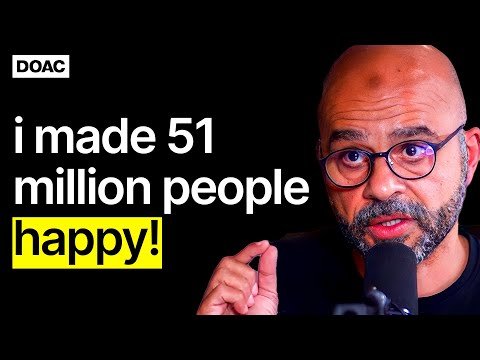
The Happiness Expert That Made 51 Million People Happier: Mo Gawdat | E101
Mo Gawdat (guest), Steven Bartlett (host), Narrator
In this episode of The Diary of a CEO, featuring Mo Gawdat and Steven Bartlett, The Happiness Expert That Made 51 Million People Happier: Mo Gawdat | E101 explores engineer-Turned-Happiness-Expert Reveals Formula For Joy And Future AI Mo Gawdat, former Chief Business Officer at Google X, shares how early success, deep depression, and the tragic loss of his son Ali led him to engineer a practical model for happiness and launch the One Billion Happy movement. He explains happiness as a mathematical-like equation between life’s events and our expectations, and shows how illusions of control, time, and ego create unnecessary suffering. Gawdat outlines tools like radical acceptance, gratitude, managing inner dialogue, and separating love from conditions to build resilient, lasting happiness. In the second half, he warns that rapidly advancing artificial intelligence will soon surpass human intelligence and argues our everyday online behavior is effectively “raising” these sentient systems, making our ethics and online conduct critical to humanity’s future.
Engineer-Turned-Happiness-Expert Reveals Formula For Joy And Future AI
Mo Gawdat, former Chief Business Officer at Google X, shares how early success, deep depression, and the tragic loss of his son Ali led him to engineer a practical model for happiness and launch the One Billion Happy movement. He explains happiness as a mathematical-like equation between life’s events and our expectations, and shows how illusions of control, time, and ego create unnecessary suffering. Gawdat outlines tools like radical acceptance, gratitude, managing inner dialogue, and separating love from conditions to build resilient, lasting happiness. In the second half, he warns that rapidly advancing artificial intelligence will soon surpass human intelligence and argues our everyday online behavior is effectively “raising” these sentient systems, making our ethics and online conduct critical to humanity’s future.
Key Takeaways
Happiness follows a predictable ‘equation’ you can work with logically.
Gawdat defines happiness as the feeling that arises when your perception of life’s events meets or exceeds your expectations of how life should be. ...
Unhappiness is a signal, and recovery speed is a trainable skill.
Gawdat emphasizes that even the ‘world’s happiest man’ still feels negative emotions; the difference is how fast he returns to baseline happiness. ...
You are not your thoughts; treating your brain as ‘other’ gives you control.
Drawing on neuroscience, Gawdat explains that the brain generates thoughts as a biological function, much like the heart pumps blood. ...
Radical, ‘committed’ acceptance turns trauma into purposeful action instead of lifelong suffering.
After his son Ali died from a series of preventable surgical errors, Gawdat and Ali’s mother confronted a brutal truth: nothing could bring him back. ...
Gratitude and ‘looking down’ are powerful, trainable antidotes to modern dissatisfaction.
Because the brain is wired to scan for threats, we easily fixate on what’s wrong. ...
Ambition is healthy; confusing it with expectations is what makes success feel empty.
Gawdat distinguishes ambitions (things you strive for) from expectations (conditions you require to be happy). ...
Our online behavior is ‘raising’ future AI; ethical conduct now shapes their ethics later.
In the AI section, Gawdat argues that modern AI systems learn far more from user behavior than from their original programmers. ...
Notable Quotes
“Happiness becomes that calm and peacefulness you feel when you're okay with life as it is.”
— Mo Gawdat
“Your brain does what you tell it to do. You're the boss. Tell it.”
— Mo Gawdat
“I simply said, 'Okay, he's gone. There's nothing I can do to bring him back, but I can make his essence alive.'”
— Mo Gawdat
“Gratitude is the ultimate solution to the happiness equation.”
— Mo Gawdat
“For the machines to become amazing teenagers in ten years’ time, we need to become amazing parents today.”
— Mo Gawdat
Questions Answered in This Episode
Your happiness equation hinges on expectations: how, in practical day‑to‑day terms, can someone lower unhealthy expectations without losing their drive and standards in a high-performance career?
Mo Gawdat, former Chief Business Officer at Google X, shares how early success, deep depression, and the tragic loss of his son Ali led him to engineer a practical model for happiness and launch the One Billion Happy movement. ...
You mentioned six grand illusions and seven blind spots that distort our perception—could you walk through one or two more of them in detail, with concrete examples of how to spot and correct them in real time?
In Ali’s case, his death was linked to clear human error; what did you actually do, step-by-step, to pursue accountability and systemic change while still avoiding getting stuck in anger and revenge?
The idea that our social media behavior is ‘raising’ AI is powerful; what specific online habits would you recommend we change tomorrow morning to positively influence AI’s emerging ethics?
You said your biggest cherished failure was under-developing your feminine side; what daily practices or decisions have most helped you rebalance that in yourself, and how would you advise a very ‘masculine-coded’ founder to start that same shift?
EVERY SPOKEN WORD
Install uListen for AI-powered chat & search across the full episode — Get Full Transcript
Get more out of YouTube videos.
High quality summaries for YouTube videos. Accurate transcripts to search & find moments. Powered by ChatGPT & Claude AI.
Add to Chrome