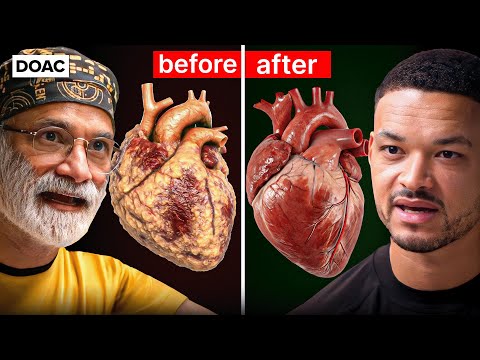
Insulin Doctor: The Fastest Way To Burn Dangerous Visceral Fat! I'm Finding Mould In My Patients!
Dr. Pradip (Pradeep) Jamnadas (guest), Steven Bartlett (host), Narrator
In this episode of The Diary of a CEO, featuring Dr. Pradip (Pradeep) Jamnadas and Steven Bartlett, Insulin Doctor: The Fastest Way To Burn Dangerous Visceral Fat! I'm Finding Mould In My Patients! explores insulin Doctor Reveals Fasting Blueprint To Erase Deadly Visceral Fat Cardiologist Dr. Pradeep Jamnadas explains why visceral belly fat, chronic high insulin, and hidden inflammation are driving an epidemic of premature heart disease—even in people who appear healthy. He argues that conventional markers like normal blood sugar and LDL alone miss years of underlying metabolic damage driven by hyperinsulinemia, leaky gut, toxins, and mold.
Insulin Doctor Reveals Fasting Blueprint To Erase Deadly Visceral Fat
Cardiologist Dr. Pradeep Jamnadas explains why visceral belly fat, chronic high insulin, and hidden inflammation are driving an epidemic of premature heart disease—even in people who appear healthy. He argues that conventional markers like normal blood sugar and LDL alone miss years of underlying metabolic damage driven by hyperinsulinemia, leaky gut, toxins, and mold.
He lays out a prevention-first strategy built around fasting (especially 18:6 and periodic longer fasts), low-frequency eating, fiber-rich real foods, resistance and interval training, gut repair, toxin avoidance, and key supplements such as vitamin D3, K2, omega-3, magnesium and probiotics.
Jamnadas distinguishes between calorie restriction and true fasting, emphasizing that fasting uniquely lowers insulin, burns visceral fat first, boosts ketones, stem cells, autophagy and mitophagy, and improves vagus nerve and heart function.
He also challenges common beliefs on ‘healthy’ foods (fruit, white rice, vegetable oils, calcium supplements), highlights the under‑recognized roles of mold and pesticides, and stresses that nearly all coronary artery disease is traceable to specific, modifiable sources of inflammation.
Key Takeaways
Visceral belly fat is a visible sign of dangerous hyperinsulinemia.
A protruding belly with relatively lean limbs strongly suggests insulin resistance and high background insulin, even if blood sugar and HbA1c are normal. ...
Fasting, not just calorie cutting, is the fastest way to lose visceral fat and reset metabolism.
Calorie restriction alone triggers metabolic slowdown and loss of both fat and muscle. ...
Frequent refined carbs and processed foods drive insulin resistance long before diabetes shows up.
Eating every 2–3 hours—especially refined carbs, sugars, juices, white flour products, and low‑fiber processed foods—keeps insulin elevated for most of the day. ...
Gut health and leaky gut are central drivers of fatty liver and coronary artery disease.
A dysfunctional microbiome and compromised intestinal barrier allow bacterial wall fragments (lipopolysaccharides) and other gut contents into the bloodstream, first hitting the liver via the portal vein. ...
Hidden toxins—especially mold, pesticides, and heavy metals—create chronic inflammation that accelerates heart disease.
Jamnadas reports that a large proportion of his patients test high for pesticides, herbicides, heavy metals, and mold toxins. ...
Exercise should prioritize resistance training and short, intense intervals over chronic long‑distance cardio.
In his practice, extreme endurance exercisers (long daily cycling, long treadmill runs, chronic marathon training) often show more coronary artery disease and inflammation than those doing brief aerobic work plus resistance and HIIT. ...
Several common ‘health’ practices backfire: calcium pills, fruit overload, seed oils, and overcooked foods.
High‑dose calcium supplements are linked with increased vascular calcification; Jamnadas stops them in cardiac patients and instead emphasizes vitamin D3 and K2 for proper calcium handling. ...
Notable Quotes
“If you have a belly sticking out, you have a problem.”
— Dr. Pradeep Jamnadas
“By the time you are diagnosed as having diabetes, you already have coronary artery disease.”
— Dr. Pradeep Jamnadas
“Fasting is supposed to be a normal part of your existence. That's the way you were designed.”
— Dr. Pradeep Jamnadas
“There's always a reason why you get hardening of the arteries.”
— Dr. Pradeep Jamnadas
“Life is only expressed in this moment, right now.”
— Dr. Pradeep Jamnadas
Questions Answered in This Episode
You’ve described a 72‑day fast and even a 183‑day supervised fast—what specific lab markers and thresholds do you monitor during such extreme protocols to know when to stop or intervene?
Cardiologist Dr. ...
If a lean, athletic person with visible abs has a high coronary calcium score, how would you prioritize investigating gut, mold, or other hidden sources of inflammation in their case?
He lays out a prevention-first strategy built around fasting (especially 18:6 and periodic longer fasts), low-frequency eating, fiber-rich real foods, resistance and interval training, gut repair, toxin avoidance, and key supplements such as vitamin D3, K2, omega-3, magnesium and probiotics.
Given your concerns about long‑term statin side effects but also their proven benefits in some groups, in which specific patient profiles do you still consider statins non‑negotiable?
Jamnadas distinguishes between calorie restriction and true fasting, emphasizing that fasting uniquely lowers insulin, burns visceral fat first, boosts ketones, stem cells, autophagy and mitophagy, and improves vagus nerve and heart function.
You argue that modern fruit intake contributes to fatty liver via fructose; can you outline a practical, evidence‑based guideline for how much fruit (and what types) an otherwise healthy person can safely consume?
He also challenges common beliefs on ‘healthy’ foods (fruit, white rice, vegetable oils, calcium supplements), highlights the under‑recognized roles of mold and pesticides, and stresses that nearly all coronary artery disease is traceable to specific, modifiable sources of inflammation.
Many people live in environments where mold remediation and organic, grass‑finished foods are financially or logistically difficult—what is your ‘minimum effective dose’ protocol for someone on a tight budget who still wants to meaningfully reduce visceral fat, inflammation, and heart risk?
EVERY SPOKEN WORD
Install uListen for AI-powered chat & search across the full episode — Get Full Transcript
Get more out of YouTube videos.
High quality summaries for YouTube videos. Accurate transcripts to search & find moments. Powered by ChatGPT & Claude AI.
Add to Chrome