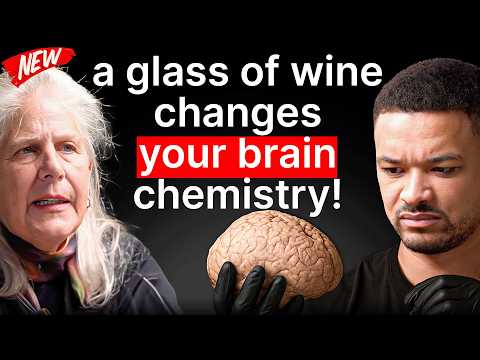
No.1 Brain Scientist: Your Brain Is Lying To You! Here's How I Discovered The Truth!
Steven Bartlett (host), Dr. Jill Bolte Taylor (guest)
In this episode of The Diary of a CEO, featuring Steven Bartlett and Dr. Jill Bolte Taylor, No.1 Brain Scientist: Your Brain Is Lying To You! Here's How I Discovered The Truth! explores harvard Neuroscientist: How Four Brain Personalities Control Your Life Harvard-trained neuroanatomist Dr. Jill Bolte Taylor explains how the human brain contains four distinct, anatomically grounded “characters” that shape how we think, feel, and behave: left-thinking, left-emotional, right-emotional, and right-thinking selves.
Harvard Neuroscientist: How Four Brain Personalities Control Your Life
Harvard-trained neuroanatomist Dr. Jill Bolte Taylor explains how the human brain contains four distinct, anatomically grounded “characters” that shape how we think, feel, and behave: left-thinking, left-emotional, right-emotional, and right-thinking selves.
She recounts her catastrophic left-hemisphere stroke at 37, which erased her language, ego, and memories for years, plunging her into a blissful, present-moment right-brain consciousness and forcing an eight‑year rebuild of her left-brain capacities.
From this lived experiment and decades of research, she argues that modern society is dangerously over-identified with the left-thinking and left-emotional brain—productivity, ego, fear, and trauma—while neglecting the present, playful, and peaceful capacities of the right hemisphere.
She outlines practical tools for “whole brain living,” including recognizing your four inner characters, deliberately shifting between them, using the 90‑second rule for emotions, healing trauma through integration rather than erasure, and protecting brain health through lifestyle choices.
Key Takeaways
You have four distinct, anatomically-based ‘characters’ in your brain that you can learn to recognize and choose between.
Taylor maps four personality “characters” onto four brain regions: (1) Left-thinking: analytical, structured, language-based, ego-driven, focused on me, time, goals, and control (her ‘Helen – hell on wheels’); (2) Left-emotional: stores pain, trauma, fear, craving, and defensive reactions (her ‘Abby’); (3) Right-emotional: playful, embodied, sensory, spontaneous, present-moment joy and curiosity; (4) Right-thinking: expansive, peaceful, awe-filled, interconnected, ‘wisdom’ consciousness. ...
Get the full analysis with uListen
Modern life overuses the left brain, creating a crisis of meaning, connection, and mental health.
Society disproportionately rewards the left-thinking brain (productivity, data, achievement) and lives trapped in the left-emotional brain (rumination, trauma replay, anxiety, addiction). ...
Get the full analysis with uListen
Emotions are designed to last about 90 seconds unless you mentally re-trigger them.
Neurally, we do three things: think thoughts, feel emotions, and run physiological loops that match those emotions. ...
Get the full analysis with uListen
Trauma can’t be deleted; it must be integrated and repurposed with other brain characters.
Trauma memories and associated fear responses live largely in the left-emotional circuitry (including the amygdala and related limbic structures). ...
Get the full analysis with uListen
You can deliberately shift brain states using awareness, practice, and even sensory hacks.
Step one is self-observation: notice when you’re in each character—at work (1), in resentment or fear (2), in play or embodiment (3), or in awe and gratitude (4). ...
Get the full analysis with uListen
Cellular brain health underpins mental health; lifestyle choices are non-negotiable.
Mental health is constrained by the physical health of brain cells. ...
Get the full analysis with uListen
Reframing existence as an improbable miracle can shift your baseline mindset.
Taylor walks through the improbability of any individual’s existence—from the egg that became you forming during your mother’s fifth week in your grandmother’s womb, to winning the ‘race’ among hundreds of thousands of possible eggs and millions of sperm, to 250,000 new cells forming per second during gestation. ...
Get the full analysis with uListen
Notable Quotes
“I did not die that day. And that meant no matter how disabled I was, I had the potential to grow and heal and become whatever I would become.”
— Dr. Jill Bolte Taylor
“We are feeling creatures who think, not thinking creatures who feel.”
— Dr. Jill Bolte Taylor
“So many people are trying to get rid of their emotional reactivity, but the way to heal it is not to get rid of it.”
— Dr. Jill Bolte Taylor
“We are so skewed as a society to the two parts of the left brain… and we get in trouble when this is the only portion of our brain that we value, because look at the world we currently live in.”
— Dr. Jill Bolte Taylor
“Your life is worth 30 seconds. If you're in your car and you're getting ready to pull out between those two cars that are coming, your life is worth 30 seconds.”
— Dr. Jill Bolte Taylor
Questions Answered in This Episode
You argue that trauma should be integrated rather than erased; for someone who feels their Character 2 completely dominates their life, what’s the very first, smallest step they can take this week to start shifting energy toward Characters 3 and 4?
Harvard-trained neuroanatomist Dr. ...
Get the full analysis with uListen AI
In your stroke, the right hemisphere’s bliss made it tempting not to seek help; do you see any risks in people over-romanticizing right-brain consciousness and neglecting critical left-brain responsibilities like safety, planning, or justice?
She recounts her catastrophic left-hemisphere stroke at 37, which erased her language, ego, and memories for years, plunging her into a blissful, present-moment right-brain consciousness and forcing an eight‑year rebuild of her left-brain capacities.
Get the full analysis with uListen AI
Your four-characters model is anatomically grounded but also quite metaphorical—if a skeptical neuroscientist challenged you to design a rigorous study to validate this framework, what would that experiment look like?
From this lived experiment and decades of research, she argues that modern society is dangerously over-identified with the left-thinking and left-emotional brain—productivity, ego, fear, and trauma—while neglecting the present, playful, and peaceful capacities of the right hemisphere.
Get the full analysis with uListen AI
You linked addiction and craving to the left insular cortex; based on that, how would you redesign current addiction treatment programs to better leverage right-hemispheric play, connection, and awe rather than focusing primarily on suppression and control?
She outlines practical tools for “whole brain living,” including recognizing your four inner characters, deliberately shifting between them, using the 90‑second rule for emotions, healing trauma through integration rather than erasure, and protecting brain health through lifestyle choices.
Get the full analysis with uListen AI
For high-achieving listeners whose livelihoods depend on a strong Character 1, how can they realistically protect their careers while still dialing back left-brain dominance enough to avoid burnout and cultivate the peace and presence you describe?
Get the full analysis with uListen AI
Transcript Preview
You've bought a present for me in this box, and I feel nervous and excited.
(laughs) So this is a human brain with a spinal cord. Such a masterpiece. But what people don't know is that we have four different structured parts of our brain that automatically shape how we think, feel, and behave. But what if it's not unconscious? What if we could pick and choose who and how we wanna be in any moment on purpose, like we can manifest our own mental health?
And by the end of this conversation today, you're gonna teach me how to do that?
Absolutely. You're gonna so get it.
Harvard neuroscientist, Dr. Jill Bolte Taylor- ... has transformed how we understand the brain through her research and own traumatic experience. She's teaching the world how to unlock every part of their brain to regain control of their thoughts, emotions, and behavior.
We have a problem. We are skewed as a society to the two parts of the left brain which focuses on me, the individual. How do I fit myself into a society? And trauma's living in there, as is cravings and addiction. And we need this, it protects us, but we get in trouble when this is the only portion of our brain that we value, because look at the world we currently live in.
So, is there a strategy for making sure that you don't act upon it?
Well, so many people are trying to get rid of their emotional reactivity, but the way to heal it is not to get rid of it. I mean, we're wired for this. Why do I wanna just put myself in a little box and say, "I don't wanna have pain. I don't wanna be mad. I don't wanna be a robot." I don't wanna be a robot. I wanna be a whole human with a whole brain. Like, this is life, it'll last this long, and then it's gone. And it took me losing the left side of my brain for eight years to realize just how, how precious this thing is.
So how do I control and protect my brain at all costs?
Well, there's a lot. So you ready? Bum, bum, bum. I want some hot stuff.
I see messages all the time in the comments section that some of you didn't realize you didn't subscribe, so if you could do me a favor and double-check if you're a subscriber to this channel, that would be tremendously appreciated. It's the simple, it's the free thing that anybody that watches this show frequently can do to help us here to keep everything going and this show in the trajectory it's on. So, please do double-check if you've subscribed, and, uh, thank you so much, because in a strange way, you are, you're part of our history, and you're on this journey with us, and I appreciate you for that. So yeah, thank you. Dr. Jill Bolte Taylor, what have you spent your professional career endeavoring to understand, and why does it matter?
Install uListen to search the full transcript and get AI-powered insights
Get Full TranscriptGet more out of YouTube videos.
High quality summaries for YouTube videos. Accurate transcripts to search & find moments. Powered by ChatGPT & Claude AI.
Add to Chrome