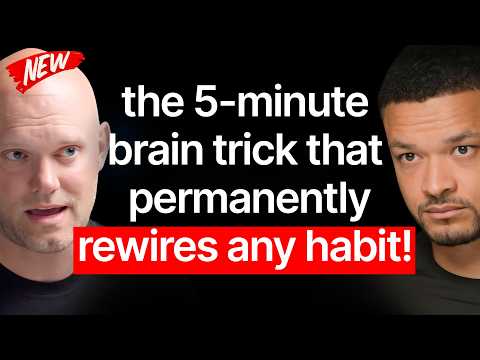
Discipline Expert: The Habit That Will Make Or Break Your Entire 2026!
Steven Bartlett (host), James Clear (guest)
In this episode of The Diary of a CEO, featuring Steven Bartlett and James Clear, Discipline Expert: The Habit That Will Make Or Break Your Entire 2026! explores james Clear Reveals Systems, Not Goals, Will Define Your 2026 James Clear explains how habits truly drive long-term results, arguing that outcomes are simply lagging measures of daily behaviors. He breaks down his four-step habit model—cue, craving, response, reward—into practical “laws” for making good habits easier and bad habits harder. The conversation emphasizes starting embarrassingly small, creating conditions for success, and designing environments and social circles that make desired behaviors the path of least resistance. Clear also contrasts goals versus systems, highlights the power of identity and enjoyment in habit formation, and explores how to stay consistent across changing life seasons.
James Clear Reveals Systems, Not Goals, Will Define Your 2026
James Clear explains how habits truly drive long-term results, arguing that outcomes are simply lagging measures of daily behaviors. He breaks down his four-step habit model—cue, craving, response, reward—into practical “laws” for making good habits easier and bad habits harder. The conversation emphasizes starting embarrassingly small, creating conditions for success, and designing environments and social circles that make desired behaviors the path of least resistance. Clear also contrasts goals versus systems, highlights the power of identity and enjoyment in habit formation, and explores how to stay consistent across changing life seasons.
Key Takeaways
Design systems; stop obsessing over goals.
Goals set direction, but your daily systems—your recurring habits—determine where you actually end up. ...
Make good habits obvious, attractive, easy, and satisfying.
Use Clear’s Four Laws: put cues in sight, find the fun version of the habit, reduce friction with tiny two-minute starters, and create immediate rewards so your brain wants to repeat the behavior.
Start embarrassingly small and master showing up.
Shrink habits to the point where doing them feels almost trivial—one page of reading, one push-up, five minutes at the gym—because consistency enlarges ability and builds identity over time.
Engineer your environment and social circle to match your goals.
Physical spaces and people act like gravity, constantly nudging your behavior; join groups where your desired behavior is normal and arrange your spaces so the right action is the path of least resistance.
Use “reduce the scope, stick to the schedule” to stay consistent.
On bad or busy days, do a smaller version of the habit instead of skipping entirely; this protects the streak, preserves your identity, and makes it easier to ramp back up later.
Treat habits as a lifestyle, not a 30‑day finish line.
Repetition matters indefinitely—habits don’t “complete”; they need to evolve with your life seasons, careers, and family demands rather than remaining rigid or all-or-nothing.
Leverage identity and narrative to lock habits in place.
Every action is a vote for the type of person you become; framing yourself as “a runner” or “a kind person” and emphasizing wins builds a self-image that you’ll fight to be consistent with.
Notable Quotes
“We don’t rise to the level of our goals, we fall to the level of our systems.”
— James Clear
“A habit must be established before it can be improved.”
— James Clear
“The person who’s having fun is actually the person who’s dangerous.”
— James Clear
“The secret to winning is actually learning how to lose.”
— James Clear
“To want the outcome without the lifestyle is to torture yourself.”
— James Clear
Questions Answered in This Episode
Which of my current daily habits are truly upstream drivers of my future results, and which are just noise?
James Clear explains how habits truly drive long-term results, arguing that outcomes are simply lagging measures of daily behaviors. ...
If I applied the two-minute rule, what would the smallest version of my most important new habit look like?
How could I redesign my home, workspace, and digital environment so that my desired behaviors become the easiest options?
In what areas of my life am I clinging to old systems or habits that once served me but no longer fit this season?
What identity do I want my habits to reinforce over the next year, and what “votes” am I actually casting each day?
EVERY SPOKEN WORD
Install uListen for AI-powered chat & search across the full episode — Get Full Transcript
Get more out of YouTube videos.
High quality summaries for YouTube videos. Accurate transcripts to search & find moments. Powered by ChatGPT & Claude AI.
Add to Chrome