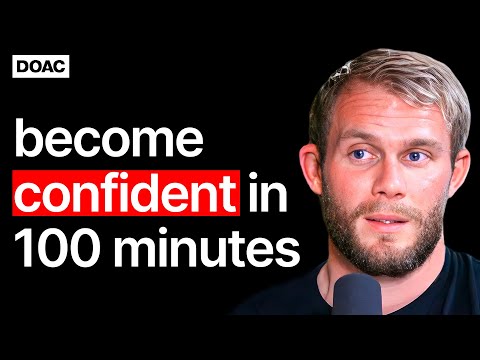
James Smith: Become Confident In 100 Minutes | E174
James Smith (guest), Steven Bartlett (host)
In this episode of The Diary of a CEO, featuring James Smith and Steven Bartlett, James Smith: Become Confident In 100 Minutes | E174 explores james Smith Redefines Confidence: Action, Audacity, and Honest Self-Work James Smith joins Steven Bartlett to unpack confidence as a learnable skill rooted in repetition, evidence, and a willingness to lose, rather than a fixed personality trait or magical 'superpower.'
James Smith Redefines Confidence: Action, Audacity, and Honest Self-Work
James Smith joins Steven Bartlett to unpack confidence as a learnable skill rooted in repetition, evidence, and a willingness to lose, rather than a fixed personality trait or magical 'superpower.'
They explore how pain points, early life experiences, dating, work, and relationships all intersect with confidence, and why inaction is still a choice that compounds self-doubt.
Smith emphasizes audacity, small uncomfortable actions (like asking for discounts or posting online), and long-term repetition of ‘boring’ tasks as the real engines of change.
The conversation also dives into modern dating, monogamy, porn, boredom, purpose, and how consciously choosing your environment and habits protects mental health and fuels a meaningful, confident life.
Key Takeaways
Confidence Is Built From Evidence And Repetition, Not Affirmations
Smith frames confidence as predicting success on a spectrum where anxiety predicts failure and confidence predicts success. ...
Use Pain Points To Override Fear At The Crossroads
When you feel ‘not confident enough,’ you’re at a left/right choice between action and inaction. ...
Train Confidence With Small, Deliberately Uncomfortable Tasks
Confidence behaves like fitness: if you stop training it, you lose it. ...
Audacity And Being Willing To Lose Are Prerequisites For Success
Smith and Bartlett both link their careers to an audacious initial bet: starting a podcast with the intent to be the biggest, or posting contrarian fitness content knowing it would attract hate. ...
Design Your Environment: Friends, Content, And Convenience Shape Confidence
Your ‘passengers’—the people you metaphorically sit in a car with for eight hours—either push you forward or hold you back. ...
Modern Dating And Monogamy Require Conscious, Confident Choice
Smith sees dating as a huge confidence pain point: people lack confidence either to leave bad relationships or pursue new ones. ...
Purpose And Confidence Grow From Incompletable Goals And Boring Reps
Both men describe shifting from finite, outcome-based goals (six-pack for summer, sell a company) to ‘infinite game’ pursuits (consistency in the gym, a podcast with no end, mastering jiu-jitsu). ...
Notable Quotes
“Whatever you're not changing, you're choosing.”
— James Smith
“Confidence isn’t a personality trait; it’s how you predict success in something.”
— James Smith
“Losing is not the same as being defeated.”
— James Smith (quoting Rickson Gracie)
“People seem to think people are paying a lot more attention to us than they actually are.”
— James Smith
“The opposite of happiness is boredom.”
— James Smith (quoting Tim Ferriss)
Questions Answered in This Episode
You distinguish sharply between ‘losing’ and ‘being defeated.’ Can you describe a recent situation where you caught yourself on the verge of being defeated and consciously chose to reframe it as just another loss?
James Smith joins Steven Bartlett to unpack confidence as a learnable skill rooted in repetition, evidence, and a willingness to lose, rather than a fixed personality trait or magical 'superpower.'
When you talk about monogamy critics as building an ‘inner citadel’ from past hurt, how do you avoid falling into the same trap yourself—defending monogamy simply because it has worked for you and your parents?
They explore how pain points, early life experiences, dating, work, and relationships all intersect with confidence, and why inaction is still a choice that compounds self-doubt.
You argue that dating apps and alcohol erode real-world social confidence; what would a practical 30-day ‘confidence training’ dating plan look like for someone who currently relies entirely on apps and booze?
Smith emphasizes audacity, small uncomfortable actions (like asking for discounts or posting online), and long-term repetition of ‘boring’ tasks as the real engines of change.
You advocate the ‘utility of deprivation’ for porn and masturbation, especially for single men; how should someone realistically phase this down without creating shame, rebound bingeing, or secrecy in a relationship?
The conversation also dives into modern dating, monogamy, porn, boredom, purpose, and how consciously choosing your environment and habits protects mental health and fuels a meaningful, confident life.
Given that you see confidence as expectation plus evidence, how would you coach someone with a genuinely catastrophic public failure in their past (e.g., a viral humiliation) to rebuild a new evidence base without being trapped by that history?
EVERY SPOKEN WORD
Install uListen for AI-powered chat & search across the full episode — Get Full Transcript
Get more out of YouTube videos.
High quality summaries for YouTube videos. Accurate transcripts to search & find moments. Powered by ChatGPT & Claude AI.
Add to Chrome