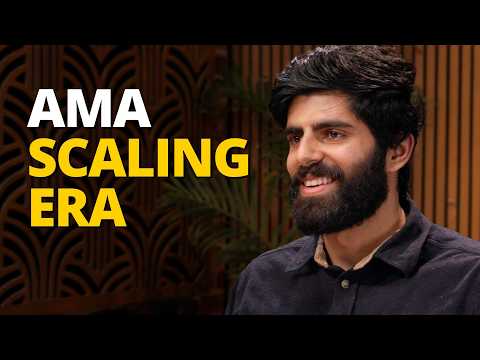
AMA: career advice given AGI, how I research ft. Sholto & Trenton
Dwarkesh Patel (host), Trenton Bricken (guest), Sholto Douglas (guest), Narrator, Narrator
In this episode of Dwarkesh Podcast, featuring Dwarkesh Patel and Trenton Bricken, AMA: career advice given AGI, how I research ft. Sholto & Trenton explores aI Careers, AGI Timelines, and Building a High‑Leverage Podcast Empire Dwarkesh Patel hosts an AMA with Anthropic researchers Sholto Douglas and Trenton Bricken, discussing his new book *The Scaling Era*, AI research challenges, and career advice under fast AGI timelines.
AI Careers, AGI Timelines, and Building a High‑Leverage Podcast Empire
Dwarkesh Patel hosts an AMA with Anthropic researchers Sholto Douglas and Trenton Bricken, discussing his new book *The Scaling Era*, AI research challenges, and career advice under fast AGI timelines.
They explore why current LLMs struggle to make novel cross‑domain discoveries, the likely need for RL and better memory scaffolding, and how humans can remain valuable by managing AI teams and developing deep domain expertise.
Much of the conversation covers how Patel selects guests, prepared the podcast to become a viable business, and how writing, blogging, and distribution (e.g., YouTube Shorts) can rapidly accelerate influence.
They also touch on personal preparation for AGI, talent pipelines like fellowships, and why being near the frontier (geographically and intellectually) is crucial for both impact and understanding.
Key Takeaways
Curated, cross‑disciplinary synthesis can massively raise public understanding of AI.
Patel’s book compiles the best segments from diverse experts—AI CEOs, researchers, economists, philosophers—plus diagrams and sidebars, making highly technical interviews accessible and giving readers a structured way to see how ideas across disciplines connect.
Get the full analysis with uListen
Current LLM training objectives don’t reliably produce novel scientific insights.
Sholto and Trenton argue that next‑token prediction gives broad knowledge but not the research skills or exploratory behaviors needed for original discoveries; they expect significant reinforcement learning and more agentic, interactive setups will be necessary.
Get the full analysis with uListen
Memory scaffolding and summarization for models are underdeveloped but crucial.
They speculate that models don’t yet know what to remember or how to compress and summarize over time, contrasting this with human awareness of memory limits and pointing to early experiments (like Claude playing Pokémon) where better scaffolds dramatically improve performance.
Get the full analysis with uListen
Deep expertise will still matter; you’ll likely manage AI ‘teams’ rather than be replaced outright.
They predict individuals will command ever‑greater leverage by supervising many AI agents or workflows, so building real domain knowledge and management capability remains important even under relatively fast AGI timelines.
Get the full analysis with uListen
Frontier proximity—intellectually and geographically—is a powerful career strategy.
All three emphasize positioning yourself near the frontier (e. ...
Get the full analysis with uListen
High‑quality content can ‘one‑shot’ the right audience; slow audience compounding is overrated.
Patel notes that strong essays or episodes (e. ...
Get the full analysis with uListen
Distribution and format experiments (Shorts, hooks, titles) are as important as content.
He credits YouTube Shorts with roughly half his podcast growth and stresses writing and presenting in an informal, group‑chat style to improve engagement—while offloading a lot of this optimization to exceptionally strong, data‑driven editors.
Get the full analysis with uListen
Notable Quotes
“It is the distillation of all these different fields of human knowledge applied to the most important questions that humanity is facing right now.”
— Dwarkesh Patel (on *The Scaling Era*)
“At a minimum, you need significant RL in at least similar things to be able to approach making novel discoveries.”
— Sholto Douglas
“Put yourself close to the frontier, because you have a much better vantage point.”
— Trenton Bricken
“I believe that slow compounding growth in media is kinda fake… if it’s good enough, literally everybody who matters will read it.”
— Dwarkesh Patel
“If you do everything, you’ll win.”
— Dwarkesh Patel (quoting LBJ’s advice to his debate students)
Questions Answered in This Episode
What concrete RL or agentic training setups would be most likely to induce genuinely novel scientific discoveries in current LLM architectures?
Dwarkesh Patel hosts an AMA with Anthropic researchers Sholto Douglas and Trenton Bricken, discussing his new book *The Scaling Era*, AI research challenges, and career advice under fast AGI timelines.
Get the full analysis with uListen AI
How should a 17–22 year old balance depth in one technical field versus breadth across several, given expectations of AI‑augmented leverage?
They explore why current LLMs struggle to make novel cross‑domain discoveries, the likely need for RL and better memory scaffolding, and how humans can remain valuable by managing AI teams and developing deep domain expertise.
Get the full analysis with uListen AI
If you wanted Patel’s podcast to have maximal influence on AI governance decisions in a six‑month ‘crunch’ window, how would you redesign its format or guest lineup now?
Much of the conversation covers how Patel selects guests, prepared the podcast to become a viable business, and how writing, blogging, and distribution (e. ...
Get the full analysis with uListen AI
What are the most important but currently missing ‘memory scaffolding’ experiments that could show qualitatively new capabilities in models?
They also touch on personal preparation for AGI, talent pipelines like fellowships, and why being near the frontier (geographically and intellectually) is crucial for both impact and understanding.
Get the full analysis with uListen AI
For someone starting from zero audience, what is the most realistic path to becoming the ‘Matt Levine of AI’ within a few years—and what failure modes should they watch for?
Get the full analysis with uListen AI
Transcript Preview
Today, this is going to be an Ask Me Anything episode. I'm joined with my friends, Trenton Brickin and Sholto Douglas. You guys do some AI stuff, right? (laughs)
Yeah. A dabble. (laughs)
(laughs) Um, they're researchers at Anthropic. Other news, I have a book launching today, it's called The Scaling Era.
Yeah.
Um, I hope one of the questions ends up being, why you should buy this book. (laughs)
(laughs)
But we can kill two birds with one stone. But, um, okay, let's just get at it. What's the first question that we gotta answer?
Take us away.
So, I wanna ask the flyball question that I heard before of, why should ordinary people care about this book? Like, like, why should my mom buy and read the book?
Yeah. First, let me tell you about the book, what it is. So, you know, these last few years, I've been interviewing AI lab CEOs, researchers, people like you guys obviously, but also scholars from all kinds of different fields, economists, philosophers. And they've been addressing I think what are basically the gnarliest, most interesting, most important questions we've ever had to ask ourselves. Like, what is the fundamental nature of intelligence? What will happen when we have billions of extra workers? How do we eco- how do we model out the economics of that? Um, how do we think about an intelligence that is greater than the rest of humanity combined? Is that even a coherent concept? And so, what- what I'm super delighted with is that with Stripe Press, we made this book where we compiled and curated the best, most insightful snippets across all these interviews. And you can read Dario addressing, why does scaling work? And then on the sa- next page is Demis explaining, um, DeepMind's plans for whether they're gonna go with the RL route and how much of the AlphaZero stuff will play into the next generation of LLMs. And on the next pages is of course, you guys going through the technical details of how these models work. Um, and then there's so many different fields that are implicated. I mean, I feel like AI is one of the most multi-disciplinary fields that one can imagine because there's no field, no domain of human knowledge that is not relevant to understanding what a future society of different kinds of beings will look like. Um, there's, you know, you're gonna have like Carl Schulman talk about how the scaling hypothesis shows up in primate brain scaling from chimpanzees to humans. On the next page might be an economist trying to argue with like Tyler Cowen, explaining why he doesn't expect explosive economic growth, and why the bottlenecks will eat all that up. Um, anyways, so that's why your mom should buy this book. It just like, it is the distillation of all these different fields of human knowledge applied to the most important questions that humanity is facing right now.
Install uListen to search the full transcript and get AI-powered insights
Get Full TranscriptGet more from every podcast
AI summaries, searchable transcripts, and fact-checking. Free forever.
Add to Chrome