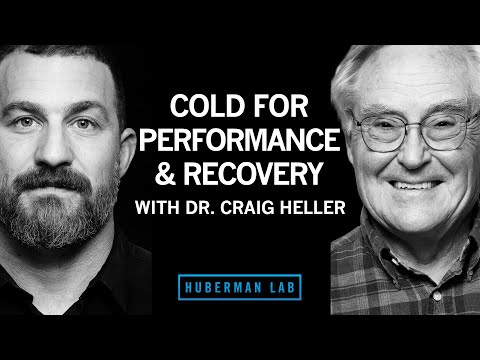
Using Temperature for Performance, Brain & Body Health | Dr. Craig Heller
Andrew Huberman (host), Craig Heller (guest), Narrator, Narrator
In this episode of Huberman Lab, featuring Andrew Huberman and Craig Heller, Using Temperature for Performance, Brain & Body Health | Dr. Craig Heller explores cool Your Hands, Boost Performance: Dr. Heller’s Temperature Revolution Explained Dr. Andrew Huberman interviews Stanford physiologist Dr. Craig Heller on how body temperature regulation profoundly impacts physical and cognitive performance, recovery, and safety.
Cool Your Hands, Boost Performance: Dr. Heller’s Temperature Revolution Explained
Dr. Andrew Huberman interviews Stanford physiologist Dr. Craig Heller on how body temperature regulation profoundly impacts physical and cognitive performance, recovery, and safety.
Heller explains why traditional cooling strategies (cold towels on neck/head, ice vests, ice baths) are often ineffective or counterproductive, and why specialized ‘heat loss portals’ in the palms, soles, and upper face are the real keys.
Using properly controlled palmar (glabrous skin) cooling, his lab has repeatedly shown dramatic increases in work volume (often 2–3x) and endurance, with minimal delayed onset muscle soreness.
They also explore implications for sport, military, medical recovery, sleep, hypothermia/hyperthermia treatment, and misconceptions about brown fat, shivering, and energy drinks.
Key Takeaways
Use glabrous skin (palms, soles, upper face) as primary heat-loss portals for performance and safety.
Special arterio-venous anastomoses (AVAs) under hairless skin in the palms, soles, and upper face shunt large volumes of blood directly from arteries to veins, enabling rapid heat exchange. ...
Get the full analysis with uListen
Avoid ice-cold water or packs on hands and portals; use cool, not freezing, temperatures to prevent vasoconstriction.
Very cold stimuli (like ice water or frozen bottles held continuously) trigger reflex vasoconstriction in the AVAs, effectively shutting down the very heat-loss pathways you're trying to exploit. ...
Get the full analysis with uListen
Pre-cooling before aerobic efforts and intermittent cooling between anaerobic sets can dramatically enhance performance.
Lowering core temperature slightly before endurance efforts (e. ...
Get the full analysis with uListen
Common cooling practices (cold towels on neck, torso ice vests, brief ice baths) can be misleading or counterproductive.
Cooling the neck, head, or torso strongly stimulates skin temperature receptors that feed into the hypothalamic ‘thermostat,’ making you *feel* cooler while core temperature may continue rising. ...
Get the full analysis with uListen
Proper cooling can greatly reduce delayed onset muscle soreness (DOMS) despite much higher training loads.
In multiple experiments, subjects who used palmar cooling between heavy sets vastly exceeded their normal training capacities (e. ...
Get the full analysis with uListen
Temperature management is critical in clinical and extreme environments, yet standard protocols often ignore the best portals.
In post-anesthesia recovery, patients are typically slow to rewarm with blankets and heat lamps because they vasoconstrict when hypothermic, preventing heat from entering the core. ...
Get the full analysis with uListen
Cooler sleep environments work because they let you passively regulate temperature via exposed portals, not just because ‘cold is good.’
The circadian system lowers the body’s temperature set-point at night, so you naturally become cooler and more prone to feeling cold at sleep onset, then heat up under too many blankets. ...
Get the full analysis with uListen
Notable Quotes
“You literally have the capacity to cook your muscles.”
— Dr. Craig Heller
“Why would you endanger your health with steroids when such an ineffective tool gives you maybe one percent per week, and we’re seeing three hundred percent in a month with cooling?”
— Dr. Craig Heller
“You can feel great and have a dangerously hyperthermic temperature.”
— Dr. Craig Heller
“If your car is overheating and you have a hose, you don’t spray the tubes—you spray the radiator. The palms, soles, and face are your radiators.”
— Dr. Craig Heller
“We didn’t discover these blood vessels; they’re in Gray’s Anatomy. Nobody knew what they were for.”
— Dr. Craig Heller
Questions Answered in This Episode
If someone doesn’t have access to a CoolMitt, what specific, step-by-step at-home protocol (water temperature, duration, number of sets) would you recommend they test for palmar cooling between weightlifting sets, and how should they monitor whether they’re provoking vasoconstriction?
Dr. ...
Get the full analysis with uListen AI
Given your data that glabrous skin cooling can double endurance in the heat, how would you design a pre-race and in-race cooling strategy for a marathon runner competing in a hot, humid city without violating competition rules?
Heller explains why traditional cooling strategies (cold towels on neck/head, ice vests, ice baths) are often ineffective or counterproductive, and why specialized ‘heat loss portals’ in the palms, soles, and upper face are the real keys.
Get the full analysis with uListen AI
Your research shows huge training volume gains with minimal DOMS when cooling portals; is there any evidence or concern that reducing heat stress might blunt other beneficial adaptations, such as mitochondrial biogenesis or connective tissue strengthening, over the long term?
Using properly controlled palmar (glabrous skin) cooling, his lab has repeatedly shown dramatic increases in work volume (often 2–3x) and endurance, with minimal delayed onset muscle soreness.
Get the full analysis with uListen AI
Current medical protocols for hyperthermia and post-anesthesia warming do not prioritize palmar/plantar/facial portals despite your findings—what, in your view, are the main scientific or institutional barriers to updating these guidelines, and what evidence would finally force a change?
They also explore implications for sport, military, medical recovery, sleep, hypothermia/hyperthermia treatment, and misconceptions about brown fat, shivering, and energy drinks.
Get the full analysis with uListen AI
You mentioned caffeine’s antagonism of adenosine and its potential to impair local vasodilation in working muscle; if you could run a definitive study on ‘pre-workout’ formulas, what hypotheses would you test about their net impact on muscle temperature, blood flow, and actual performance versus perception?
Get the full analysis with uListen AI
Transcript Preview
(Instrumental music) Welcome to the Huberman Lab Podcast, where we discuss science and science-based tools for everyday life. I'm Andrew Huberman, and I'm a professor of neurobiology and ophthalmology at Stanford School of Medicine. Today, I have the pleasure of introducing Dr. Craig Heller as my guest on the Huberman Lab Podcast. Dr. Heller is a professor of biology and neurosciences at Stanford. His laboratory works on a range of topics, including thermal regulation, Down syndrome, and circadian rhythms. Today, we talk about thermal regulation, how the body heats and cools itself and maintains what we call homeostasis, which is an equilibrium of processes that keeps our neurons healthy, our organs functioning well. And as Dr. Heller teaches us, thermal regulation can be leveraged in order to greatly increase our performance in athletics and mental performance as well. Learning to control your core body temperature is one of the most, if not the most powerful thing that you can do to optimize mental and physical performance regardless of the environment that you're in. He also dispels many common myths about heating and cooling the body, including the idea that putting a cold pack on your head or neck is the optimal way to cool down quickly. And in fact, as Dr. Heller tells us, it actually can be counterproductive and lead to hyperthermia. It's a fascinating conversation from which I learned a tremendous amount of new information, and we didn't even get into the other incredibly interesting work that Dr. Heller does on Down syndrome and circadian rhythms and sleep, so we hope to have him back in the future to discuss those topics. As you'll soon see, Dr. Heller is a wealth of knowledge on all things human physiology, biology, and human performance. It's no surprise then that he's been chair of the Biology Department at Stanford for many years, as well as director of the Human Biology Program. So, if you're interested in human biology and how to improve your performance in any context or setting, athletic or otherwise, I think you'll very much enjoy today's conversation. Before we begin, I'd like to emphasize that this podcast is separate from my teaching and research roles at Stanford. It is, however, part of my desire and effort to bring zero-cost-to-consumer information about science and science-related tools to the general public. In keeping with that theme, I'd like to thank the sponsors of today's podcast. Our first sponsor is ROKA. ROKA makes sunglasses and eyeglasses that are of the absolute highest quality. I've spent a lifetime working on the visual system, and I can tell you that the visual system has to go through a lot of work in order to maintain clarity of what you see when there are shadows, when you go into different types of indoor lighting, and so on. And a lot of glasses don't work well because you put them on, and then you're in bright light, and you can see fine, but then you move into a shadow, and then you have to take them off, and they don't adjust or they don't adjust quickly enough. With ROKA, their eyeglasses and sunglasses are designed with the visual system biology in mind, so you always see things with perfect clarity. The glasses are also terrific because they're very lightweight, and they won't slip off your face if you're exercising, if you're running or biking. In fact, they were designed for the purpose of being able to be worn while you are engaging in those sorts of activities or simply working at your desk. I happen to wear readers at night, uh, when I drive or when I work, and I love their sunglasses 'cause I can wear them anywhere, and also the aesthetics of their sunglasses and eyeglasses are terrific. Unlike a lot of other performance glasses that frankly make people look like cyborgs, the aesthetics on ROKAs are really terrific. You could wear them anywhere you'd like to go. If you'd like to try ROKA glasses, you can go to roka.com, that's R-O-K-A dot-com, and enter the code Huberman to save 20% off your first order. That's ROKA, R-O-K-A dot-com, enter the code Huberman at checkout. Today's podcast is also brought to us by InsideTracker. InsideTracker is a personalized nutrition platform that analyzes data from your blood and DNA to help you better understand your body and help you reach your health goals. I'm a big believer in getting regular blood work done, and now with the advent of modern DNA tests, you can also analyze your DNA to see what you ought to be doing for your immediate and long-term health. We hear a lot these days about optimization, optimizing hormones, optimizing your metabolism, optimizing this, optimizing that, but unless you know the measurements of metabolic factors, hormones, and other things that are in your blood and DNA, you don't know what to optimize. With InsideTracker, it makes all of that very easy. They can come to your house to take the blood and DNA test, or you can go to a nearby clinic. They send you the information, and you take those results, and unlike a lot of laboratories doing blood work out there and DNA tests, they have a simple platform, a dashboard that walks you through your results and helps you identify what sorts of nutritional or behavioral or other types of practices you might want to incorporate into your life in order to positively impact your immediate and long-term health. It's a very easy system to use, and you will gain a ton of information simply by doing that test, whether or not you end up making changes to what you're doing or not. If you'd like to try InsideTracker, you can go to insidetracker.com/huberman to get 25% off any of InsideTracker's plans. Just use the code Huberman at checkout. Today's episode is also brought to us by Athletic Greens. Athletic Greens is an all-in-one vitamin mineral probiotic drink. I've been using Athletic Greens since 2012, so I'm delighted that they're sponsoring the podcast. The reason I started using Athletic Greens and the reason I still take Athletic Greens once or twice a day is because it covers all of my nutritional bases. In fact, if people ask me, and I often am asked, "What supplement should I take?" I always recommend Athletic Greens, and in fact, if you were to take just one supplement, I recommend Athletic Greens for the simple reason that the vitamins, minerals, and probiotics and adaptogens cover all your nutritional bases, and the probiotics optimize gut brain health, which we now know is essential for mood, for immune system function, for metabolic function. It's just got so many great things in there. I really do feel better when I'm drinking my Athletic Greens. I mix mine up with some water.... little bit of lemon juice. And as I mentioned before, I'll drink it once or twice a day. If I travel, I might even drink it a third time just because of the additional stress on my mind and body. If you'd like to try Athletic Greens, you can go to athleticgreens.com/huberman to claim a special offer. They'll give you five free travel packs. So these are little travel packs that make it really easy to mix up Athletic Greens if you're on the plane or in the car. And they'll give you a year's supply of vitamin D3 K2. There is now ample evidence that vitamin D3 K2 is supportive of the immune system and a bunch of other biological functions, and K2 has been shown to be important for cardiovascular health. So again, if you go to athleticgreens.com/huberman, you'll get the Athletic Greens, the five free travel packs, and the year's supply of vitamin D3 K2. And now for my discussion with Dr. Craig Heller. Great to have you here.
Install uListen to search the full transcript and get AI-powered insights
Get Full TranscriptGet more from every podcast
AI summaries, searchable transcripts, and fact-checking. Free forever.
Add to Chrome